Top 10 Countries that Speak Spanish: A 2025 Guide
Spanish is the world's second most-spoken native language, but the vibrant tapestry of its dialects is often overlooked.Spanish is the world's second most-spoken native language, but the vibrant tapestry of its dialects is often overlooked. Beyond simply listing the countries that speak Spanish, this guide offers a deep dive into the nuances that make each nation's version of the language unique. From the highlands of Bogotá to the bustling streets of Madrid, the language evolves, reflecting distinct histories, cultures, and local flavours.
Understanding these differences is the first step towards true fluency and cultural appreciation. We'll explore the top 10 Spanish-speaking countries, uncovering key dialect features, essential vocabulary, and the cultural contexts that shape how the language is used every day. This is more than a simple list; it's a practical guide designed to make your learning journey more effective and culturally aware.
Whether you're a parent in Singapore seeking lessons for your child, a teenager preparing for the DELE exams, or a professional aiming to use Spanish for career growth, knowing these regional variations is crucial. It helps you connect more authentically with native speakers and navigate the diverse Spanish-speaking world with confidence. Let's explore the linguistic identity of each country and enrich your understanding of this global language.
1. Mexico
As the most populous of all countries that speak Spanish, Mexico is a titan of the Spanish-speaking world. With over 128 million inhabitants, its influence on the language is undeniable. Spanish arrived during the colonial era and has since evolved into a unique and vibrant dialect, heavily influenced by indigenous languages, most notably Nahuatl. This linguistic blend gives Mexican Spanish its distinctive character and vocabulary.
The nation's cultural output, from the global reach of media giants like Televisa to the literary acclaim of authors such as Octavio Paz and Carlos Fuentes, has cemented its dialect's place on the world stage. Mexico City also hosts the world's largest Spanish-language book fair, further highlighting its central role. Before embarking on a cultural immersion trip, it's wise to ensure you're prepared for any eventuality. When planning your trip to Mexico, considering comprehensive travel health insurance can provide peace of mind.
Key Aspects of Mexican Spanish
This quick reference box summarises the linguistic landscape of Mexico.
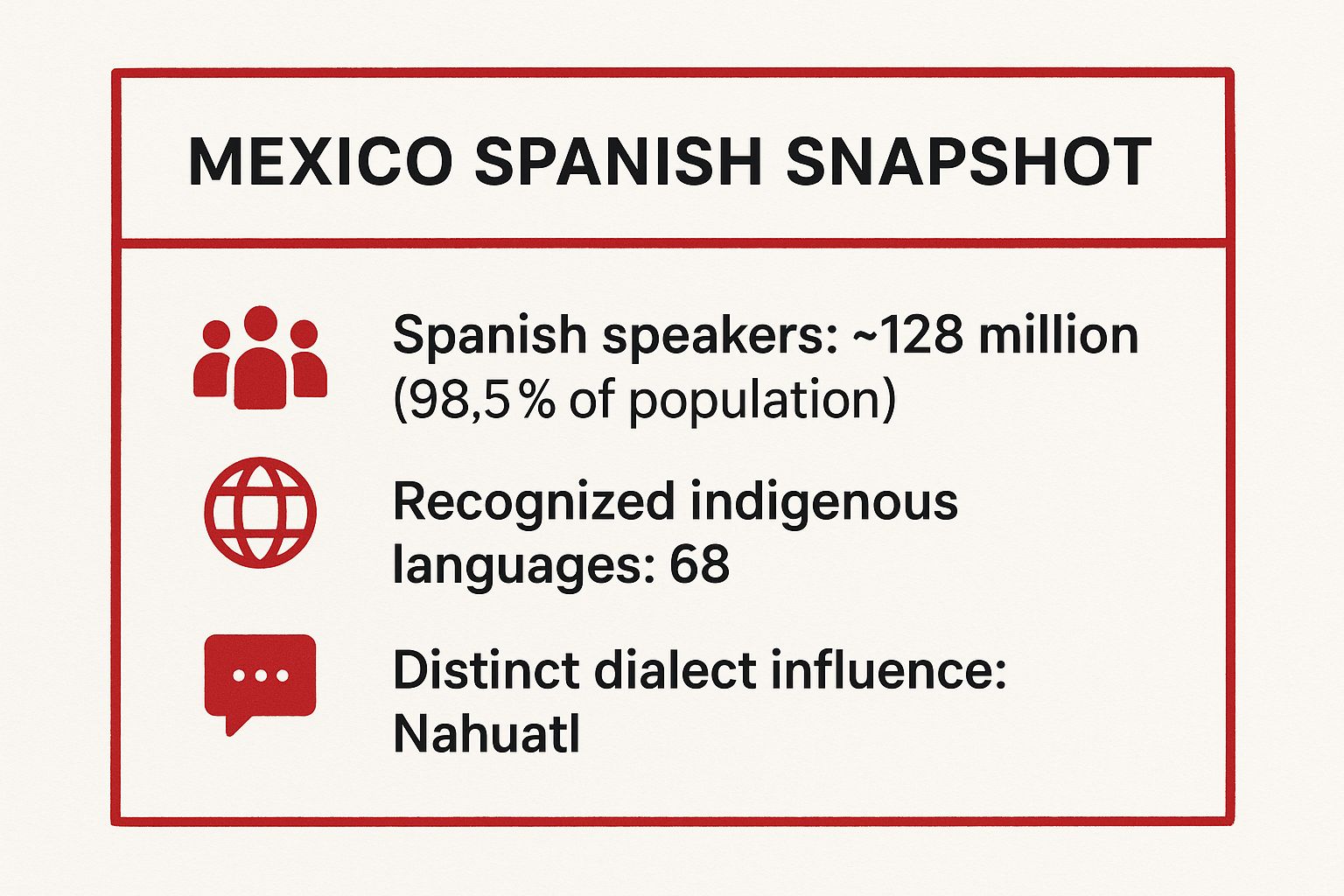
The data clearly shows that while Spanish is overwhelmingly dominant, the country maintains a rich tapestry of indigenous linguistic heritage that continues to shape its primary language.
Tips for Learners
To sound more natural when speaking Mexican Spanish, focus on these practical tips:
- Learn key vocabulary: Integrate words like platicar (to chat) and chamba (work) into your conversations.
- Master diminutives: Using suffixes like -ito and -ita (e.g., ahorita, cafecito) is extremely common to convey affection or smallness.
- Understand formality: The formal 'usted' is used more frequently than in Spain, especially in professional settings or when addressing elders.
2. Spain
As the birthplace of the Spanish language, Spain holds a foundational role among countries that speak Spanish. Originating in the medieval kingdom of Castile, the language, now known as Castilian Spanish, has spread globally. With a population of over 47 million, Spain is the standard-bearer for European Spanish, which features distinct pronunciation and grammatical structures that set it apart from its Latin American counterparts.

The nation's linguistic authority is institutionalised through the Real Academia Española (RAE), which publishes definitive dictionaries and grammar guides. This influence is further extended by the Instituto Cervantes, which promotes Spanish language and culture through over 90 centres worldwide. Spain's cultural exports, from Pedro Almodóvar's acclaimed films to major publishing houses like Planeta, reinforce the global presence of its specific dialect. This rich linguistic environment can be both challenging and rewarding for new students. Discover if Spanish is easy to learn as you explore its European roots.
Key Aspects of Spanish in Spain
This quick reference box summarises the linguistic landscape of Spain.
The data underscores Spain's multilingual identity, where Castilian Spanish coexists with influential regional languages, creating a diverse and dynamic linguistic environment that continues to shape the standard European dialect.
Tips for Learners
To sound more authentic when speaking European Spanish, focus on these practical tips:
- Master 'vosotros': The use of vosotros for the informal plural 'you' is a hallmark of Spanish from Spain. Practice its unique conjugations (e.g., vosotros sois, habláis).
- Practise the 'ceceo/distinción': In most of Spain, the 'z' and 'c' (before 'e' or 'i') are pronounced with a 'th' sound, unlike the 's' sound used in Latin America.
- Learn key vocabulary: Use words like coche (car), ordenador (computer), and piso (apartment) instead of their Latin American equivalents.
3. Colombia
Often celebrated for its clear and melodic pronunciation, Colombia is another heavyweight among the countries that speak Spanish. With around 51 million speakers, it is the third-most populous Spanish-speaking nation. The Spanish spoken here, particularly in the Andean highlands around Bogotá, is frequently cited as one of the most neutral and grammatically precise dialects, making it a popular standard for language learners and international media.
Colombia’s reputation for clear Spanish has made it a hub for the dubbing industry and international call centres serving global Spanish-speaking markets. The country's cultural influence is also significant, powered by figures like Nobel laureate Gabriel García Márquez, whose literature showcases the richness of Colombian Spanish. This combination of linguistic clarity and cultural depth firmly establishes Colombia's important position in the Spanish-speaking world.
Key Aspects of Colombian Spanish
This quick reference box summarises the linguistic landscape of Colombia.
The data shows that while Spanish is the official and dominant language, the country's diverse geography has fostered distinct regional dialects, from the Caribbean coast to the mountainous interior, each contributing to its linguistic identity.
Tips for Learners
To sound more natural when speaking Colombian Spanish, focus on these practical tips:
- Learn key vocabulary: Familiarise yourself with common Colombian slang like chévere (cool) and parce (buddy/mate).
- Master diminutives: Colombians frequently use suffixes like -ico and -ica (e.g., ratico, momentico), especially in the Andean regions.
- Understand formality: The formal 'usted' is used very commonly, even among friends and family in some regions, so it is crucial to know when to use it.
4. Argentina
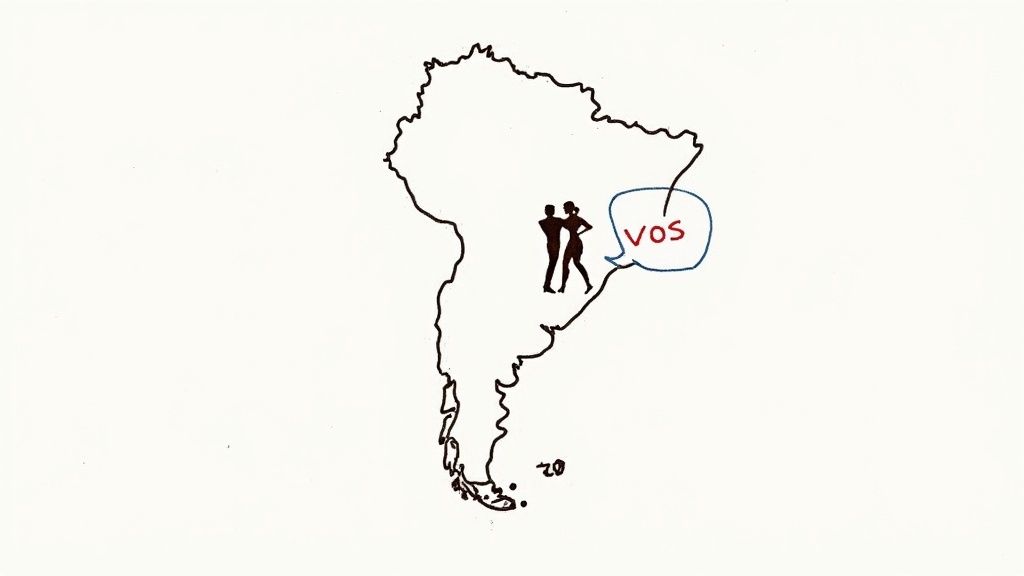
Home to approximately 45 million people, Argentina is another major player among countries that speak Spanish and boasts one of the most distinctive dialects in Latin America. Known as Rioplatense Spanish, this variant is heavily characterised by the use of ‘voseo’ (the pronoun ‘vos’ instead of ‘tú’) and an intonation pattern that reveals a strong Italian influence. This musical cadence makes Argentine Spanish instantly recognisable.
The nation's rich literary tradition, with figures like Jorge Luis Borges and Julio Cortázar, has popularised its unique linguistic features worldwide. From the passionate lyrics of tango music to the dialogue in acclaimed films, Argentina’s dialect is a core part of its cultural identity. This dialect is so distinct that Argentine Spanish teachers often specialise in teaching its specific grammar and pronunciation.
Key Aspects of Argentine Spanish
This quick reference box summarises the linguistic landscape of Argentina.
The data clearly shows that Argentine Spanish is defined by its use of 'voseo', a unique pronunciation for 'll' and 'y', and significant lexical influence from Italian, particularly in the form of Lunfardo slang.
Tips for Learners
To sound more authentic when speaking Argentine Spanish, focus on these practical tips:
- Learn voseo conjugations: Practice using forms like vos tenés (you have) and vos sos (you are) instead of the standard tú forms.
- Master the 'zh' sound: Pronounce the 'll' and 'y' sounds as a soft 'zh' (like the 's' in 'treasure'), for example in words like calle and yo.
- Understand key slang: Familiarise yourself with some Lunfardo (Buenos Aires slang) and the common interjection che, used to get someone's attention.
5. Peru
With a population of approximately 32 million, Peru is a captivating nation where Spanish serves as an official language alongside indigenous languages like Quechua and Aymara. This linguistic coexistence has profoundly shaped the country's Spanish, creating a dialect rich with history and regional diversity. Peruvian Spanish varies significantly across its coastal, Andean, and Amazonian regions, each with unique cadences and vocabularies.
The nation's cultural influence is demonstrated through its world-renowned literature, with Nobel laureate Mario Vargas Llosa bringing Peruvian narratives to global audiences. Furthermore, the international fame of its cuisine, championed by chefs like Gastón Acurio, has popularised Spanish culinary terms like ceviche and pisco. This cultural export ensures Peru's distinct form of Spanish is recognised as a key part of the vibrant tapestry of countries that speak Spanish.
Key Aspects of Peruvian Spanish
This quick reference box summarises the linguistic landscape of Peru. The strong influence of Quechua is a defining feature, with many words like papa (potato) and coca having been adopted into global Spanish from Peru. The Spanish spoken in the capital, Lima, is often considered one of the more neutral and clear dialects in Latin America, making it relatively easy for learners to understand.
Tips for Learners
To sound more natural when speaking Peruvian Spanish, focus on these practical tips:
- Learn regional vocabulary: While coastal Spanish is more standard, if you travel to the highlands, knowing Quechua-influenced words will be very helpful.
- Embrace diminutives: Similar to Mexico, Peruvians frequently use suffixes like -ito and -ita to express affection or smallness.
- Use 'usted' appropriately: The formal 'usted' is common, particularly in the Andes and when showing respect, often used more than 'tú'.
- Listen for pronunciation: Notice how highland speakers often place more emphasis on consonants, a feature influenced by Quechua speech patterns.
6. Venezuela
With around 28 million Spanish speakers, Venezuela is another key nation among countries that speak Spanish. The country’s dialect is deeply influenced by its Caribbean geography, resulting in a melodic and rapid speech pattern that distinguishes it from other South American varieties. This Spanish is also marked by its rich, unique vocabulary and frequent use of affectionate diminutives, creating a warm and expressive form of the language.
Venezuelan culture, particularly its acclaimed telenovelas, has historically popularised its specific dialect across Latin America. The global Venezuelan diaspora has further spread its linguistic nuances worldwide. Prominent cultural figures like novelist Rómulo Gallegos and conductor Gustavo Dudamel have also showcased the richness of Venezuelan Spanish on an international stage, embedding its unique phrases and rhythms into the global consciousness.
Key Aspects of Venezuelan Spanish
This quick reference box summarises the linguistic landscape of Venezuela.
The Spanish spoken in Venezuela exhibits significant regional variation. Coastal areas reflect a stronger Caribbean influence, while the Andean regions and the central plains (llanos) have their own distinct accents and vocabulary, showcasing the country's diverse linguistic tapestry.
Tips for Learners
To sound more natural when speaking Venezuelan Spanish, focus on these practical tips:
- Learn key vocabulary: Integrate characteristic words like chévere (cool), pana (friend/buddy), and vaina (a versatile word for 'thing' or 'stuff').
- Listen for dropped sounds: The letter 's' at the end of syllables is often aspirated (pronounced like an 'h') or dropped entirely, a common feature of Caribbean Spanish.
- Embrace diminutives: Using the suffix -ito or -ita is extremely common to show affection or smallness, such as un cafecito (a little coffee) or ahorita (right now).
7. Chile
Home to around 18 million speakers, Chile is one of the most distinctive countries that speak Spanish, renowned for a dialect that can challenge even seasoned learners. Chilean Spanish is famous for its rapid pace, unique intonation, and a vocabulary rich with local slang. The dialect features significant phonetic changes, like aspirating or dropping the final 's' in words, which contributes to its reputation as one of the most difficult varieties to master.
The country's unique linguistic identity is proudly showcased in its cultural exports. The works of Nobel laureates like Pablo Neruda and Gabriela Mistral, along with contemporary authors such as Isabel Allende, bring Chilean Spanish to a global audience. Furthermore, Chilean films often require subtitles for other native Spanish speakers, highlighting just how distinct its pronunciation and slang can be. This challenging yet vibrant dialect offers a rewarding experience for dedicated learners.
Key Aspects of Chilean Spanish
This video offers an excellent introduction to the unique sounds and slang of Chilean Spanish.
The rapid-fire delivery and unique expressions shown here are hallmarks of everyday communication in Chile, making listening practice essential for comprehension.
Tips for Learners
To navigate conversations in Chilean Spanish more effectively, focus on these practical tips:
- Learn essential slang: Familiarise yourself with words like cachai (you know?), po (an emphasis marker, like 'then'), and weón (dude/mate).
- Practise your listening: The pronunciation is highly distinctive. Start by listening to clearer speakers, like newsreaders, before moving on to more casual, everyday speech.
- Listen for the dropped 's': Be aware that the 's' at the end of syllables or words is often aspirated (like an 'h' sound) or dropped entirely, so ¿cómo estás? might sound like ¿cómo ehtái?
- Be patient: Mastering this dialect takes time. Don't be discouraged; Chileans are generally friendly and appreciate the effort to understand their unique way of speaking.
8. Ecuador
Home to the Galápagos Islands and a stunning slice of the Andes, Ecuador is a geographically diverse nation with a unique linguistic landscape. Spanish is the official language for its approximately 14 million speakers, but it coexists with several indigenous languages, most notably Kichwa (Ecuadorian Quechua). This heritage is officially recognised in the nation’s constitution, creating a rich multicultural environment.
Ecuadorian Spanish is known for its clear pronunciation, especially in the highland regions like the capital, Quito, making it a popular destination for language learners. The country's Spanish has distinct regional variations, from the Andean Sierra to the tropical coast. Cultural figures like novelist Jorge Icaza and artist Oswaldo Guayasamín have carried the nation's voice to international audiences, showcasing why Ecuador is a key member of the list of countries that speak Spanish.
Key Aspects of Ecuadorian Spanish
This quick reference box summarises the linguistic landscape of Ecuador.
The significant presence of Kichwa speakers has a noticeable influence on the Spanish spoken in the Andean highlands, enriching its vocabulary and local expressions. This creates a distinct dialect that reflects the country's deep indigenous roots.
Tips for Learners
To speak Spanish more naturally while in Ecuador, consider these practical tips:
- Practise highland pronunciation: The Spanish spoken in Quito is often considered one of the clearest in Latin America, making it an excellent model for learners.
- Learn some Kichwa-influenced words: Incorporate common words derived from Kichwa, such as guagua (baby) or choclo (corn), into your vocabulary.
- Use 'usted' frequently: The formal 'usted' is used more commonly than in many other Spanish-speaking nations, even in relatively informal situations.
- Recognise regional accents: Be aware that coastal Spanish has a faster rhythm and different slang compared to the slower, clearer Spanish of the highlands.
9. Guatemala
Guatemala is a cornerstone among countries that speak Spanish in Central America, with around 12 million speakers. Its linguistic identity is profoundly shaped by its indigenous heritage; Spanish coexists with 21 officially recognised Mayan languages, creating a unique and diverse cultural tapestry. This blend is particularly evident in Guatemalan Spanish, which has absorbed numerous loanwords and phonetic influences from its Mayan counterparts.
The nation's rich multilingual environment is a source of cultural pride and academic interest. Destinations like Antigua Guatemala have become popular hubs for Spanish language learners seeking immersion in this distinct dialect. The work of Nobel laureates like author Miguel Ángel Asturias and activist Rigoberta Menchú has brought Guatemala's complex linguistic reality to the global stage, showcasing how languages intertwine to tell the nation's story. Understanding this context is key to appreciating the depth of communication here, from a simple greeting to a deeper conversation. For a solid foundation, you can learn more about how to ask 'how are you' in Spanish.
Key Aspects of Guatemalan Spanish
This quick reference box summarises the linguistic landscape of Guatemala.
Guatemalan Spanish is notable for its voseo usage and the significant influence of indigenous languages, particularly in rural areas. While Spanish is the official language used in government and commerce, Mayan languages are vital to the cultural identity of a large portion of the population. This creates a bilingual or even multilingual reality for many citizens.
Tips for Learners
To sound more natural when speaking Guatemalan Spanish, focus on these practical tips:
- Embrace 'voseo': The use of 'vos' instead of 'tú' for the familiar second person is standard. Practice conjugations like vos tenés (you have) and vos sos (you are).
- Learn Mayan-influenced words: Incorporate local vocabulary like patojo (kid) or shuco (dirty/a type of hot dog) to connect more with local speakers.
- Be aware of language backgrounds: Many indigenous Guatemalans speak Spanish as a second language, which may influence their accent and grammar. Be patient and respectful in your interactions.
10. Cuba
With approximately 11 million Spanish speakers, Cuba is another significant member of the countries that speak Spanish, particularly within the Caribbean. The island’s dialect, español cubano, is famous for its rapid, rhythmic quality, heavily shaped by its Canarian roots and significant Afro-Caribbean linguistic influences. This blend has created a variety of Spanish that is instantly recognisable for its unique intonation and melodic cadence.
Cuban Spanish is characterised by the aspiration or complete omission of the 's' at the end of syllables and words, a feature common to Caribbean Spanish. The nation's profound cultural impact, especially through music like salsa and son, has popularised its unique expressions worldwide. The works of influential figures like poet José Martí and singer Celia Cruz have carried the island's distinct dialect far beyond its shores, cementing its place in the global Spanish-speaking consciousness.
Key Aspects of Cuban Spanish
This quick reference box summarises the linguistic landscape of Cuba.
The data highlights Spanish as the universal language, while acknowledging the historical linguistic influences that have shaped its modern form, particularly from African languages.
Tips for Learners
To sound more natural when speaking Cuban Spanish, focus on these practical tips:
- Listen for the 's' sound: Practice tuning your ear to how the 's' is often aspirated to an 'h' sound (e.g., estás sounds like ehtah) or dropped entirely.
- Learn key slang: Integrate essential local terms like asere or qué bolá? (a common greeting meaning "what's up?") and yuma (a foreigner, especially from the US).
- Embrace the rhythm: Immerse yourself in Cuban music. Listening to salsa, son, and rumba is one of the best ways to internalise the natural rhythm and intonation of the dialect.
Spanish-Speaking Countries Overview
| Country | Implementation Complexity 🔄 | Resource Requirements ⚡ | Expected Outcomes 📊 | Ideal Use Cases 💡 | Key Advantages ⭐ |
|---|---|---|---|---|---|
| Mexico | Moderate – diverse regional dialects & slang | High – large population, rich media | Wide reach in Spanish-speaking markets | Business/media targeting North America & learners | Largest Spanish market; clear pronunciation; cultural influence |
| Spain | Moderate – formal standard with regional languages | Moderate – institutional language bodies | Standard Spanish education, formal communication | Formal education, European market, linguistic standard | Standard Spanish; strong regulation; rich literature |
| Colombia | Low to Moderate – regional accents but generally clear | Moderate – media hubs and education | Clear communication, media production | Language learners; call centers; media production | Neutral accent; learner-friendly; strong grammar |
| Argentina | Moderate to High – unique voseo and intonation | Moderate – cultural and literary centers | Distinctive dialect, cultural richness | Arts, literature, regional cultural contexts | Unique dialect; strong cultural heritage |
| Peru | Moderate – variation with indigenous influence | Moderate – bilingual education | Mix of clear and indigenous-influenced Spanish | Tourism, indigenous cultural studies | Blend of Spanish and indigenous languages; neutral coastal Spanish |
| Venezuela | Moderate – rapid Caribbean speech, slang heavy | Moderate – media & diaspora influence | Expressive dialect, warm communication | Caribbean cultural contexts, diaspora communities | Melodic intonation; rich vocabulary; accessible dialect |
| Chile | High – very rapid, heavy slang, phonetic shifts | Moderate – mostly urban educational hubs | Difficult for learners, culturally rich | Advanced learners; cultural immersion | Strong cultural identity; vibrant linguistic evolution |
| Ecuador | Low to Moderate – clear highland dialect | Moderate – bilingual education efforts | Clear communication in highlands, indigenous influence | Language learners; Andean region focus | Clearest highland Spanish; strong bilingual culture |
| Guatemala | Moderate – voseo plus Mayan influences | Moderate – multilingual education | Mix of Spanish and Mayan; rural-urban linguistic divide | Immersion programs; multicultural research | Clear pronunciation; rich multicultural environment |
| Cuba | High – rapid Caribbean speech, consonant drops | Moderate – cultural diaspora and media | Expressive, rhythmic dialect distinct in Caribbean | Caribbean culture, music, diaspora studies | Rhythmic intonation; rich Afro-Caribbean vocabulary |
Start Your Spanish Journey with Confidence
Your journey through the diverse world of Spanish-speaking nations has revealed a crucial truth: Spanish is far more than a single language. It is a vibrant tapestry of cultures, dialects, and histories, woven across continents. From the formal elegance of Castilian Spanish in Spain to the melodic and clear pronunciation found in Colombia, and the unique voseo of Argentina, each variation offers a distinct flavour and a new perspective. Understanding these nuances is the key to transforming from a student of Spanish into a confident, culturally aware global communicator.
Recognising the differences among the many countries that speak Spanish is not just an academic exercise; it is a practical tool. It equips you to navigate real-world conversations with greater ease, whether you are negotiating a business deal in Mexico City, ordering a coffee in Santiago, or simply making new friends on a trip to Peru. This awareness allows you to adapt your listening and speaking skills, appreciate local expressions, and connect more deeply with the people you meet.
Turning Knowledge into Actionable Skills
The path to fluency is built on two pillars: consistent practice and effective learning strategies. As you absorb the rich vocabulary and distinct grammatical structures from different regions, it is essential to have a system for making the information stick. Mastering techniques to retain new vocabulary and grammar is key to long-term success. For practical guidance on this, exploring the Top 5 Best Ways to Retain Information Effectively can provide you with the cognitive tools needed to accelerate your learning and build a lasting foundation.
Your next steps should focus on immersion and application. Consider these actions:
- Target Your Listening: Seek out music, films, and podcasts from a specific country you are interested in. This will train your ear to its unique accent and slang.
- Engage with Native Speakers: Find opportunities for language exchange. Speaking with natives from different countries that speak Spanish will expose you to authentic speech patterns you cannot find in textbooks.
- Embrace the Diversity: Do not be afraid of the variations. Instead, see them as an exciting part of the learning adventure. Every new idiom or regional term you learn adds another layer to your understanding.
Ultimately, embracing the rich diversity of the Spanish language opens up a world of over 500 million speakers. It is an invitation to explore dozens of unique cultures, expand your professional opportunities, and build meaningful connections across the globe. Your journey has just begun, and with this newfound awareness, you are perfectly positioned to dive deeper and achieve true linguistic mastery.
Ready to experience this linguistic diversity firsthand? At Spanish Council Singapore, our certified native tutors from Spain and Latin America bring the authentic sounds and cultures of their home countries directly to your classroom. We help you navigate the nuances, so you can speak with confidence anywhere in the world. Enrol in a course at Spanish Council Singapore and start your journey with experts who live and breathe the language.