how do you respond to how are you in Singapore: A quick guide
Figuring out how to answer "how do you respond to how are you" really boils down to context. The right answer isn't a one-size-fits-all thing; it completely depends on who's asking, where you are, and what feels right in the moment. It can be anything from a breezy "I'm good, thanks!" to a more genuine, detailed update.
Decoding the Hidden Meaning of "How Are You?"
Ever stopped to think why such a simple question can feel a bit tricky? In Singapore, "How are you?" often works more like a social handshake than a genuine inquiry into your well-being. It's a way to acknowledge someone and open the door to conversation.
Think of it as a polite 'hello' with a question mark. Grasping this little nuance is the first step to answering with confidence, whether you're queuing for kopi at a hawker centre or walking into a formal business meeting. The real skill is learning to read the room.
Reading the Social Cues
The setting and your relationship with the person tell you everything. When a cashier at NTUC asks how you are, they're being courteous; a quick, positive reply is all that's needed. But when a close friend asks the same thing over lunch, they probably want the real story.
Paying attention to these subtle differences is what makes conversations flow smoothly. It's a key part of becoming truly fluent in English, going beyond just words and grammar into the heart of cultural norms. For those looking to sharpen these skills, check out our guide on how to speak English fluently.
This flowchart is a great cheat sheet for navigating these situations.
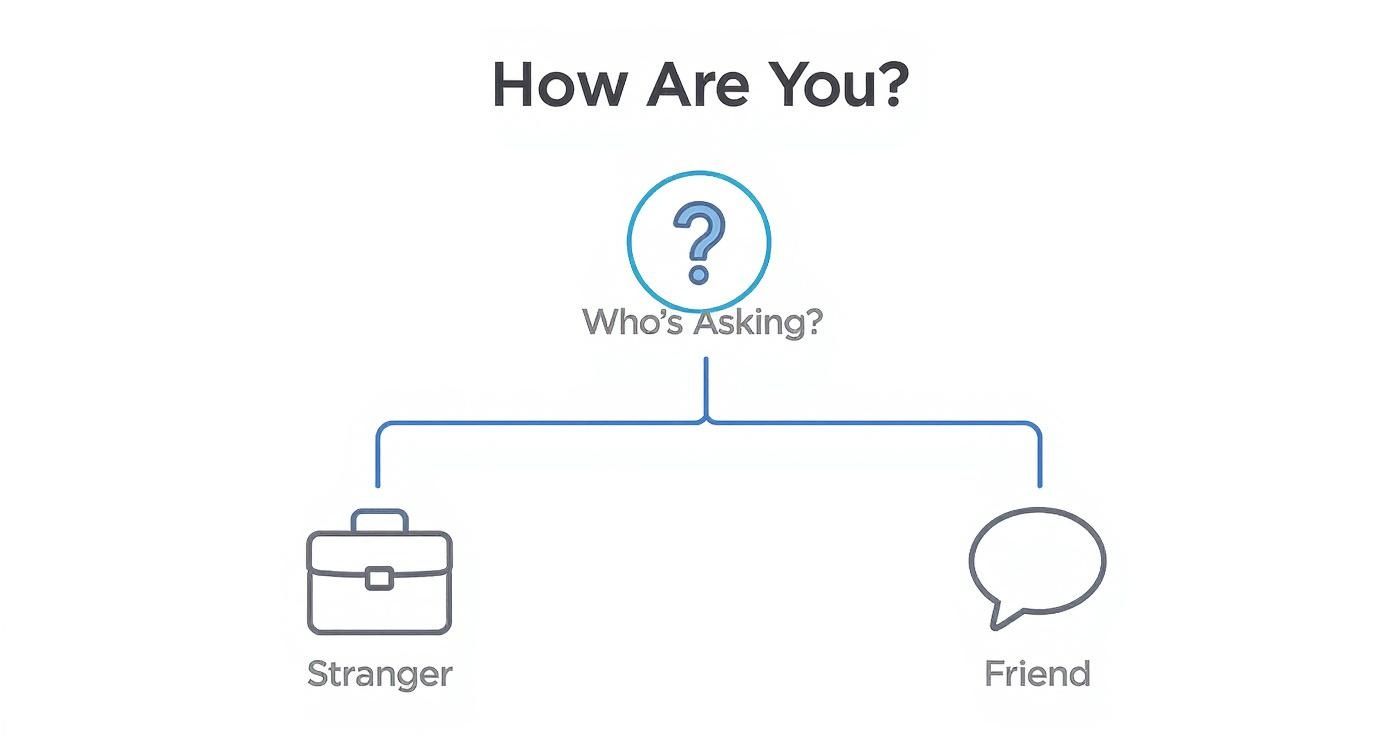
As you can see, the closer your relationship, the more personal your reply can be.
The goal isn’t just to give an answer—it’s to connect in a way that fits the moment. By understanding the unspoken intent, you can build rapport and keep conversations comfortable in any setting.
To build on this, you might find some useful strategies in this guide on how to improve your communication. The tips there are brilliant for all kinds of social interactions.
Quick Guide to Responding to "How Are You?" in Singapore
To make things even clearer, here's a quick table that breaks down common scenarios you'll encounter in Singapore.
| Scenario | Your Relationship | Go-To Response Style | Example Phrase |
|---|---|---|---|
| Passing a colleague in the office | Acquaintance | Brief, positive, and professional | "I'm good, thanks! Busy day. You?" |
| At a cashier or with a service staff | Stranger | Short, polite, and neutral | "Good, thank you." |
| Catching up with a close friend | Close Friend | Honest, detailed, and personal | "Actually, I'm a bit tired, work has been mad. How about you?" |
| Networking at a professional event | New Contact | Positive, slightly detailed, opens conversation | "Doing great, thanks for asking! Really enjoying the talks today." |
This table acts as a simple guide to help you match your response to the social expectation, ensuring your interactions are always smooth and appropriate.
Casual Replies for Friends and Family
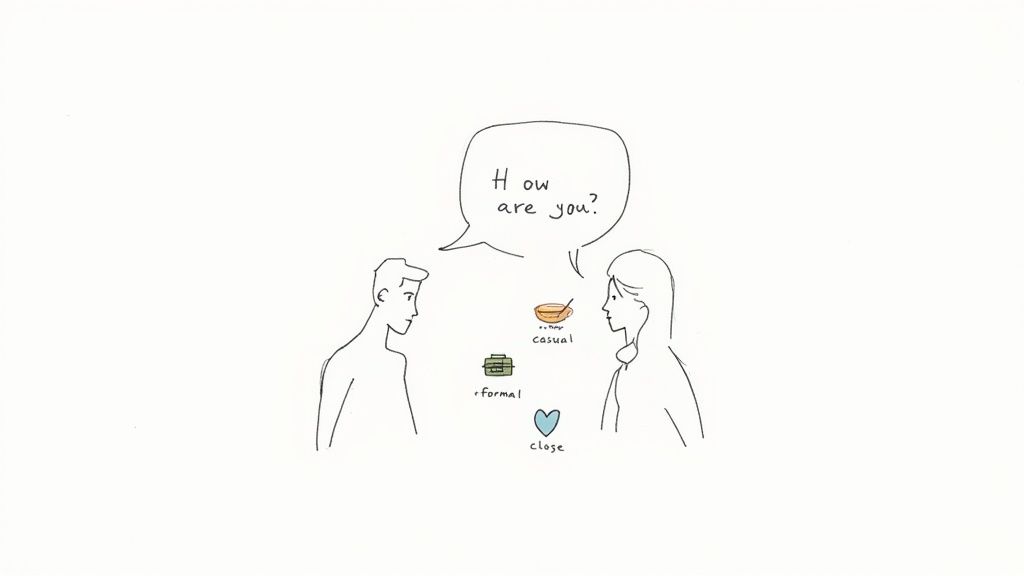
When friends and family ask how you are, the usual script gets tossed out the window. This isn’t a polite formality; it's a real question. It’s your cue to drop the automatic "I'm fine, thanks" and share something a little more genuine to strengthen your connection.
Here in Singapore, this is often where the conversation picks up its unique, local flavour. A bit of Singlish can instantly make your reply feel more relaxed and familiar. Saying something like, "Not bad, lah!" is a classic for a reason – it’s a warm, positive response that any local friend will immediately get.
These small, honest check-ins are really the glue that holds relationships together. They signal that you feel comfortable enough with the other person to be yourself.
Adding a Bit of Detail
Replying to a friend's "how are you" is all about sharing a small slice of your life. You don't need to launch into a full-blown monologue, but adding one specific detail is what sparks a real conversation.
- Mention a recent experience: "Pretty good, just had an amazing lunch at Maxwell."
- Talk about something you're excited for: "Can't complain, really looking forward to the long weekend!"
- Keep it real, but brief: "A bit tired today, work was hectic. What about you?"
This simple act of adding a little extra invites a proper back-and-forth. It’s a universal way to build rapport, and you’ll find similar social nuances in other languages. In fact, anyone learning Bahasa Melayu will quickly notice how context and tone shape these everyday greetings.
Asking a Better Question Back
The real magic in these casual chats happens when you return the question with genuine interest. Don't just tack on an automatic "…and you?". Go a step further by asking about something specific you know is going on in their life.
A thoughtful follow-up question shows you’re not just going through the motions; you’re genuinely interested in their life and what they have to say.
For instance, try something like, "I'm great, thanks for asking! Hey, how did that big presentation go last week?" This one move shows you listen, you remember, and you actually care. It elevates a simple greeting into a true moment of connection, making your friend feel seen and valued.
Navigating Professional and Formal Settings
When you're in a professional environment—be it a high-stakes job interview or a crucial client meeting—the simple question "How are you?" takes on a new meaning. It's less of a personal check-in and more of a subtle test of your professional poise. The real goal here is to come across as polite, positive, and concise. Your answer should signal that you’re competent and ready to get down to business.
A classic, safe reply is often your best bet. Something like, "I'm doing well, thank you. And yourself?" works almost every time. It's polished, respectful, and neatly hands the conversational baton back to them, which is just good manners. This approach fits perfectly with the business culture here in Singapore, where politeness and efficiency are highly valued.
Maintaining a Professional Boundary
The trick is to steer clear of overly personal details, good or bad. Venting about your terrible morning commute or gushing about your upcoming weekend plans can feel out of place and unprofessional. Think of the workplace greeting as more of a professional ritual than a genuine invitation to bare your soul.
This emphasis on formality is a real cornerstone of local business etiquette. As noted in guides to Singapore's business culture on globig.co, a courteous reply like 'I’m doing well, thank you,' often accompanied by a firm handshake, is the gold standard.
Remember, in a formal setting, your answer to "How are you?" sets the tone for the entire interaction. A brief, positive, and forward-looking response signals that you are professional, focused, and ready for business.
This practice of keeping a polite but firm professional boundary isn't unique to Singapore; it’s a common thread in many cultures. For instance, knowing how to express gratitude appropriately is a vital cross-cultural skill. If that's something you're working on, you might find our guide on saying thank you in Mandarin helpful.
Examples of Effective Professional Responses
Of course, you can tweak your reply slightly to better fit the situation. The core principles of staying positive and keeping it brief, however, should always remain.
Here are a few common scenarios and some solid ways to respond:
- In a job interview: "I'm doing very well, thank you. I was really looking forward to our conversation today." This shows you're enthusiastic and prepared.
- Meeting a new client: "I'm great, thank you for asking. It's a pleasure to finally meet you in person." It’s a warm, yet perfectly professional, opening.
- Greeting a senior manager: "Very well, thank you. I hope you're having a productive week." This response is respectful and keeps the focus squarely on business.
At the end of the day, knowing how do you respond to how are you in these settings is all about projecting respect and upholding a professional image. A polished, brief, and positive answer is always the right move.
Understanding Key Cultural Influences
In Singapore, a simple "How are you?" isn't just a casual question; it's a social dance influenced by a rich mix of cultures. Our society is a unique tapestry woven from Chinese, Malay, and Indian traditions, which creates a specific etiquette that values harmony and respect above all else. Grasping this is the first step to truly understanding the replies you get.
One of the most powerful undercurrents, particularly from the Chinese heritage, is the concept of ‘saving face’. This is all about maintaining social harmony and ensuring no one feels embarrassed or awkward. It means a Singaporean might give you a polite, neutral "Okay lah, not bad" even if their day has been a complete disaster.
It's not about being insincere. It's about prioritising the collective comfort of the interaction over a detailed, personal update, especially in a casual setting. The aim is to keep things pleasant and smooth for everyone.
The Role of Non-Verbal Communication
What isn't said is often just as important as the words themselves. In Singapore, non-verbal communication tends to be more reserved than in many Western cultures. Grand gestures are uncommon, and holding direct, intense eye contact can sometimes come across as a bit aggressive. A softer, more moderate glance is the norm.
This understated approach goes hand-in-hand with keeping the social peace. It's a sign of emotional discretion, and studies on local customs back this up, showing how much we rely on unspoken rules when we greet each other. In fact, as this guide on Singaporean etiquette at Morgan McKinley points out, respecting personal space and reading non-verbal cues are huge.
Essentially, a quiet or reserved demeanour is usually a sign of politeness and respect, not a lack of interest.
Learning to read these subtle signals—the tone of voice, the body language, the overall context—is crucial. It helps you look beyond a standard, surface-level answer and connect with the person in a more meaningful way. It’s a skill that makes all the difference in communicating effectively here.
How to Respond When You Are Not Okay
Let’s be real, a cheery "I'm great, thanks!" isn't always the truth. Life gets tough, and pretending otherwise can feel draining. But navigating this common pleasantry when you're struggling is a delicate balance. You want to be authentic without oversharing or making the other person uncomfortable.
The secret is context. How you answer your boss is going to be wildly different from how you answer your best friend. With a colleague or a casual acquaintance, the goal is often to be tactfully vague. This approach signals you’re going through something without opening the door to a deep conversation you’re probably not in the mood for at the water cooler.
Finding the Right Words
So, what do you actually say? Having a few phrases in your back pocket can make all the difference. You can acknowledge the question and your feelings while keeping the conversation moving, especially in professional or quick, casual settings.
Here are a few go-to options I’ve found work well:
- With colleagues: "I've been better, but I'm hanging in there. How are you?"
- With a casual friend: "Honestly, it's been a bit of a rough week. Thanks for asking, though."
- For a brief chat (like with a barista): "A bit tired today, but powering through!"
These replies are honest but brief. They politely close the door on follow-up questions and gracefully return the conversational ball to their court.
It helps to remember that most people ask "How are you?" as a social courtesy. By acknowledging their good intention, you can be truthful about your feelings while still keeping the interaction positive and light.
Knowing how do you respond to how are you when you're not feeling it is all about finding that middle ground. You can hint at your reality without having to lay out all the details. It's about being sincere while navigating the social script with grace and protecting your own privacy.
A Few Common Questions About Answering 'How Are You?'

Even when you've got the basics down, some moments can still catch you off guard. Let's dig into a few common sticking points and how to handle them smoothly.
What if I’m in a Hurry?
We’ve all been there – dashing between meetings or trying to catch the bus when someone asks how you are. You want to be polite, but you just can't stop.
The trick is to acknowledge them warmly while clearly signalling you have to go. A quick smile and a brief reply are all it takes.
Give these a try:
- "Great, thanks! Catch you later!"
- "All good! Sorry, in a bit of a rush."
- "Doing well, thanks! We should catch up properly soon."
These get the job done. They’re friendly, positive, and gently close the door on a longer chat without seeming dismissive.
How Do I Respond Over Text or Email?
Replying digitally is a whole different ball game. The good news is you usually have more time to think, but the unspoken rules can still be fuzzy. A casual text from a mate? Feel free to be more open. A professional email? A quick, polite reply before diving into business is the way to go.
A good rule of thumb for digital replies: Mirror the sender's tone. If they're brief and to the point, stick to that. If their message feels more relaxed, you can be a bit more personal in your response.
Here in Singapore, how you answer can also be influenced by deep-seated cultural norms. With a population that's roughly 75% Chinese, 13.5% Malay, and 9% Indian, social customs often shape the conversation. You can find some fantastic insights into Singaporean cultural etiquette at expatica.com.
For some, especially neurodivergent individuals, navigating these social cues can be a real challenge. Having access to resources like conversation scripts specifically designed for neurodivergent people can be incredibly helpful for building confidence and making these interactions feel more manageable.
Ready to master more than just greetings? At Spanish Council Singapore, we offer engaging Spanish lessons that build real-world communication skills for adults, teens, and kids. Start your journey to fluency with us today!