How Long to Learn Spanish a Realistic Timeline
So, how long does it really take to learn Spanish? The honest answer is anywhere from six months to a few years, depending on your dedication. It helps to think of it like training for a marathon, not a sprint—your finish time is entirely dictated by your training schedule and intensity.
Your Spanish Learning Timeline Explained
The journey to speaking Spanish fluently doesn't have a one-size-fits-all timeline. It's shaped by your goals, your study habits, and how much time you can realistically set aside each week. Luckily, we have some reliable benchmarks to help set clear expectations.
Solid research gives us a great framework for understanding this journey. According to estimates from the U.S. Foreign Service Institute (FSI), Spanish is considered one of the most accessible languages for native English speakers to learn. They project it takes roughly 24–30 weeks, or about 600–750 class hours, of dedicated instruction to reach general professional proficiency. You can read more about these language learning estimates and what they involve. This data gives us a concrete starting point to map out what's possible.
Visualising Your Path to Fluency
To get a better sense of how these hours translate into real-world progress, it helps to visualise the path ahead. The timeline below shows how different levels of commitment—from a casual learner to a dedicated student—can shape your learning speed.
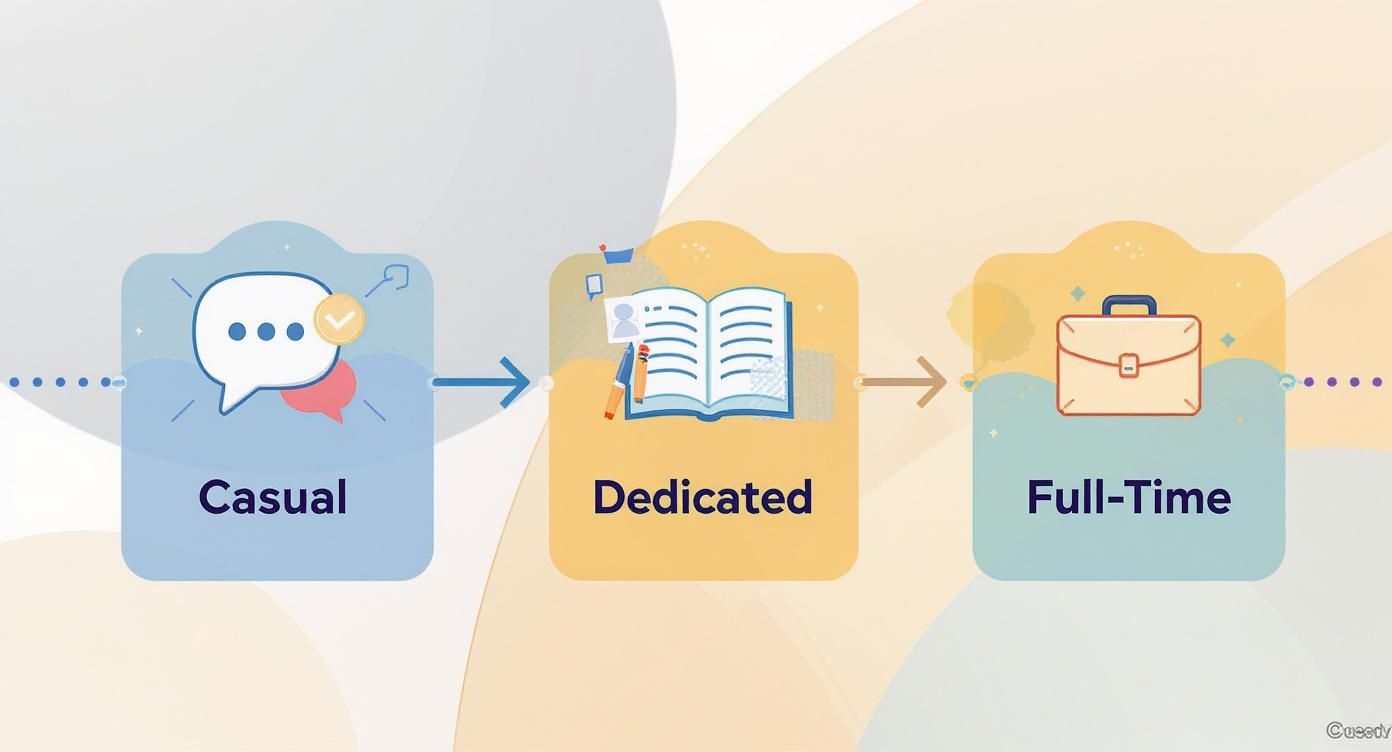
As you can see, consistency is what truly drives progress, whether you're studying casually or going for full-time immersion.
The difference between hitting your goal in six months versus two years often just comes down to the number of hours you put in weekly. But what does "conversational fluency" actually look like in terms of weekly effort? Let's break it down into a simple, actionable table.
Estimated Time to Conversational Spanish Fluency
This table translates those broad FSI estimates into tangible weekly commitments. It gives a clear picture of how different study intensities directly impact your timeline to becoming a confident Spanish speaker, which for most people means reaching a solid B1 level.
| Study Intensity | Hours Per Week | Estimated Timeline |
|---|---|---|
| Casual Learner | 1-3 Hours | 18-24 Months |
| Consistent Student | 5-7 Hours | 10-12 Months |
| Dedicated Learner | 10-15 Hours | 6-9 Months |
| Immersion Seeker | 20+ Hours | 3-5 Months |
The core takeaway is this: you control the pace. A learner who actively engages with the language for just five hours a week will progress significantly faster than someone who passively studies for one hour.
Defining What Spanish Fluency Means for You
When people decide to learn Spanish, the word "fluency" often feels like this huge, vague mountain to climb. What does being fluent actually mean? Does it mean you never make a mistake? Or that you sound exactly like someone from Madrid or Mexico City?
The reality is much less intimidating. Fluency isn't one single destination; it’s a spectrum of abilities. Thinking about it as a journey with clear milestones makes the whole process feel achievable. It turns a fuzzy dream into a solid, step-by-step plan.
The best roadmap for this journey is the Common European Framework of Reference for Languages (CEFR). It’s a bit of a mouthful, but it simply breaks down language ability into six clear levels, from A1 (total beginner) to C2 (mastery).
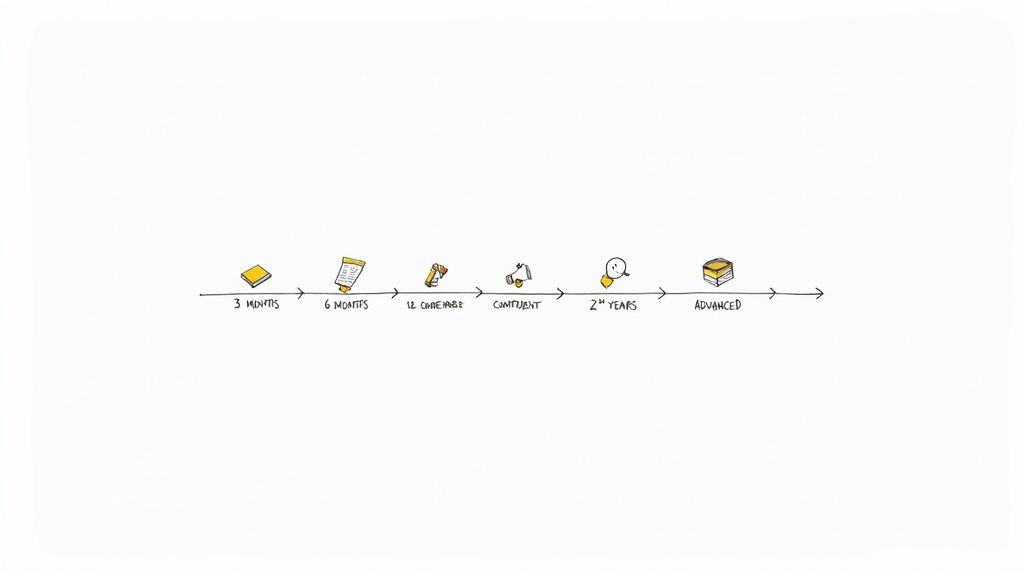
So, instead of just vaguely aiming for "fluency," you can pick a specific, meaningful target. Want to handle your holiday in Spain with ease? That's an A2 level. Need to hold your own in professional meetings? You're probably looking at a B2 or C1. Each level represents a real-world set of skills you can actually use.
From Beginner to Mastery: The CEFR Levels Explained
Knowing what you can do at each stage helps you define what fluency means for your life. This framework gives you signposts so you always know where you are and what’s next. Let's translate these academic labels into practical, everyday abilities.
Beginner Levels (A1 & A2)
- A1 (Beginner): Right at the start, you're learning the absolute basics. Think introducing yourself, asking where the bathroom is, or ordering a café con leche. You can understand and use familiar, everyday phrases.
- A2 (Elementary): Now things are getting a bit more interesting. You can handle simple, routine conversations about familiar topics. This is the "tourist-ready" level, where you can confidently book a hotel, buy train tickets, and ask for directions.
Intermediate Levels (B1 & B2)
- B1 (Intermediate): This is a huge milestone and what many people consider conversational fluency. You can understand the gist of conversations on topics you know, and you can handle most situations that pop up while travelling. You can start sharing stories and opinions.
- B2 (Upper-Intermediate): At this point, you can chat with native speakers without causing major strain for either of you. The conversation flows. You can understand the main ideas of complex articles and even follow the plot of a Spanish film.
According to the official CEFR guidelines, reaching a B1 level means a learner can "understand the main points of clear standard input on familiar matters… deal with most situations likely to arise whilst travelling… and describe experiences, events, dreams, hopes & ambitions." You can dive deeper into these language level descriptions from the official source.
Advanced Levels (C1 & C2)
- C1 (Advanced): You're expressing yourself with confidence and spontaneity now. You can use Spanish flexibly for work, study, and social life. You're no longer just communicating; you're articulating complex ideas clearly and effectively.
- C2 (Mastery): This is as close to native-level proficiency as it gets. You can understand pretty much everything you hear or read, pick up on subtle humour and nuance, and express yourself with precision and grace.
Connecting Levels to Study Hours
Okay, so how long does it actually take to hit these levels? While everyone learns at a different pace, we can attach some ballpark study hours to each CEFR milestone. This gives you a tangible way to map out your learning schedule and see how much time you’ll need to invest to reach your goal.
The table below breaks down each level, what it looks like in the real world, and a rough estimate of the cumulative hours needed to get there.
Spanish Fluency Levels and Required Study Hours
| CEFR Level | Description | Capability Example | Estimated Hours (Cumulative) |
|---|---|---|---|
| A1 | Beginner | Introduce yourself and order food from a menu. | 80 – 100 Hours |
| A2 | Elementary | Navigate travel situations and have simple conversations. | 180 – 200 Hours |
| B1 | Intermediate | Discuss personal interests and share stories with friends. | 350 – 400 Hours |
| B2 | Upper-Intermediate | Participate confidently in work meetings and watch films. | 500 – 600 Hours |
| C1 | Advanced | Debate complex topics and understand nuanced writing. | 700 – 800 Hours |
| C2 | Mastery | Operate academically or professionally at the highest level. | 1,000 – 1,200 Hours |
By understanding this structure, you can stop asking the vague question, "How long to learn Spanish?" and start asking a much more powerful one: "How long will it take me to reach B1?" This simple shift in perspective makes your language journey more focused, measurable, and ultimately, far more likely to succeed.
Key Factors That Shape Your Learning Speed
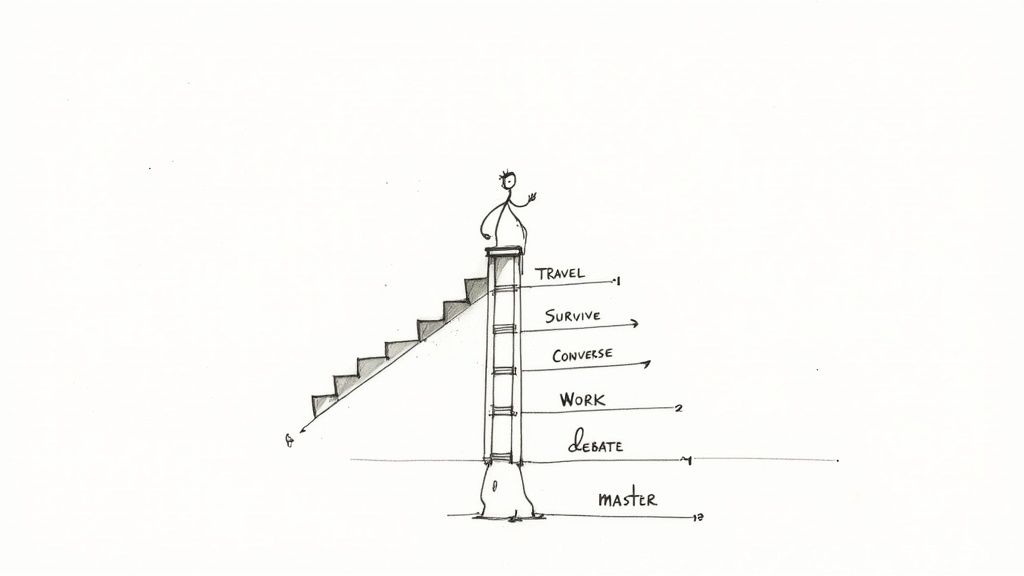
Ever wondered why some people seem to become conversational in Spanish in just a few months, while others are still struggling years later? It's not because of some mythical "language gene." The real answer comes down to a few key factors that can either supercharge your progress or put the brakes on.
Getting a handle on these variables is the first step toward making your study time count. Think of it like this: some factors are the hand you're dealt, but many more are about how you play your cards. Knowing what they are helps you set a realistic pace and build a smarter study plan. Instead of just grinding away, you can focus your energy where it’ll have the biggest impact.
Your Linguistic Starting Point
Your native language plays a huge role in how quickly you'll get the hang of Spanish. Good news for English speakers: you’ve got a massive head start. Both languages have deep Latin roots, which means you'll instantly recognise thousands of words called cognates.
Words like nación (nation), información (information), and animal (animal) give you a built-in vocabulary list from day one. This is a huge leg-up. While a native Mandarin or Japanese speaker has to learn every new word from zero, you're starting with a solid foundation. It's a big reason why we often say Spanish is one of the easier languages for English speakers to pick up. For more on this, check out our guide: https://spanish.sg/blog/is-spanish-easy-to-learn.
And if you already speak another Romance language—like French, Italian, or Portuguese—you’re on an even faster track. Concepts like gendered nouns and tricky verb conjugations will feel second nature, letting you absorb Spanish grammar that much quicker.
Your Chosen Learning Method
How you study is just as critical as what you study. An hour spent passively thumbing through a textbook is no match for 30 minutes of active conversation with a tutor. The best learning methods are always the ones that get you to actively use the language, not just consume it.
A winning strategy should mix it up and hit all four core skills:
- Active Listening: Don't just hear Spanish; really listen. Tune into podcasts, music, and conversations, trying to catch the meaning.
- Intentional Speaking: Make yourself talk! Practise pronunciation and try to form sentences, preferably with native speakers who can give you live feedback.
- Focused Reading: Start small with simple articles and work your way up. Reading shows you how grammar and vocabulary work together in the wild.
- Practical Writing: Send a text, jot down a shopping list, or keep a simple journal in Spanish. It forces you to think about sentence structure and recall words.
The fastest learners don’t just absorb the language; they produce it. A balanced approach that gets you speaking and writing from the get-go will shave months, if not years, off your timeline compared to passive learning alone.
Consistency and Time Commitment
This is the big one. It's also the factor you have 100% control over. Learning a language is a marathon, not a sprint, and consistency beats intensity every single time.
Studying for 30 minutes every day is far more powerful than a four-hour cram session once a week. Daily practice keeps the language fresh in your brain, building and reinforcing the neural pathways you need. Think of it like going to the gym—you'll see better results with short, regular workouts than with one massive, exhausting session on a Sunday.
What you do during that time is just as important. An hour spent chatting in a conversation class or getting lost in a Spanish-language Netflix show will do more for you than an hour of mind-numbing flashcards. Ultimately, finding strategies to make learning fun and engaging is what will keep you coming back day after day, and that's the real secret to getting fluent.
Building Your Personalised Study Plan
Knowing what affects your learning speed is one thing, but turning that knowledge into a real, actionable plan is where the magic happens. A one-size-fits-all approach just doesn't cut it because, let's face it, everyone's life is different. The real goal is to build a routine that you can actually stick to—one that fits your schedule, not some idealised version of one.
A smart study plan isn’t about cramming more hours into your day. It’s about making the hours you do have really count. Think of it like a balanced diet for your brain, covering the four core language skills: listening, speaking, reading, and writing. If you let one of those areas slide, it'll inevitably slow down your progress in the others.
This proactive approach is especially crucial if you're learning outside of a Spanish-speaking country. Take the United States, for example—it's the world's largest market for Spanish learners, with over 8.5 million students. Seeing how these learners structure their time can offer some great clues for anyone trying to learn from afar. You can dig into more insights on the global interest in learning Spanish on worldsacross.com.
The Busy Professional: 5 Hours Per Week
If you're juggling a demanding career, finding even five hours a week can feel like a victory. The secret here is to weave Spanish into the fabric of your existing routine. This plan is all about high-impact activities that you can squeeze into those little pockets of free time.
- Listening (1.5 hours): During your commute, swap your usual playlist or news for a Spanish podcast. Shows like Hoy Hablamos or Notes in Spanish are fantastic for this.
- Speaking (1 hour): Carve out one solid hour for a focused conversation. This could be a private lesson or a language exchange, but the key is dedicated, uninterrupted speaking practice.
- Reading (1.5 hours): Use your lunch break to read graded news articles from a source like News in Slow Spanish for 15-20 minutes a day.
- Writing (1 hour): Block out two 30-minute sessions a week to write. You could journal about your day in Spanish or draft short emails to a language partner.
The Dedicated Student: 10-15 Hours Per Week
With a bit more time on your hands, you can really start to deepen your connection with the language. This kind of schedule is perfect for university students or anyone who can commit to a more structured daily rhythm, putting them on the fast track to fluency.
This approach gives you a much richer mix of structured lessons and pure, enjoyable immersion.
- Listening (3-4 hours): Go ahead and binge that Spanish-language series on Netflix (with Spanish subtitles, of course!). You can also put on some Spanish music and challenge yourself to write down the lyrics.
- Speaking (2-3 hours): Try to lock in at least two sessions a week with a tutor or language exchange partner. Finding someone you click with is so important. If you need some pointers, check out our guide on finding a great language exchange in Singapore.
- Reading (3-4 hours): It's time to graduate from articles to your first short novel in Spanish. Using an e-reader makes it a breeze to look up new words on the fly.
- Writing (2-3 hours): Keep a daily journal and push yourself to write longer, more detailed entries. You could also jump into online forums or social media groups that discuss your hobbies in Spanish.
As you map out your study plan, it helps to think like a teacher. Applying proven instructional design best practices to your own learning can make your study time far more effective and, honestly, a lot more fun.
The Immersion Seeker: 20+ Hours Per Week
For those on a gap year, prepping for a move abroad, or who can simply go all-in, an immersion-style plan is the most direct path to fluency. This schedule is designed to make Spanish a part of almost everything you do.
This level of commitment is the next best thing to actually living in a Spanish-speaking country.
The goal here is to switch your brain's default setting to Spanish. It’s less about 'studying' and more about 'living' the language. This intensity creates rapid neural connections and builds intuitive understanding much faster than traditional methods.
A Sample Immersion Week
- Morning (2 hours): Kick off the day with structured learning. This is your time for grammar drills, textbook exercises, and solidifying the rules.
- Afternoon (2-3 hours): Shift into consumption mode. Watch Spanish films, get lost in long-form podcasts, and read articles or book chapters about things you're genuinely interested in.
- Evening (1-2 hours): Make this your production time. Have a long chat with a native speaker, write a detailed blog post, or even join a debate in a Spanish-language group.
This kind of intensive schedule takes serious motivation, but it’s how learners can hit conversational fluency in as little as three to five months.
Ultimately, it doesn’t matter which profile you fit into. The most important step is to simply create a plan, stick to it as best you can, and be willing to adjust it along the way. Consistency, not perfection, is what will get you to the finish line.
Choosing the Right Tools for Your Journey
It's easy to feel lost in the sea of Spanish learning resources out there. With countless apps, websites, and courses all promising to make you fluent, how do you know where to put your time and energy? Making a smart choice here is a big deal, because the tools you use can massively speed up—or slow down—how long it takes you to learn Spanish.
Think of it like trying to assemble a piece of IKEA furniture. You could try winging it with a butter knife and sheer determination. You might get there in the end, but it'll be a slow, frustrating process, and the final result will probably be a bit wobbly. Or, you could use the specific Allen key and screwdriver they provide, follow the clear instructions, and get it done right, and fast. The second approach is always the winner.
Comparing Popular Learning Approaches
Today’s learners have more options than ever, and each one has its pros and cons. Getting to know the differences is the first step in building a study plan that actually works for you.
-
Language Apps (e.g., Duolingo, Babbel): These are brilliant for picking up basic vocabulary and getting into the habit of daily practice. They're gamified, which makes learning feel less like a chore, and they’re perfect for a quick study session on the MRT. The downside? They often don't get you very far with real conversational skills or tricky grammar.
-
Online Tutors (e.g., italki, Preply): Platforms that connect you with native speakers are fantastic for one-on-one speaking practice. This is where you can really hone your accent, build confidence, and get instant feedback. The main drawback is that it can sometimes lack a clear structure, so you might feel like you're drifting without a clear learning path.
-
Self-Study (e.g., Textbooks, YouTube): If you're highly disciplined and self-motivated, the DIY route can be great for your wallet. There's a ton of free or cheap material available. The catch is that you have to be your own teacher, planner, and cheerleader, all in one. It’s very easy to lose steam or accidentally pick up bad habits without an expert to guide you.
The Power of a Structured Programme
While all the tools above have their place, they often miss one crucial element that an expert-led course provides: a clear, proven roadmap. A well-designed programme doesn't just throw random words and phrases at you. It guides you logically from one concept to the next, making sure you have a rock-solid foundation before you start building on it.
This structured approach is non-negotiable if you have a specific goal, like passing an official exam. For example, to earn a DELE A2 diploma, you have to pass a tough test covering listening, reading, writing, and speaking. This level, as defined by the Cervantes Institute, demands a deep understanding of grammar and vocabulary that's really difficult to achieve through self-study alone. You can see the full DELE A2 exam requirements on examenes.cervantes.es.
A certified course aligns your learning with internationally recognised standards like CEFR and DELE. This means every hour you put in is directly contributing to a measurable and officially recognised skill level, taking all the guesswork out of your progress.
Why Expert-Led Courses Accelerate Progress
Joining a structured course, like the ones at a dedicated language school, gives you a few game-changing advantages that you just can't get on your own. It's the difference between wandering through a forest with a compass and hoping for the best, versus following an experienced guide along a well-marked trail.
Here’s what makes the difference:
- Expert Feedback: Certified, native-speaking teachers catch your mistakes the moment you make them. This stops bad habits from becoming permanent.
- Accountability and Motivation: Having a set class schedule and a group of classmates keeps you showing up, especially on those days when your motivation is low.
- A Clear Path to Fluency: A professional curriculum is designed to build your skills step-by-step. You master the basics before moving on to more complex ideas, which prevents you from feeling overwhelmed and builds your confidence.
Ultimately, picking the right tools is about creating a balanced learning plan. While apps and tutors are helpful supplements, building your strategy around a structured programme from a reputable language school in Singapore provides the solid foundation and expert guidance you need to reach your Spanish goals much more efficiently.
Common Misconceptions About Learning Spanish
Before we dive into timelines, let's clear the air. A lot of people get bogged down by myths that make learning Spanish feel like an impossible mountain to climb. These ideas can really kill your motivation before you even start.
Let's dismantle a few of the biggest ones, so you can start your journey with the right mindset.
Myth 1: You're Too Old to Learn a New Language
This is probably the most common—and most damaging—myth out there. We’ve all heard that kids are like sponges, soaking up languages effortlessly. While that’s true to an extent, it doesn't mean adults are at a disadvantage. In fact, we have our own secret weapons.
The old idea of a strict 'critical period' for language learning has been largely debunked. Sure, kids often have an easier time picking up a native-like accent. But adults are often faster at grasping the system of a language. We can use logic, understand grammatical explanations, and apply learning strategies we’ve spent a lifetime developing. Research on adult language acquisition actually shows adults can outpace children in the initial stages for these very reasons.
Your adult brain isn't a liability; it's an asset. You can connect new words to existing knowledge, understand abstract grammar rules, and be far more disciplined in your study habits.
Myth 2: You Have to Live Abroad to Become Fluent
Living in a Spanish-speaking country is a fantastic way to learn, no doubt about it. But is it the only way? Absolutely not. You don't need a plane ticket to Madrid or Mexico City to get fluent.
Today, you can create a surprisingly effective Spanish immersion bubble right here in Singapore. The trick is to weave the language into the fabric of your daily life consistently.
Here’s how you can create your own "virtual immersion":
- Go Digital in Spanish: Switch your phone and social media accounts to Spanish. It’s a simple change that gives you constant, low-stakes exposure to new vocabulary.
- Tune In to Spanish Media: Turn your Netflix binge-watching, Spotify playlists, and podcast listening into learning opportunities. Start with subtitles, then work your way to listening without them.
- Find Your People: Look for language exchange partners online, join a conversation class, or find a local Spanish-speaking group. The goal is to make speaking a regular habit, not a rare event.
Myth 3: You Can Skip the Grammar
Some language apps and methods sell the idea that you can just "absorb" Spanish like a child, without ever opening a grammar book. While it’s crucial to start speaking and not get bogged down by rules, ignoring grammar entirely is like trying to build a LEGO masterpiece without any instructions.
You might be able to put a few bricks together, but you’ll never build anything complex or stable.
Grammar is the skeleton of the language. It’s what gives it structure and logic. Understanding fundamentals like verb conjugations, gendered nouns, and sentence order is what lets you graduate from repeating memorised phrases to actually expressing your own unique thoughts.
The sweet spot is a balanced approach. Combine plenty of real-world speaking practice with a solid-enough grasp of the rules that hold it all together. That’s the real shortcut to fluency.
Answering Your Top Questions About Learning Spanish
Let's dive into some of the most common questions that come up when you're starting your Spanish journey. Getting a handle on these from the get-go helps you set realistic goals and walk into your first lesson with confidence.
Can I Actually Learn Spanish in 3 Months?
So, can you become fluent in just three months? The short answer is, probably not. But you can make a huge amount of progress.
If you go all-in with an intensive schedule—I'm talking 20+ hours a week of focused study and practice—you can definitely reach a solid conversational level. Think A2 or even a low B1. You'll be able to handle yourself on holiday, order food, and have simple, friendly chats without much trouble.
Think of it like this: in three months, you can build a really strong, reliable foundation. You won’t have built the whole house, but you'll have the framework in place to keep adding to it. True fluency, where you're debating politics or leading a business meeting, simply takes more time.
Which Type of Spanish Should I Learn?
This is a big one for beginners: Castilian Spanish (from Spain) or Latin American Spanish? Honestly, when you're just starting out, it doesn't really matter.
The fundamental grammar and vocabulary are about 95% identical. It's a lot like the difference between British and American English—they're different, but you can understand both just fine.
Most good courses teach a "neutral" Spanish that works everywhere. Once you're comfortably at a B1 level, you can start diving into the specific slang and accent of a region you're passionate about, whether that's Argentina, Mexico, or Spain.
So, what are the real hurdles for English speakers? It almost always comes down to two things: verb conjugations and the subjunctive mood. These grammatical concepts don't really have a direct equivalent in English, so they take a bit of practice to click.
Another common challenge is just keeping up with the speed of native speakers. The solution is simple but requires consistency: listen, listen, and listen some more, right from day one. It trains your ear to catch the rhythm and flow of the language.
Ready to start your journey with a clear, structured path? Spanish Council Singapore offers expert-led courses designed to help you achieve your fluency goals efficiently. Our native teachers provide the guidance and accountability you need to succeed. Find the perfect course for you at https://spanish.sg.