learn thai singapore: Top options to learn Thai in Singapore
Planning a trip to Bangkok, connecting with Thai friends, or simply captivated by the culture? Deciding to learn Thai is an exciting step, but finding the right resources in Singapore can be a challenge. With so many options-from university courses and private schools to flexible apps and community classes-it’s difficult to know which path best suits your goals, budget, and learning style.
This guide cuts through the noise. We have meticulously researched and categorised the top 12 resources to learn Thai in Singapore, providing a practical analysis of each. We'll explore who each option is best for, what to realistically expect, and how to get the most out of your investment.
Whether you're a professional seeking conversational skills, a student aiming for academic proficiency, or a casual learner looking for a new hobby, this list will help you make an informed decision. We provide a direct comparison of language schools, private tutors, online platforms, and even community programmes available locally. Each entry includes detailed insights and direct links to get you started, ensuring you find the perfect fit to begin speaking Thai with confidence.
1. NUS Centre for Language Studies (Undergraduate Thai)
For those seeking an academically rigorous and structured path to fluency, the National University of Singapore (NUS) offers the most comprehensive programme to learn Thai in Singapore. The Centre for Language Studies (CLS) provides a full undergraduate pathway, from beginner (LAT1201 Thai 1) to advanced levels, all taught by specialist university faculty. This isn't a casual course; it’s a credit-bearing programme designed for deep, systematic learning.
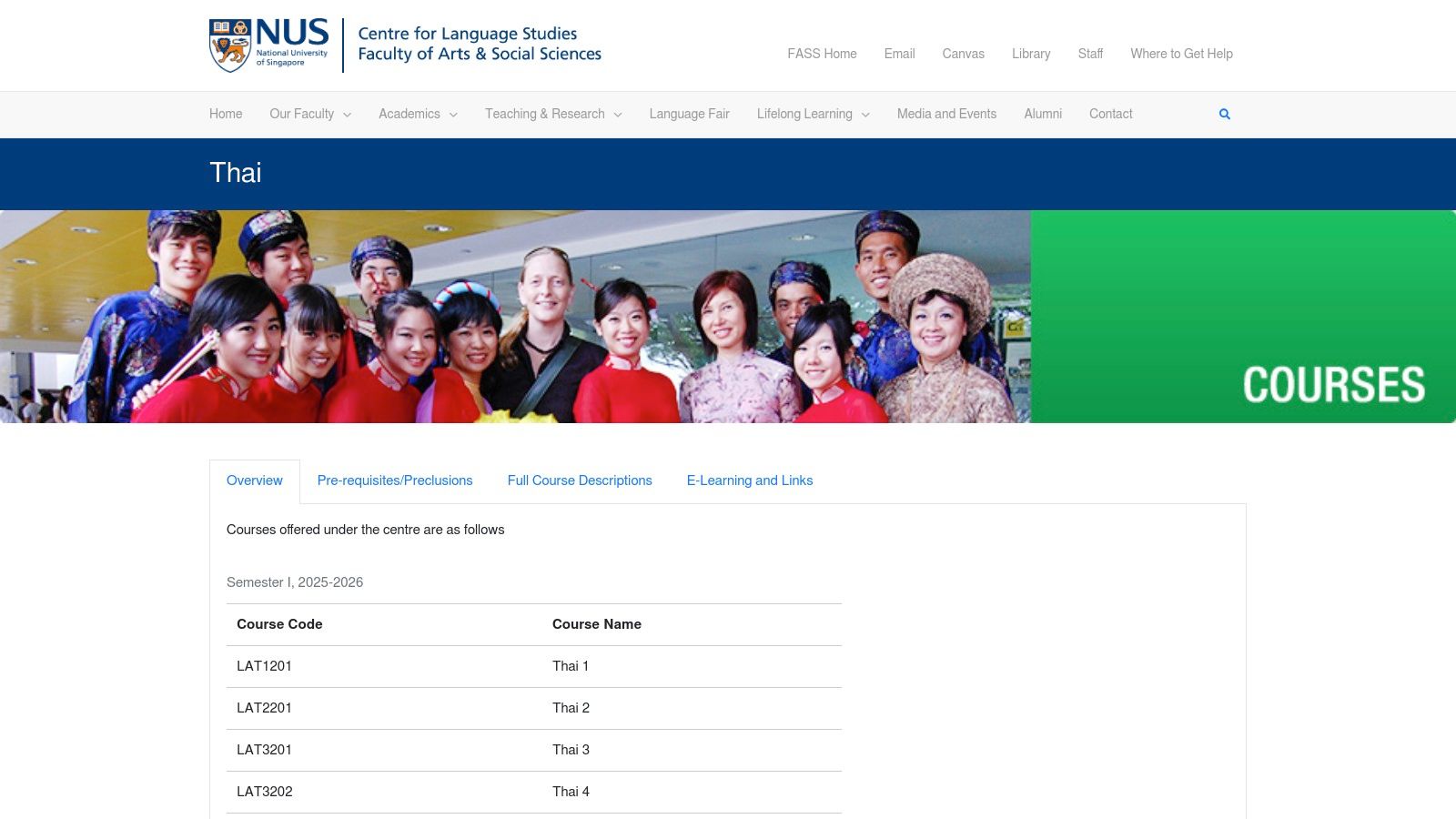
The curriculum is aligned with the Common European Framework of Reference for Languages (CEFR), ensuring your proficiency is benchmarked to international standards. Students progress semester by semester, building a solid foundation in grammar, vocabulary, and cultural context. The key advantage is access to NUS’s extensive resources, including potential immersion programmes and exchange opportunities in Thailand.
Key Considerations & Limitations
The primary drawback is its exclusivity. These modules are almost entirely restricted to enrolled NUS undergraduates, making it inaccessible for the general public or professionals seeking flexible evening classes. The structure is also rigid, following the university’s fixed semester schedule. If you are a prospective or current NUS student with a serious interest in mastering Thai within a formal academic framework, this is unequivocally the best option in the country.
- Best for: Enrolled NUS students seeking a deep, academic understanding of the Thai language.
- Access: Primarily restricted to NUS students. Non-students may have limited access via the Centre for Lifelong Education (L³), subject to availability.
- Structure: Formal, credit-bearing university modules with fixed semester timetables.
- Website: fass.nus.edu.sg/cls/thai/
2. NUS CLS Language Programme (Public/Lifelong Learning)
For those who want the academic rigour of NUS without being an undergraduate, the CLS Language Programme is the ideal solution. It offers the university's high-quality Thai language curriculum to the general public through accessible, part-time evening courses. These 10-week programmes are delivered online via Zoom, making it a convenient way for working adults and lifelong learners to learn Thai in Singapore from a reputable institution.
The key appeal is its combination of quality and accessibility. The programme often qualifies for SkillsFuture Credit, and seniors may be eligible for National Silver Academy (NSA) subsidies, significantly lowering the financial barrier. Unlike the undergraduate modules, these courses are designed specifically for the public, with clear schedules, fees, and registration details published online, removing any guesswork from the enrolment process.
Key Considerations & Limitations
While highly accessible, the programme still operates on fixed academic schedules. Intakes are set for specific times of the year, and popular classes can fill up quickly, requiring prospective students to plan ahead. This structured format offers less flexibility than self-paced apps or private tutoring. It’s perfect for disciplined learners who thrive in a structured, cohort-based online classroom environment and value the prestige of an NUS-backed certificate.
- Best for: Working professionals and the general public seeking a structured, high-quality online Thai course with certification.
- Access: Open to the public, with potential discounts for NUS alumni, staff, and students.
- Structure: Part-time, 10-week online courses with fixed evening schedules and set intake dates.
- Website: fass.nus.edu.sg/clslang/thai/
3. NTU Centre for Modern Languages (Thai)
Similar to NUS, Nanyang Technological University (NTU) offers a formal academic pathway for its students to learn Thai in Singapore. The Centre for Modern Languages provides Thai language modules as credit-bearing electives, designed for absolute beginners and focusing on a balanced development of all four core skills: listening, speaking, reading, and writing. A key feature is the early introduction to the Thai script, setting a strong foundation for literacy.
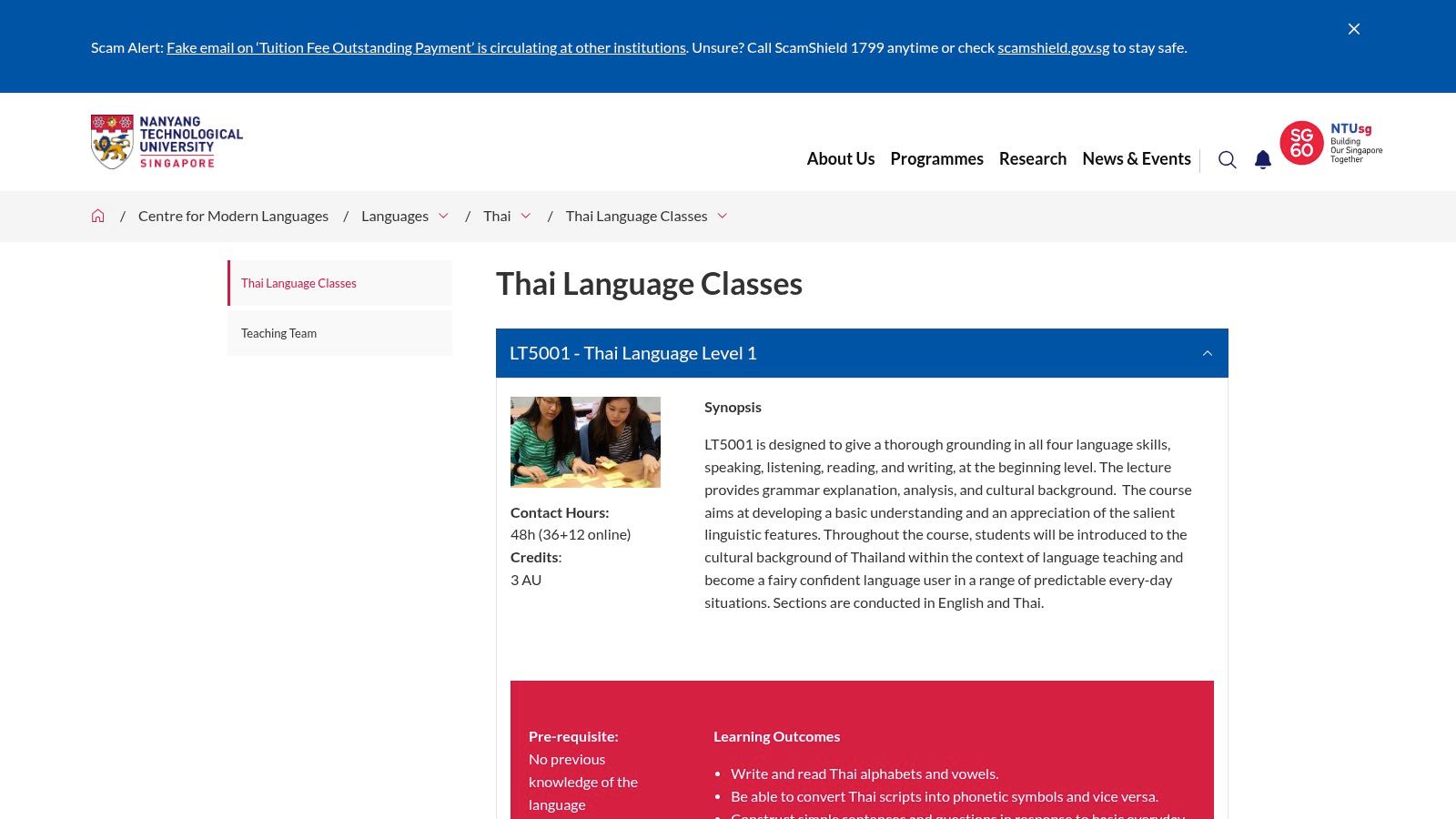
The curriculum is structured within the university framework, with defined contact hours (typically 48 hours per semester) and formal assessments. This ensures a systematic and well-paced learning experience, integrating cultural context alongside linguistic skills. It's an ideal choice for NTU students looking to add a valuable language skill to their degree with the rigour of an academic setting.
Key Considerations & Limitations
The most significant limitation is access, as these courses are generally restricted to enrolled NTU students. This makes it unsuitable for the general public or working professionals. The programme is also tied to NTU’s fixed academic calendar, offering little flexibility for those with demanding schedules outside of university life. For an NTU undergraduate, however, it represents a fantastic, on-campus opportunity to formally study the Thai language.
- Best for: Enrolled NTU students seeking a structured, credit-bearing elective in foundational Thai.
- Access: Primarily restricted to NTU students; not open to the public.
- Structure: Formal university elective modules with fixed semester schedules and assessments.
- Website: www.ntu.edu.sg/cml/languages/thai/thai-language-classes
4. inlingua School of Languages (Singapore)
For learners who value flexibility, a central location, and a globally recognised teaching methodology, inlingua School of Languages is a strong contender. Situated conveniently on Orchard Road, it offers Thai language courses in both small-group and private one-to-one formats. This structure allows learners to choose a path that best suits their budget, schedule, and specific learning objectives, making it a popular choice for busy professionals and dedicated hobbyists alike.
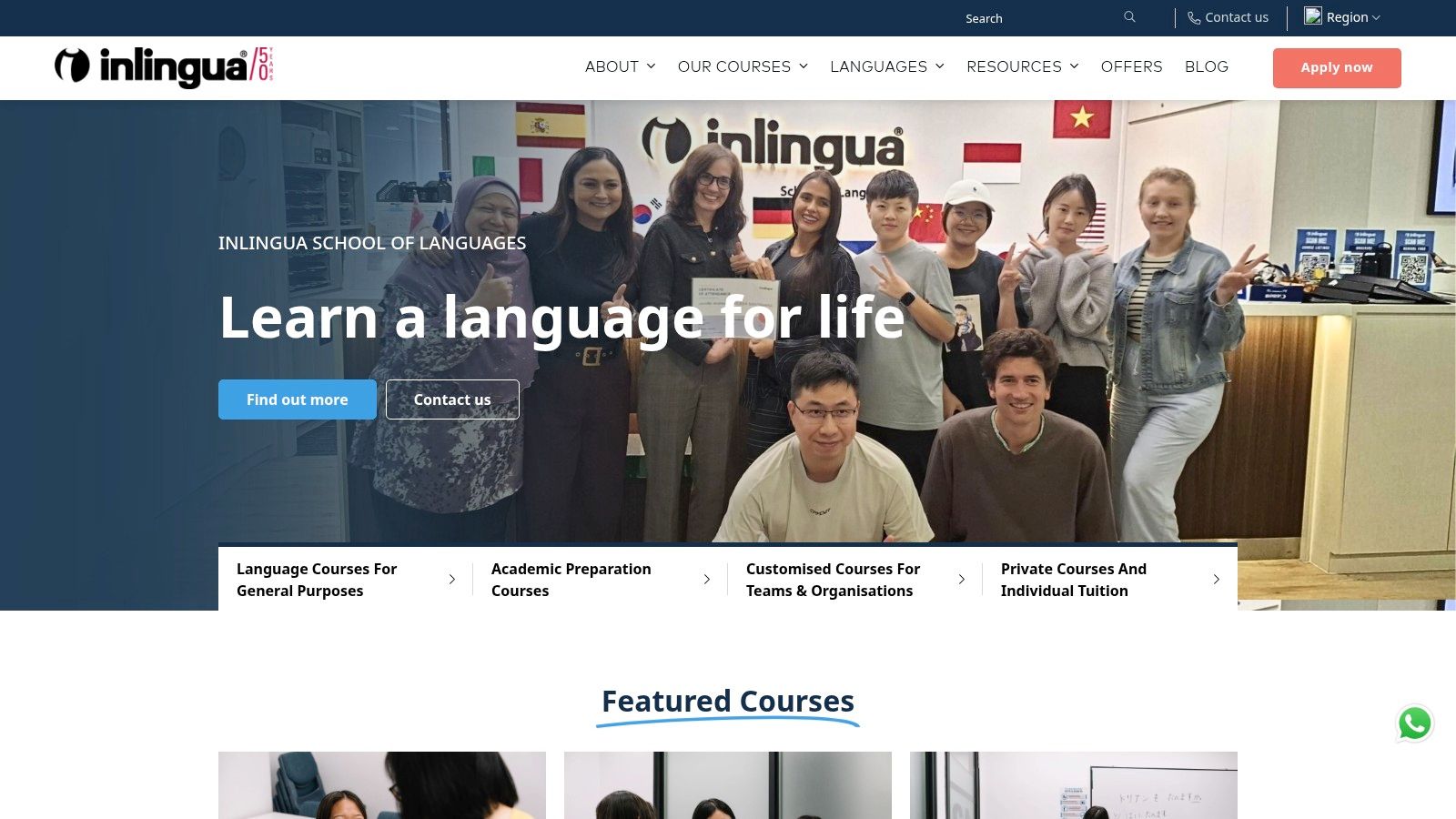
The school utilises the established inlingua method, which prioritises conversational practice from the first lesson, supported by its proprietary learning materials. Whether you opt for in-person classes at their centre or online sessions, the focus remains on active participation and practical communication. This blend of customisable study plans and a proven teaching framework makes it a reliable option to learn Thai in Singapore, a point often noted in reviews of language schools in Singapore.
Key Considerations & Limitations
The primary advantage is its customisability, especially with private tuition, where the curriculum can be tailored to your precise needs. However, pricing is not transparent on the website and requires a direct enquiry, as costs vary significantly between group and private formats. Furthermore, the availability of small-group classes for specific proficiency levels can be dependent on having enough students to form a class, which may lead to a waiting period.
- Best for: Professionals and individuals seeking flexible scheduling (online/in-person) and customisable lesson plans in a central location.
- Access: Open to the public with various course formats.
- Structure: Small-group or private tuition with flexible timetables and a focus on conversational methodology.
- Website: inlingua.edu.sg/
5. Lingo School of Knowledge (Hybrid Thai)
Lingo School of Knowledge offers a highly practical and accessible way to learn Thai in Singapore through its hybrid learning model. Combining physical classroom sessions with live Zoom access, it caters to learners who need flexibility without sacrificing interaction. The school stands out for its transparent scheduling and frequent intakes, making it easy for busy professionals or students to find a suitable starting point for their language journey.
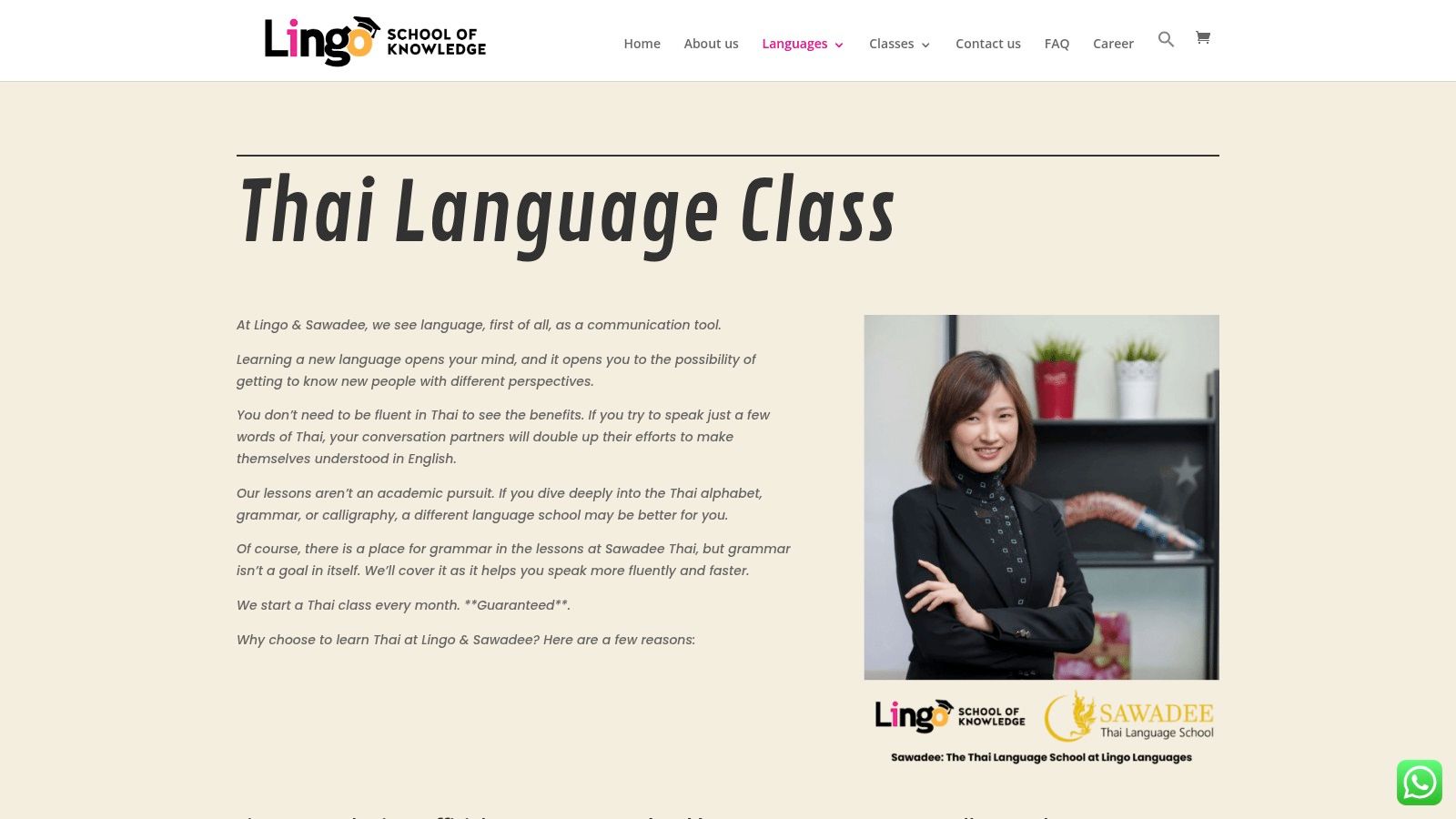
A key advantage is the intentionally small class size, capped at around eight students, which ensures ample opportunity for speaking practice and personalised attention. The curriculum is structured progressively, with the Thai script introduced at the intermediate levels, building a solid foundation before tackling reading and writing. For those who prefer a dedicated pace, private one-to-one lessons are also available.
Key Considerations & Limitations
While the hybrid model is a significant benefit, the availability of class recordings is subject to the consent of all students in the session, meaning it isn't always guaranteed. The school also has policies regarding missed classes that could impact your progression if your schedule is unpredictable. However, for learners who value clear course structures, published fees, and small, interactive group settings, Lingo offers a reliable and well-organised pathway to learning Thai.
- Best for: Learners seeking a structured, small-group environment with the flexibility of hybrid (onsite/online) classes.
- Access: Open to the public with frequent intakes throughout the year. Fees and schedules are published online.
- Structure: Progressive group courses from beginner to advanced, plus private 1:1 tuition.
- Website: www.lingo.edu.sg/thai/
6. Stanford Language Centre (Thai Made Easy)
For adult learners seeking a practical and budget-conscious entry into the Thai language, Stanford Language Centre presents its 'Thai Made Easy' course. This programme is built around a conversation-focused curriculum, prioritising practical dialogue and essential grammar to get you speaking quickly. Taught by native Thai teachers, the course offers flexibility with both face-to-face classes and online options available to suit different schedules.
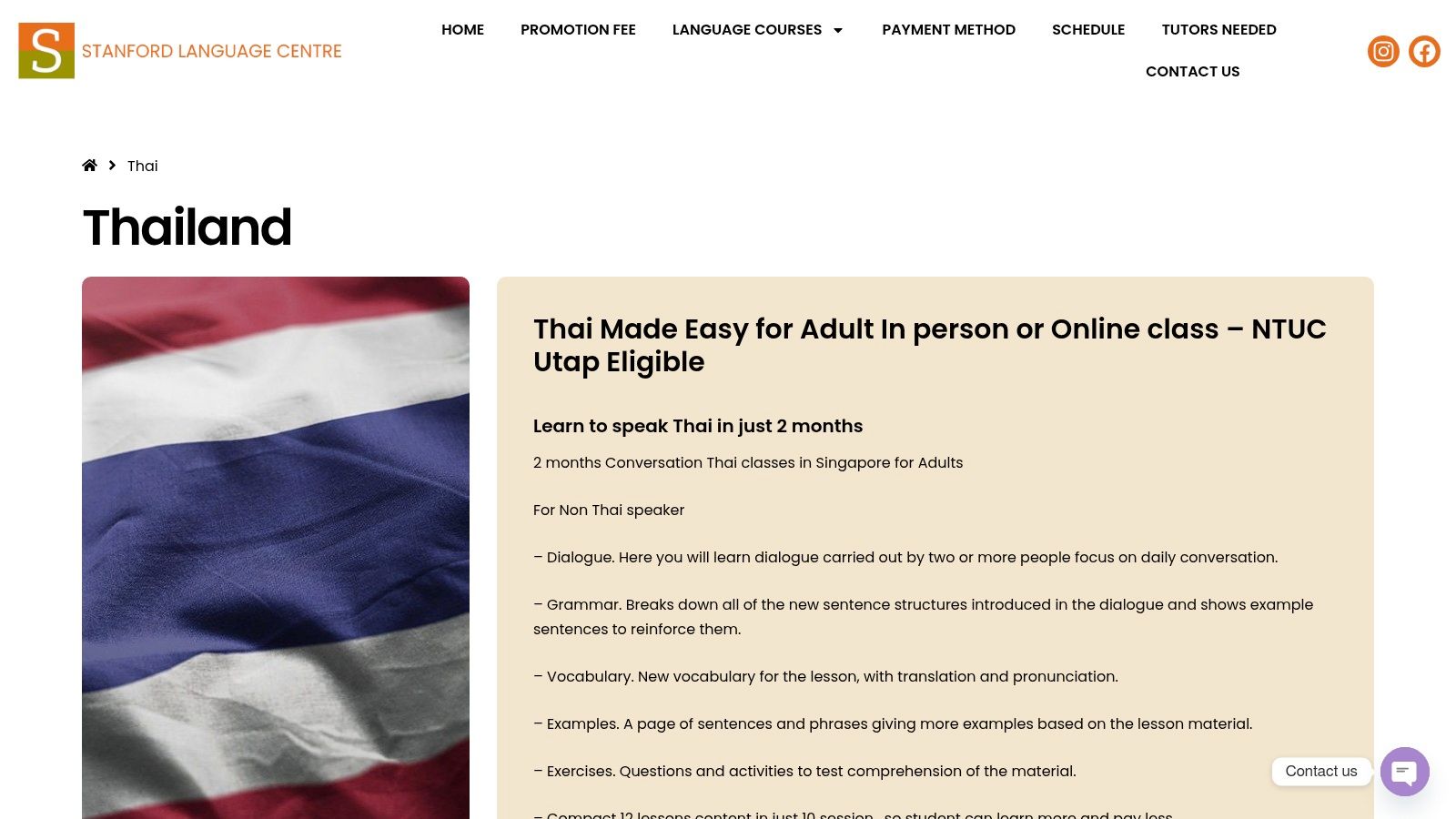
The key appeal is its direct approach to conversational skills in a group setting, often promoted as an accessible and cost-effective way to learn Thai in Singapore. The availability of NTUC UTAP funding eligibility for certain courses also makes it an attractive option for qualifying union members looking to upskill. The focus remains squarely on application rather than deep academic theory, making it ideal for travellers or those interacting with Thai speakers socially.
Key Considerations & Limitations
The main drawback is the lack of upfront scheduling information on their website; prospective students must contact the centre directly to confirm class start dates and timetables, which can be an inconvenient extra step. Additionally, while the headline monthly pricing appears very competitive, the full course cost might require further clarification upon enquiry. This model is best for learners who value a straightforward, dialogue-based classroom experience and don't mind a less detailed online presence.
- Best for: Adult learners and professionals seeking a conversation-focused, budget-friendly group class with flexible delivery options.
- Access: Open to the public, with face-to-face and online classes. Often eligible for NTUC UTAP claims.
- Structure: Condensed, conversation-centric group courses with native Thai instructors.
- Website: www.stanford.com.sg/courses/thai/
7. People’s Association / OnePA Thai Language Courses
For a highly accessible and community-focused way to learn Thai in Singapore, the courses offered through the People’s Association (PA) at various community clubs are an excellent starting point. Managed via the OnePA portal, these classes are designed for casual learners, focusing on practical conversational skills for travel or daily interactions. They provide a relaxed, neighbourhood-based environment that is less intimidating than formal language schools.
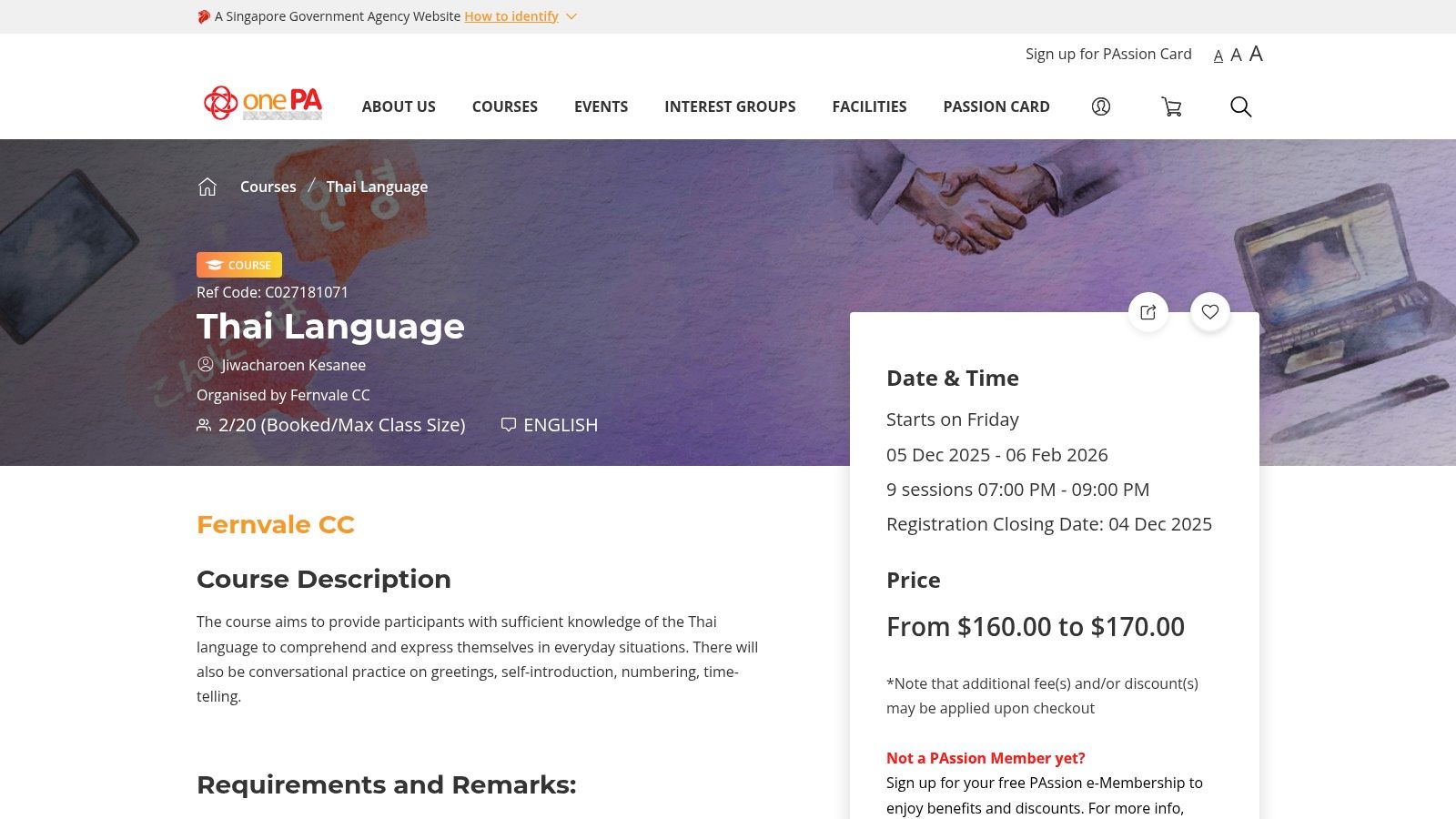
The primary advantage is convenience and affordability. With locations spread across the island, you can often find a class right in your own neighbourhood. These courses, frequently listed under SkillsFuture@PA, offer a very low barrier to entry for beginners curious about the Thai language without committing to an intensive programme. It's an ideal way to meet like-minded learners in your community and is a great alternative to more formal settings.
Key Considerations & Limitations
The main challenge with PA courses is their variability and availability. Offerings depend entirely on local demand and the availability of instructors at a specific community club, meaning you might not always find a class at your preferred time or location. Class sizes and teaching quality can also vary. These courses are best suited for foundational learning; those seeking advanced proficiency or specialised instruction will likely need to look elsewhere after completing the beginner stages.
- Best for: Absolute beginners seeking a casual, affordable, and convenient neighbourhood-based introduction to conversational Thai.
- Access: Open to the public, with booking done via the OnePA website. SkillsFuture credits can often be used.
- Structure: Non-academic, community-based classes with a focus on practical conversation.
- Website: www.onepa.gov.sg/courses/thai-language
8. Mango Languages (Thai) – App and Web
For learners who value flexibility and self-paced study, Mango Languages offers a polished app-based platform to learn Thai in Singapore. The methodology centres on conversational skills, breaking down practical dialogues into manageable components. It pairs vocabulary and grammar with cultural notes, providing context that enriches the learning process.
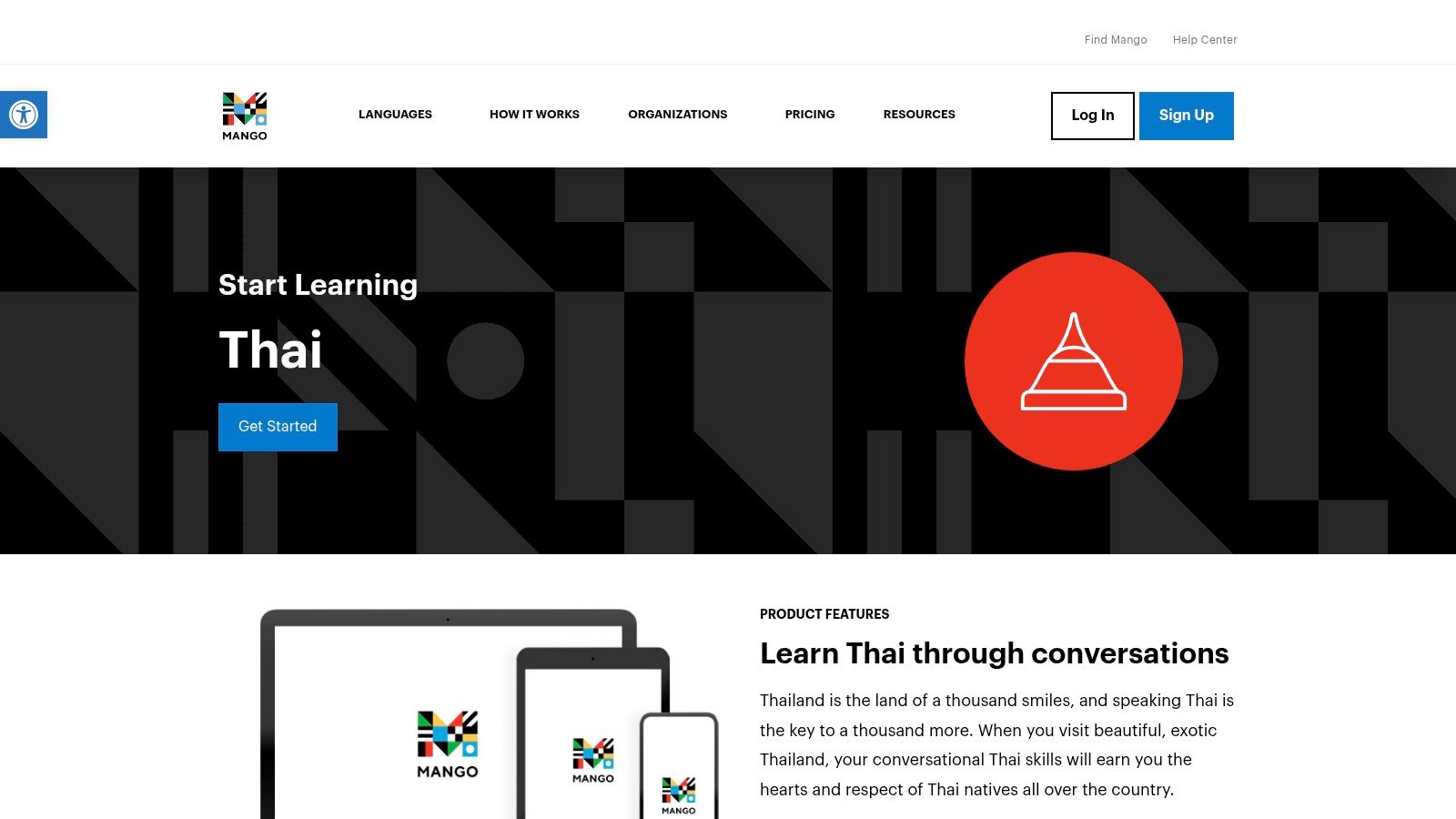
Its standout feature is the voice comparison tool, which allows you to record your pronunciation and visually compare it to a native speaker's waveform. For learners using such tools, a deeper dive into the principles of understanding speech-to-text accuracy can help set realistic expectations and make the most of the feedback. The platform’s main advantage is its potential for free access; many educational institutions and libraries globally subscribe, so it's worth checking if you can get access through your local library or school.
Key Considerations & Limitations
The primary limitation is accessibility. While some institutions offer free access, it is not a given in Singapore, and many users will need to purchase a subscription. Additionally, while excellent for building a foundational conversational ability, its depth may not satisfy advanced learners seeking the nuanced instruction of a dedicated teacher. It excels as a supplementary tool or a starting point for motivated beginners.
- Best for: Self-motivated beginners and intermediate learners needing a flexible, on-the-go practice tool.
- Access: Requires a paid subscription, though free access may be available via participating libraries or institutions.
- Structure: Self-paced, app-based modules focused on conversational phrases, pronunciation, and culture.
- Website: mangolanguages.com/available-languages/thai/
9. Pimsleur (Thai)
For learners whose primary goal is to speak and understand Thai quickly, the Pimsleur Method offers a powerful, audio-centric approach. Its core philosophy revolves around 30-minute daily lessons that are easy to fit into a busy schedule, making it ideal for the daily commute on the MRT or during a lunch break. This platform focuses on teaching conversational Thai through spaced repetition and recall, building your speaking confidence from the very first lesson.
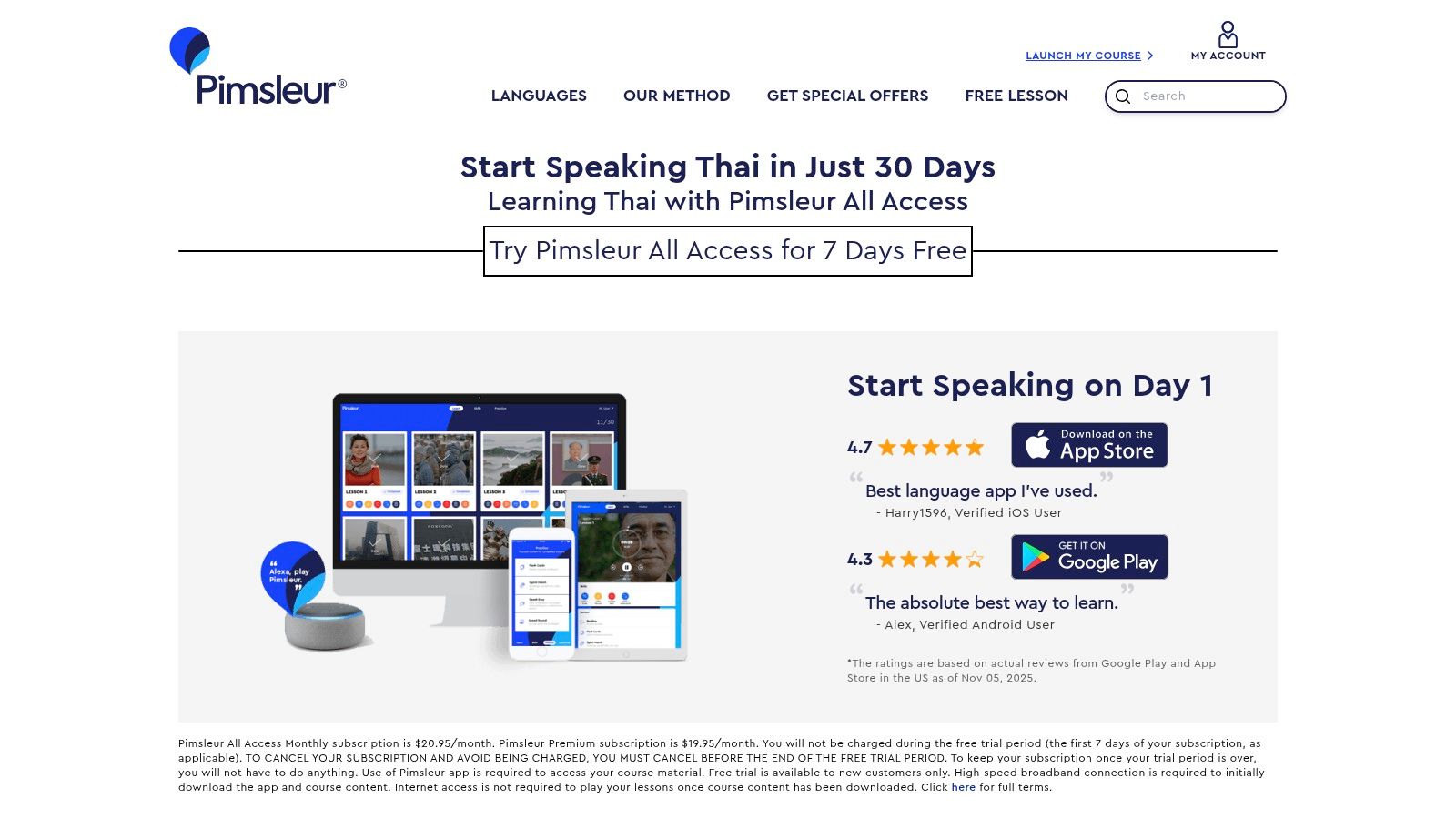
Pimsleur's strength lies in its ability to train your ear and tongue for authentic pronunciation. It prompts you to speak aloud constantly, reinforcing sentence structures and vocabulary in a way that becomes second nature. The accompanying app enhances the audio lessons with features like a voice coach, flashcards, and interactive games, providing a more well-rounded experience than just listening to audio files. It is an excellent tool for building a strong conversational foundation before moving on to more complex grammar or script.
Key Considerations & Limitations
The main drawback of the Pimsleur method is its limited focus on reading and writing the Thai script. While some visual aids are provided in the app, the curriculum is overwhelmingly geared towards aural and oral skills. If your goal is literacy, you will need to supplement this course with other resources. The subscription-based model offers a 7-day free trial, but pricing can vary and is often displayed in a local currency at checkout, so be sure to check the final cost.
- Best for: Commuters and busy professionals wanting to build conversational fluency and confidence.
- Access: App and web-based subscription model with a 7-day free trial.
- Structure: Daily 30-minute audio lessons supplemented with app-based interactive exercises.
- Website: www.pimsleur.com/learn-thai
10. Preply (Online Thai Tutors)
For learners who prioritise flexibility and personalised instruction, Preply stands out as a leading global marketplace connecting students with online Thai tutors. This platform offers an extensive selection of tutors for one-to-one video lessons, allowing you to find an instructor who perfectly matches your learning style, budget, and schedule. It’s an ideal solution for professionals with erratic work hours or anyone seeking a customised curriculum.
The platform’s strength lies in its powerful filtering system. You can sort hundreds of tutors by price, nationality (e.g., native Thai speakers), availability, and specialty, such as conversational practice or grammar focus. Most tutors offer a discounted trial lesson, allowing you to assess their teaching method before committing to a package. This makes it a low-risk way to find the right tutor to help you learn Thai in Singapore from the comfort of your home.
Key Considerations & Limitations
While the choice is vast, the experience can be inconsistent as tutor quality is not centrally standardised. Success heavily depends on finding a good match. Additionally, Preply charges a service fee on transactions, and its subscription-based lesson packages can have strict policies regarding refunds and rescheduling, so it’s crucial to review the terms carefully. Despite this, it remains an excellent resource for its sheer convenience and customisation potential. To learn more about the pros and cons of this model, see these insights into online tutoring opportunities.
- Best for: Self-directed learners needing flexible scheduling and personalised one-to-one lessons.
- Access: Fully online, accessible to anyone with an internet connection.
- Structure: Highly flexible; book individual lessons or subscribe to lesson packages based on tutor availability.
- Website: preply.com/en/online/thai-tutors
11. Superprof Singapore (Thai Tutors)
For learners prioritising flexibility and direct tutor connection, Superprof Singapore serves as a comprehensive directory of independent Thai teachers. This platform allows you to filter and compare tutors based on hourly rates, reviews, response times, and qualifications. It stands out by connecting students directly with a wide range of tutors, from native speakers offering conversational practice to experienced teachers providing structured lessons, both online and in-person.
The key advantage is choice and affordability, with many tutors offering competitive rates and often a free or discounted first lesson to ensure a good fit. This model is ideal for finding a private tutor to supplement other studies or for those who need a highly customised lesson plan that a traditional school cannot offer. It is a powerful tool if you are prepared to do your own vetting.
Key Considerations & Limitations
The platform's strength is also its main challenge: quality is highly variable. Superprof is a marketplace, not a school, so the teaching quality, reliability, and methodology depend entirely on the individual tutor you select. It is crucial to read reviews carefully, check credentials, and use the first lesson to assess their teaching style. Unlike a language centre, there is no standardised curriculum or academic oversight, placing the responsibility for progress tracking squarely on the student and tutor.
- Best for: Self-motivated learners seeking affordable, flexible one-on-one tuition and customised lesson plans.
- Access: Open to everyone; direct contact with tutors for online or in-person arrangements in Singapore.
- Structure: Unstructured; lesson format and schedule are negotiated directly with the chosen private tutor.
- Website: www.superprof.sg/lessons/thai/singapore/
12. Kinokuniya Singapore & Popular (Thai Learning Books)
For learners who prefer a tangible, self-paced approach, major local bookstores like Kinokuniya and Popular are invaluable resources. They offer direct access to physical Thai language textbooks, dictionaries, and graded readers that can supplement formal courses or form the foundation of a self-study programme. This option is perfect for those who want to browse materials before buying and build a personal learning library.
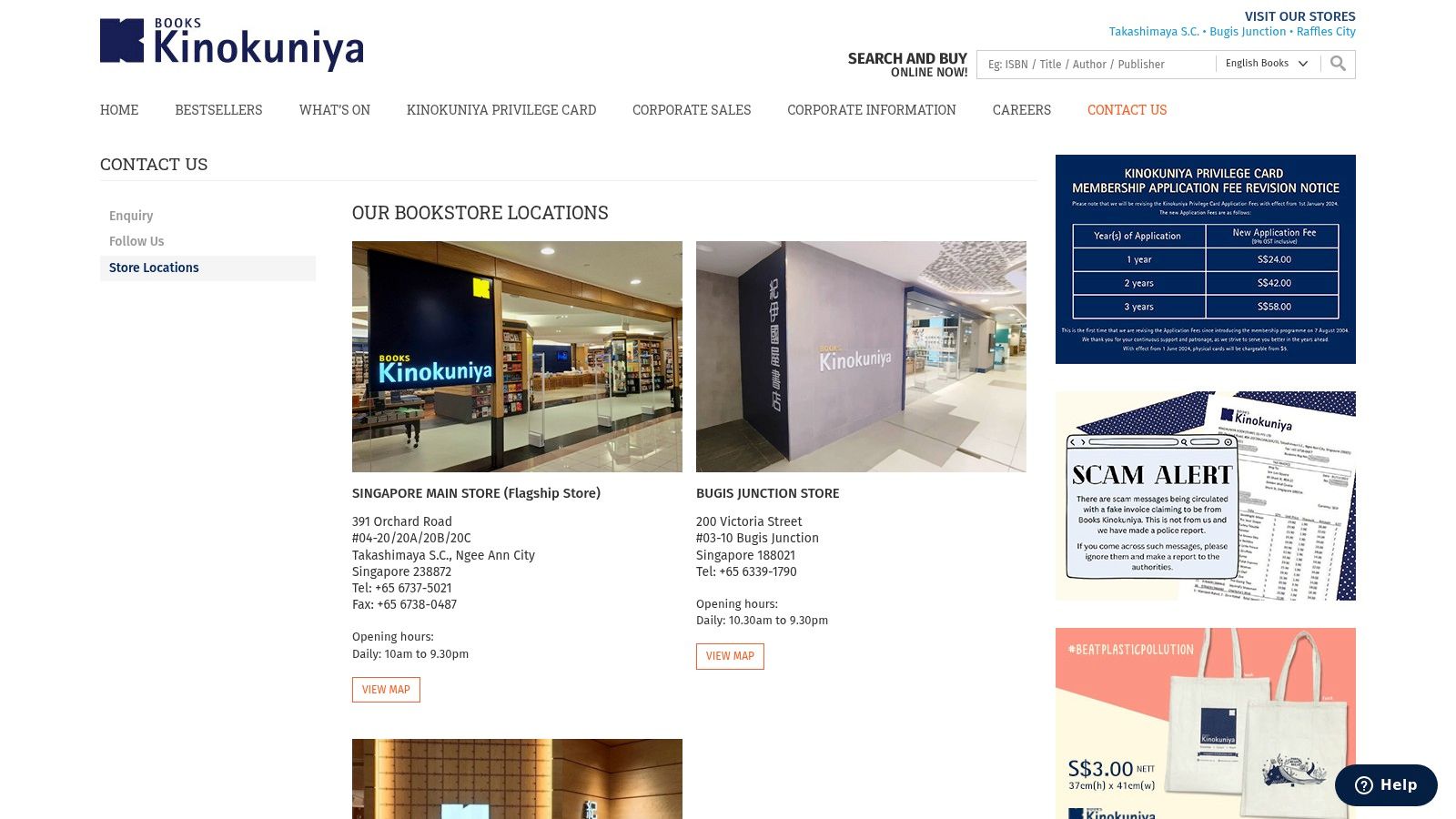
The ability to walk into a central Kinokuniya location and immediately pick up a book is a significant advantage over waiting for online deliveries. To maximise your self-study, understanding effective strategies for studying textbooks can greatly enhance retention and comprehension. While Popular’s online store lists specific Thai titles, Kinokuniya’s extensive network and ability to special order books make it a powerful tool for any serious student looking to learn Thai in Singapore.
Key Considerations & Limitations
The primary challenge is inconsistent stock. The selection of Thai learning materials can vary significantly between stores and over time, and sought-after titles may need to be specially ordered, involving a potential wait. Prices can also be higher than online international retailers. However, for immediate access and the benefit of physical inspection, these bookstores remain a crucial and convenient local resource.
- Best for: Self-studiers and students in other courses seeking supplementary physical textbooks, dictionaries, or readers.
- Access: Open to the public at all physical store locations and their respective online stores.
- Structure: Self-directed; resources can be used to complement any learning style or formal curriculum.
- Website: kinokuniya.com.sg/contact-us/store-locations/
Learn Thai in Singapore — 12-Resource Comparison
| Provider | Core features ✨ | Quality / Experience ★ | Price / Value 💰 | Target / Best for 👥 | Unique selling points 🏆 |
|---|---|---|---|---|---|
| NUS Centre for Language Studies (Undergraduate Thai) | Credit-bearing multi-level modules, placement tests ✨ | ★★★★★ (specialist faculty; rigorous) | 💰 University tuition; high value for credits | 👥 Enrolled NUS undergrads seeking academic pathway | 🏆 Credit-bearing progression, campus resources & immersion links |
| NUS CLS Language Programme (Public/Lifelong Learning) | Evening 10-week Zoom courses, SkillsFuture/NSA eligibility ✨ | ★★★★ (NUS quality, structured cohorts) | 💰 Published public fees; subsidies available | 👥 Working adults & lifelong learners | 🏆 Clear schedules, NUS brand & subsidised options |
| NTU Centre for Modern Languages (Thai) | Credit-bearing elective, Thai script intro, 4-skill focus ✨ | ★★★★ (balanced skills & assessments) | 💰 Student tuition; academic credit value | 👥 NTU students / campus beginners | 🏆 Script introduction + assessed progression |
| inlingua School of Languages (Singapore) | Small-group & 1:1, online or in-centre, flexible timetables ✨ | ★★★★ (established methodology) | 💰 Varies by format (1:1 pricier) — enquire | 👥 Professionals & urban learners wanting in-person classes | 🏆 Custom study plans, Orchard/CBD location |
| Lingo School of Knowledge (Hybrid Thai) | Hybrid onsite + Zoom, small classes (≤8), recordings available ✨ | ★★★★ (interactive small groups) | 💰 Published fees; frequent intakes | 👥 Casual & working learners wanting interaction | 🏆 Hybrid delivery + class recordings (consent) |
| Stanford Language Centre (Thai Made Easy) | Conversation-focused curriculum, native teachers, flexible modes ✨ | ★★★★ (practical dialogue emphasis) | 💰 Budget-friendly headline pricing; confirm full cost | 👥 Adults seeking practical spoken Thai | 🏆 Condensed, conversation-first format; UTAP-flagged |
| People’s Association / OnePA Thai Courses | Community-club classes, practical conversation, SkillsFuture@PA ✨ | ★★★ (community-oriented, accessible) | 💰 Low-cost community pricing | 👥 Neighbourhood learners & casual beginners | 🏆 Local venues, community subsidies & convenience |
| Mango Languages (Thai) – App & Web | Self‑paced lessons, cultural notes, voice comparison tools ✨ | ★★★ (flexible on-demand) | 💰 Subscription or free via some libraries | 👥 Self-learners & mobile/on-the-go users | 🏆 App-based voice tools; potential free library access |
| Pimsleur (Thai) | Audio-first 30min/day lessons, voice coach, offline mode ✨ | ★★★★ (excellent oral/aural training) | 💰 Subscription; 7‑day free trial | 👥 Commuters & learners prioritising speaking | 🏆 Audio method that fits daily routine |
| Preply (Online Thai Tutors) | Large tutor marketplace, filters, trial lessons ✨ | ★★–★★★★ (varies by tutor) | 💰 Wide price range; platform fees possible | 👥 Learners needing personalised 1:1 & scheduling flexibility | 🏆 Huge tutor choice; change tutors easily |
| Superprof Singapore (Thai Tutors) | Local tutor listings, transparent hourly rates, first-lesson offers ✨ | ★★–★★★ (varies; many budget options) | 💰 Budget-friendly (≈S$15–S$30/hr typical) | 👥 Budget-conscious learners seeking local tutors | 🏆 Direct contact & easy profile comparisons |
| Kinokuniya & Popular (Thai Learning Books) | Printed textbooks, dictionaries, graded readers; local pickup ✨ | ★★★ (solid print resources) | 💰 Retail prices; stock-dependent | 👥 Self-study learners & course supplementers | 🏆 Immediate local access to physical learning materials |
Choosing Your Path to Thai Fluency
Embarking on the journey to learn Thai in Singapore presents a vibrant landscape of opportunities, as we have explored. From the academically rigorous, credit-bearing courses at the National University of Singapore and Nanyang Technological University to the flexible, business-focused curricula at private institutions like inlingua, the options are as diverse as the learners themselves. Your ideal path is not about finding the single "best" resource, but about identifying the best fit for your unique circumstances.
This comprehensive guide has mapped out the varied terrain. We have seen how structured, classroom-based environments provide a solid foundation in grammar and cultural context, making them ideal for serious students. In contrast, platforms like Preply and Superprof offer unparalleled personalisation, connecting you with tutors who can tailor every lesson to your specific professional or personal goals, whether it’s mastering market-day bargaining or preparing for a business negotiation in Bangkok.
Matching the Method to Your Motivation
To make a truly effective choice, reflect deeply on your primary motivation.
- For Academic & Professional Advancement: If you require a formal qualification or deep linguistic understanding, the university programmes at NUS or NTU are your strongest contenders. Their structured approach ensures a comprehensive grasp of the language.
- For Conversational Fluency & Flexibility: Adult learners juggling work and family will find the hybrid models of Lingo School of Knowledge or the tailored schedules at Stanford Language Centre highly practical. These options blend structure with the convenience you need.
- For On-the-Go & Foundational Learning: If your schedule is unpredictable, self-directed tools are your best allies. Pimsleur’s audio-first method is perfect for your daily commute, while Mango Languages offers bite-sized, culturally rich lessons you can complete during a lunch break.
- For Community & Casual Engagement: If you want to dip your toes into the language in a low-pressure, social setting, the People's Association courses offer an affordable and accessible starting point, connecting you with fellow enthusiasts in your neighbourhood.
Your Actionable Next Steps
The most crucial step is to move from consideration to commitment. Don't let analysis paralysis hold you back. Select one or two resources from this list that resonate with your goals and learning style. Perhaps you will enrol in a formal course and supplement it with a language app for daily practice. Or maybe you will hire a private tutor for focused sessions and use books from Kinokuniya for self-study.
Ultimately, consistency will be the engine of your progress. The perfect tool is the one you use regularly. By selecting a resource that genuinely excites and engages you, you are setting yourself up for success. Start today, and you will soon find yourself confidently navigating conversations and connecting more deeply with Thai culture, all from right here in Singapore.
As you explore the rich tapestry of Asian languages, you might find your curiosity sparked for other linguistic adventures. If the structure and beauty of a Romance language appeal to you, consider expanding your skills with Spanish. Spanish Council Singapore offers immersive, expertly taught courses designed for learners of all levels right here in Singapore. Discover your passion for a new language at Spanish Council Singapore.