Finding the Best German Lessons Singapore Offers
Thinking about learning German in Singapore? It's more than just picking up a new hobby—it's a smart move for your career and personal life. With Germany being a major economic powerhouse and Singapore having strong ties to German-speaking countries, knowing the language can open up some seriously exciting doors.
Why Learn German in Singapore?
Let's be real, deciding to learn any new language is a big step. In a place like Singapore, that choice is often about getting a practical edge. Taking up German lessons in Singapore is a brilliant way to connect with one of the world's most influential economies and dive into a deep, fascinating culture. The need for German speakers is on the rise here, making it a powerful skill to have on your CV.
Unlock Your Career Potential
The business link between Singapore and Germany is incredibly strong, especially in big-money sectors. Think about it: German giants in engineering, cars, and medicine all have a major footprint here. Being able to speak German isn't just a nice-to-have; it's the thing that can make you stand out from the crowd.
Picture yourself confidently chatting with the head office in Berlin or leading a project with your teammates from Munich. This skill lifts you from a purely local role and puts you on a global career path. Many companies are actively hunting for people who can speak both English and German to smooth over communication and build better business partnerships.
Learning German isn't just about memorising words. It's about getting the business culture, building real trust, and being effective on an international stage. It shows a level of dedication that employers really notice.
Dive into Culture and Travel
It’s not all about work, though. Learning German makes your personal life way more interesting. You can truly get a feel for the cultures of Germany, Austria, and Switzerland. Imagine watching a classic German film without needing subtitles, catching the subtle jokes in a novel, or just connecting with locals on a completely different level when you travel. It turns a standard holiday into a rich, immersive adventure.
This is true for any language, really. Finding ways to practice with native speakers, maybe through a language exchange in Singapore, is a fantastic way to bring your skills to life.
It's a Growing Trend
Over the past ten years, a lot more people in Singapore have started learning German, and it’s easy to see why. Our economic and cultural ties just keep getting stronger.
Places like the Goethe-Institut Singapore have been at the heart of this boom. They offer everything from total beginner (A1) to expert-level (C1) classes, with options to learn online or face-to-face, so you can fit it into any schedule. Even universities are seeing this trend, as detailed in this article about the growth of German language learning at NUS. There's never been a better time to get started.
Navigating the Different Types of German Courses
Picking the right format for your German lessons in Singapore is a bit like choosing the right exercise plan—what gets amazing results for your friend might not be the best fit for you. It really comes down to your personal learning style, your schedule, and what you want to achieve. Getting to know the main types of courses out there is the first step to making a great choice.
The most popular option by far is group classes. These are brilliant if you love a social vibe and find that learning alongside others keeps you motivated. Group lessons typically follow a set curriculum, which gives you a clear and structured roadmap from one level to the next.
For instance, a beginner A1 group class usually meets once or twice a week. You’ll cover the essential grammar and vocabulary with a small group of other learners, creating a really supportive space where everyone can practise speaking without feeling intimidated.
Private Tuition for a Personalised Approach
At the other end of the scale, you have private tuition. Think of this as the bespoke suit of language learning—it’s made to measure, just for you. A private tutor can zero in on your weak spots, speed through the topics you find easy, and even design lessons around your specific interests, whether that’s prepping for the TestDaF exam or mastering technical jargon for your engineering role.
The sheer flexibility of one-on-one German lessons in Singapore is a massive plus for busy professionals. You can fit sessions around your work schedule, so a hectic week doesn't have to throw your learning off track.
The key difference isn't just about the number of people in the room; it's about who's in control. In a group class, you follow a well-laid-out path. With private tuition, you're in the driver's seat, setting the pace and choosing the destination.
Specialised and Intensive Options
Beyond the standard group or private setup, you'll also find specialised courses built for very specific goals. These are perfect if you have a clear, time-sensitive reason for learning German.
- Intensive Courses: These are the language learning equivalent of a bootcamp. They cram months of material into just a few weeks, with classes often held every day. It's an incredible way to get up to speed quickly before moving to or starting a new job in a German-speaking country.
- Business German: Designed specifically for the corporate world, these courses are all about professional communication. You'll learn the nuances of writing formal emails, contributing to meetings, and giving presentations in German, which can give you a real edge at work.
As you weigh your options, it helps to see how these choices link back to why people want to learn German in the first place. This infographic highlights the main drivers for Singaporeans, from boosting their careers to simply soaking up the culture.
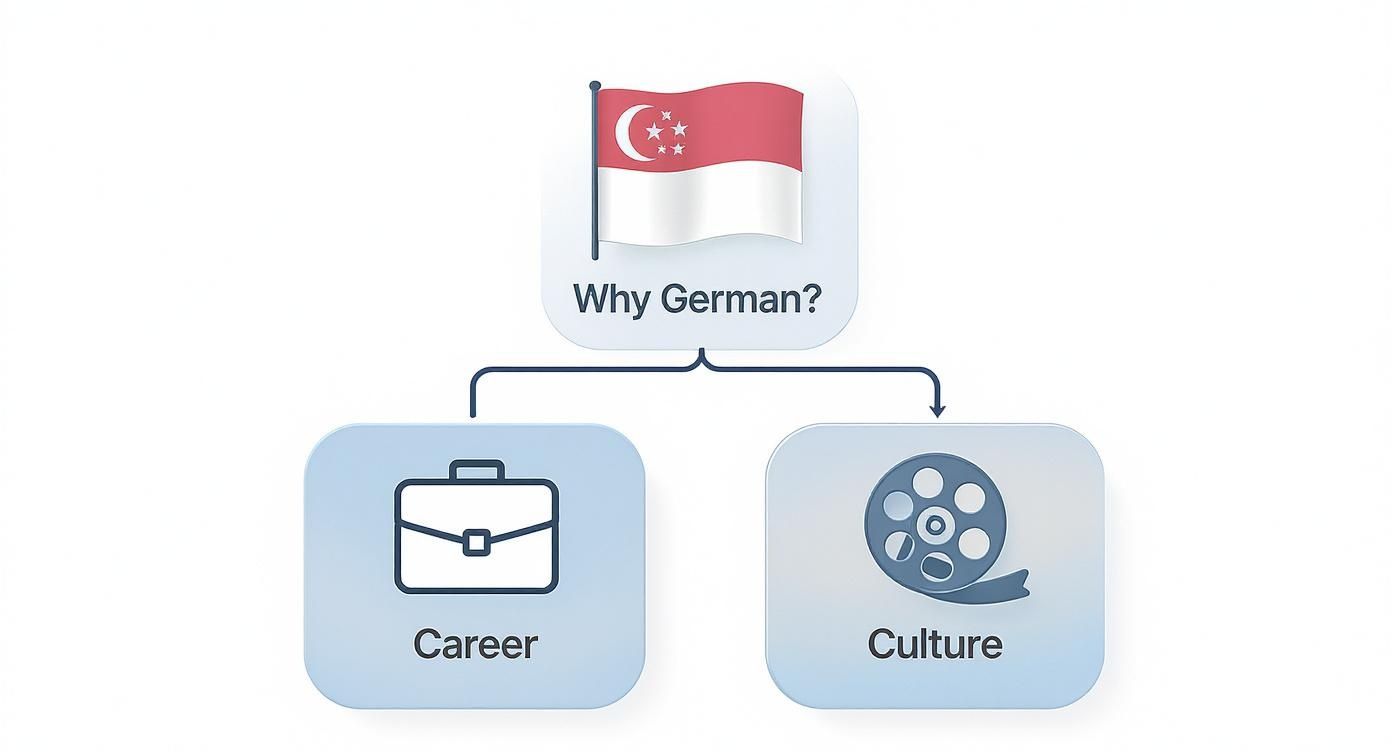
The image makes it clear that both professional growth and personal passion are huge motivators for learning German in Singapore. Ultimately, the best course is the one that slots neatly into your life and matches your goals. For learners who thrive on teamwork, a cohort-based course can be a fantastic choice, as it fosters a strong sense of community and shared accomplishment.
Where to Learn German in Singapore: Finding Your Perfect Fit

Choosing a language school is more than just picking a place to learn grammar; it's about finding a community and a teaching style that truly clicks with you. Luckily, Singapore has a great mix of options for learning German, from world-famous cultural institutes to top-notch university programmes. Each one brings its own unique flavour to the table.
If you're looking for the gold standard, the Goethe-Institut Singapore is hard to beat. As Germany's official cultural institute, it's the most recognised name in German language education worldwide. Their courses are built precisely around the Common European Framework of Reference for Languages (CEFR), so you can be sure your qualifications will be respected wherever you go.
But it’s not just about textbooks and exams. Learning at the Goethe-Institut is a full cultural immersion, with film screenings, exhibitions, and a fantastic library. It's the perfect choice if you want a certified, internationally recognised curriculum and a genuine connection to German culture.
University and International School Options
For those who prefer a more academic vibe, the National University of Singapore (NUS) offers German language modules through its Centre for Language Studies. These courses are known for their academic rigour and are often open to the public, not just NUS students.
You’ll also find excellent German education within international schools. The German European School Singapore (GESS), for instance, provides a comprehensive German curriculum, primarily for its K-12 students. Their impressive 100% pass rate for students following the Baden-Württemberg curriculum speaks to the high standard of German education available here.
For adult learners, NUS is particularly attractive because of government subsidies. With SkillsFuture Credit and the National Silver Academy (NSA), Singaporean citizens aged 50 and above can get up to a 50% fee reduction. You can learn more about the diverse German curriculum options in Singapore.
A Look at Your Options
Choosing the right German language provider in Singapore really comes down to your personal goals and learning style. To make it easier to see how the top contenders stack up, here’s a quick comparison.
Comparison of Top German Language Providers in Singapore
| Institution | Best For | CEFR Levels Offered | SkillsFuture Eligible |
|---|---|---|---|
| Goethe-Institut Singapore | Internationally recognised certification and cultural immersion. | A1–C2 | No |
| NUS Centre for Language Studies | Academically rigorous learning and government subsidies. | A1–B2 (varies) | Yes |
| Language Cul-ture | Personalised, small-group instruction. | A1–B2 | Yes |
| Learn German Singapore | Flexible scheduling and customised corporate training. | A1–C1 | No |
This table gives you a starting point, but remember to dig deeper into the specifics of each school to find the one that feels right for you.
Aligning Your Choice with Your Goals
Ultimately, your "why" should guide your "where." Are you planning to study in Germany and need an official certificate like the TestDaF? The Goethe-Institut is practically built for that purpose. Or are you a professional wanting to add a valuable skill to your resume? The structured, subsidised courses at NUS could be a perfect match.
The thought process for choosing a school is pretty similar no matter what language you're learning. For a more detailed breakdown, our guide on choosing a top language school in Singapore can help you structure your decision.
As you look into German lessons in Singapore, keep these key questions in mind:
- Curriculum and Certification: Does the school follow the CEFR? Can they prepare you for the specific exam you need to take?
- Teaching Philosophy: Do you prefer an immersive, culture-first approach or a more structured, academic method?
- Class Environment: What are the class sizes like? Is there a lively student community with events and activities?
- Financial Support: Is the school SkillsFuture eligible? This can make a huge difference to the overall cost.
By weighing these factors, you’ll find a place that doesn’t just teach you German, but also gives you an environment where you can truly thrive.
Breaking Down the Costs of German Lessons
When you first start looking into the German lessons Singapore has available, the big question is always the same: "How much is this going to set me back?" The truth is, the price can swing quite a bit depending on how you choose to learn. But it helps to stop thinking of it as just another expense and start seeing it as an investment in yourself.
A good way to look at it is like choosing a gym membership. A standard plan gives you access to all the equipment and group sessions, which is a lot like joining a group German class. But if you want a programme built just for you, you’d hire a personal trainer—that’s the equivalent of getting one-on-one private tuition.
Typical Price Ranges in Singapore
So, let's get down to the numbers to give you a clearer picture. These are general estimates, of course, as every language school has its own pricing structure.
-
Group Classes: This is usually the most wallet-friendly path. A beginner course package (think A1.1) will typically run you between S$350 and S$600. This fee generally covers a full term, which is about 20 to 30 hours of class time.
-
Private Tuition: If you're after a learning experience that's shaped entirely around your goals and pace, private lessons are unbeatable. You can expect to pay anywhere from S$70 to S$120 per hour. The hourly rate is higher, but the focused, personal attention often means you make progress much faster.
Getting the Most Bang for Your Buck
Framing the cost of German lessons as a long-term investment really puts the figures into perspective. You're not just paying to learn a new language; you're opening doors to real-world opportunities that can pay you back many times over.
For example, being fluent in German can give your career a serious boost, especially here in Singapore with its massive multinational corporate scene. The data shows that professionals who have German language certification find a lot more job opportunities waiting for them. Digging into how German proficiency impacts salaries reveals just how much your earning potential can increase, unlocking some pretty lucrative career paths.
The real value of learning German is what happens outside the classroom. It's an investment that pays dividends through career growth, higher income, and unforgettable cultural experiences.
To make this investment easier on your pocket, there are some smart strategies you can use. Many accredited language schools in Singapore are SkillsFuture eligible, which is fantastic news. It means you can use your credits to cover a big chunk of the course fees. Always double-check a school's status on the MySkillsFuture portal before enrolling.
It also pays to look out for package deals or early-bird discounts. Some schools will offer a better rate if you commit to several levels at once. If you’re serious about reaching a high level of fluency, this is an excellent way to save. A little forward planning and using the resources available can make your journey to learning German both effective and affordable.
How to Choose the Right German Class for You
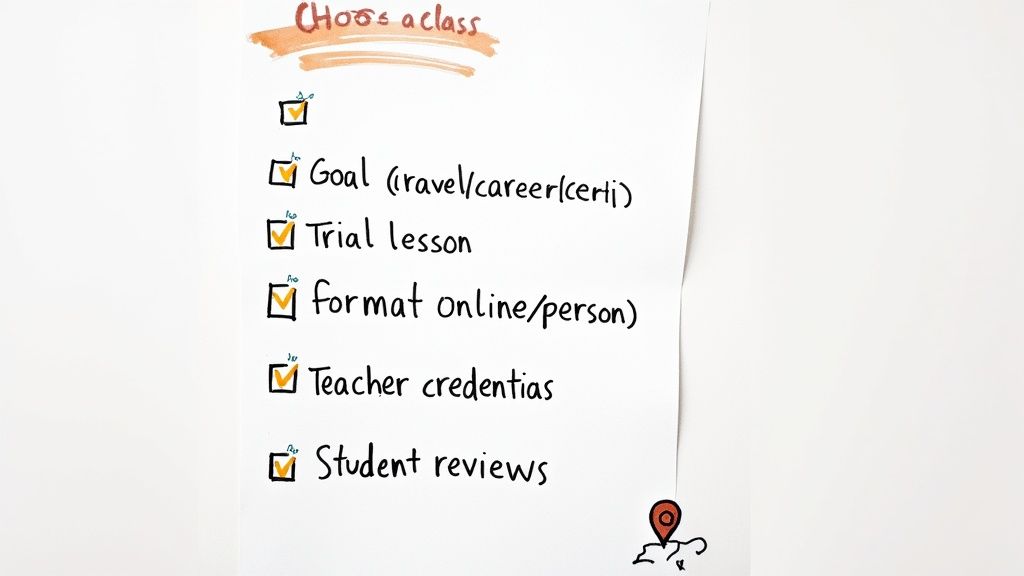
Picking the right German class feels a lot like choosing a travel buddy for a big trip. The right one can make the whole journey incredible, but the wrong one… well, that can just lead to a lot of frustration. With so many German lessons in Singapore, the trick is to find a class that genuinely clicks with your personal goals and the way you learn.
It all starts with one simple question: "Why do I want to learn German?" Your answer is your compass. It will guide every other decision you make.
Are you aiming for an official certificate like the TestDaF because you plan to study in Germany? Maybe you need to master business German to chat confidently with your colleagues in Munich. Or perhaps you're just doing it for the sheer joy of it, dreaming of ordering a coffee in Berlin.
Each of these reasons calls for a totally different kind of class. Someone heading to a German university needs a course that's laser-focused on grammar and exam prep. But if you're learning for travel, you'll get far more out of a class that’s all about conversation and culture. Be really honest with yourself here—getting this right will immediately help you filter out the options that aren't a good fit.
Define Your Learning Style and Logistics
Once you've sorted out your "why," it's time to figure out your "how." Think about how you actually learn best. Do you feed off the buzz of a group class, with plenty of people to practise with? Or do you need the undivided attention of a private tutor to really make progress?
Then, you need to get practical. Consider these key points:
- Pacing: Are you looking for a slow and steady once-a-week session, or do you want to dive in with an intensive course and see results fast?
- Location: Does the idea of a physical classroom in a convenient part of town appeal to you, or does the flexibility of online learning fit your hectic schedule better?
- Budget: What's your comfortable investment? Your budget will likely be a big factor in deciding between group classes and one-on-one tuition.
Answering these questions helps you build a clear picture of what your ideal learning setup looks like. This becomes your personal checklist, stopping you from getting tempted by a glossy brochure for a course that just won't work with your life.
Evaluate Schools and Instructors
With your personal checklist ready, you can start looking at schools and tutors with a sharp eye. Don't just skim the course descriptions on their websites; you need to dig a little deeper. A fantastic school isn't just about a solid curriculum—it’s about the teachers and the overall vibe.
A trial lesson is your best friend here. It’s a low-risk way to get a feel for a teacher's style, experience the classroom atmosphere, and see if the teaching method actually works for you before you sign on the dotted line.
As you do your research, keep an eye out for signs of quality. What are the instructors' credentials? Are they native speakers with proper teaching qualifications? Read detailed reviews from former students to get the real story. Understanding the intricacies of a tutoring business can also give you a better sense of what makes a language school professional and well-run.
By lining up your goals and learning style with some solid research, you'll find the perfect German lessons in Singapore to get you on the path to fluency.
Your Top Questions About Learning German in Singapore, Answered
Deciding to learn German is a big step, so it’s completely normal to have a few questions swirling around in your head. Getting straight, honest answers can make all the difference. Let’s dive into some of the most common things aspiring learners in Singapore want to know.
How Long Does It Really Take to Learn German?
This is the million-dollar question, and the true answer is, "it depends." While becoming truly fluent is a marathon, not a sprint, getting to a solid conversational level is a goal you can definitely reach.
To hit the B1 level on the CEFR scale—that’s where you can confidently handle most day-to-day chats and travel situations—you’re looking at roughly 400 to 600 hours of focused effort. That’s not just class time, but a mix of lessons, homework, and a bit of real-world practice. Things like daily practice or having learned another language before can definitely speed things up.
Are Online German Classes as Good as In-Person Ones?
The classic online vs. in-person debate! Online German lessons are fantastic for flexibility. They let you learn from home, fit lessons into a packed schedule, and connect with great teachers from anywhere. If you're a busy professional, this is often a lifesaver.
But there’s something special about in-person classes. The energy of a physical classroom, the immediate feedback, and the friendships you build with classmates can be incredibly motivating for some people.
Honestly, one isn't better than the other. The best format really comes down to your personality, your level of self-discipline, and the quality of the course itself.
Can I Use My SkillsFuture Credits for a German Course?
Yes, for many courses, you absolutely can! This is a brilliant way to make German lessons in Singapore much easier on your wallet. Many accredited language schools, including some programmes at NUS, are approved for SkillsFuture funding.
Before you sign up, always double-check the official MySkillsFuture portal to see if your chosen course is listed. It's a straightforward process to find the course and apply your credits, which can cover a good chunk of the fees. It's a fantastic resource for Singaporeans looking to pick up a new skill.
The trick is to look for courses that are officially registered and approved. A quick search on the portal before enrolling will give you a clear answer and help you sort out your budget.
Do I Need to Know Another Language to Learn German?
Not at all. This is a common myth that holds people back, but you can put that worry aside. Every good language school in Singapore has courses designed for total beginners, starting right from the A1 level. These classes are built on the assumption that you know zero German.
You'll start with the absolute basics—the alphabet, simple greetings—and build your skills from there. The best advice? Stay consistent, don't be afraid to make mistakes when you speak, and find fun ways to practice, like listening to German music. You could even start with some fun cultural phrases, like the different ways of wishing someone a happy birthday in German.
Ready to start your language adventure? At Spanish Council Singapore, we believe in making learning effective and enjoyable. While our expertise is in Spanish, we encourage and support every language learning journey.