
When you first start learning Spanish, one of the most useful things you can learn is how to ask someone how they're doing. The most direct translation for "how are you?" is ¿Cómo estás? for casual chats and ¿Cómo está usted? for more formal situations. It seems simple, but picking the right one is the secret to sounding natural and respectful right from the get-go.
The Most Common Ways to Ask How You Are
Asking someone how they are is the universal icebreaker, isn't it? It’s a simple way to open the door to a real conversation. In Spanish, however, this question comes with an important social layer you need to get right: the difference between formal and informal address.
Think of it like deciding whether to call someone by their first name or using "Mr." or "Ms." in English. One signals friendship and familiarity, while the other conveys respect. Nailing this choice is your first big win in sounding less like a textbook and more like a real person.
Understanding Tú vs Usted
At the heart of this difference are two little words: tú (the informal 'you') and usted (the formal 'you'). The one you choose changes the verb that comes after it.
- ¿Cómo estás? (using tú) is what you'd say to friends, family, people your age, or children. It’s warm and friendly.
- ¿Cómo está usted? (using usted) is saved for older people, your boss, a professor, or strangers you've just met. It’s polite and shows a bit of distance.
This might feel a little strange at first, but it becomes second nature with practice. For now, here’s a golden rule: when in doubt, it's always safer to be a little too formal (usted) than too casual (tú).
Pro Tip: Look closely at the verb: estás (with an 's' at the end) goes with the informal tú, and está (no 's') goes with the formal usted. This tiny detail makes a massive difference in politeness.
To help you decide on the fly, here’s a quick guide.
Choosing Your Greeting: Informal vs Formal
This table breaks down common scenarios to help you pick the perfect phrase.
| Context | Informal Phrase (Tú) | Formal Phrase (Usted) | When to Use |
|---|---|---|---|
| Friends & Family | ¿Cómo estás? | N/A | Use with people you know well and are close to. |
| Colleagues | ¿Cómo estás? | ¿Cómo está? | Depends on the workplace culture. Start formal and switch if they do. |
| Strangers | ¿Cómo estás? (if same age) | ¿Cómo está usted? | Default to usted for strangers, especially if they're older. |
| Authority Figures | N/A | ¿Cómo está usted? | Always use usted for bosses, professors, or officials. |
| Elders | N/A | ¿Cómo está usted? | It's a sign of respect to always use the formal address. |
Getting this right isn't just about grammar; it's about showing cultural awareness.
The phrase ¿Cómo estás? is a cornerstone of Spanish lessons all over the world. While you'll hear it often, its recognition in a multilingual hub like Singapore can depend on who you're talking to. You can learn more about the global reach of the Spanish language to see just how widespread it is. This first, simple choice of greeting really does set the tone for your whole conversation.
Navigating Social Rules Like a Pro
Figuring out whether to use the informal ‘tú’ or the formal ‘usted’ is much more than a simple grammar lesson. It's a window into your social awareness. Think of it like deciding whether to call your boss by their first name or stick with a more formal "Mr." or "Ms." Getting this right shows respect and a genuine grasp of Hispanic culture, which goes a long way in building a real connection.
Don't worry, picking the wrong one isn't the end of the world, but it can lead to a slightly awkward moment. Using the informal tú with an older person might come across as a bit cheeky, while using the formal usted with a close friend could make things feel unnecessarily stiff and distant. The trick is to match your language to your relationship and the situation you're in.
This simple flowchart breaks down the basic decision you'll make every time you ask someone how they are.
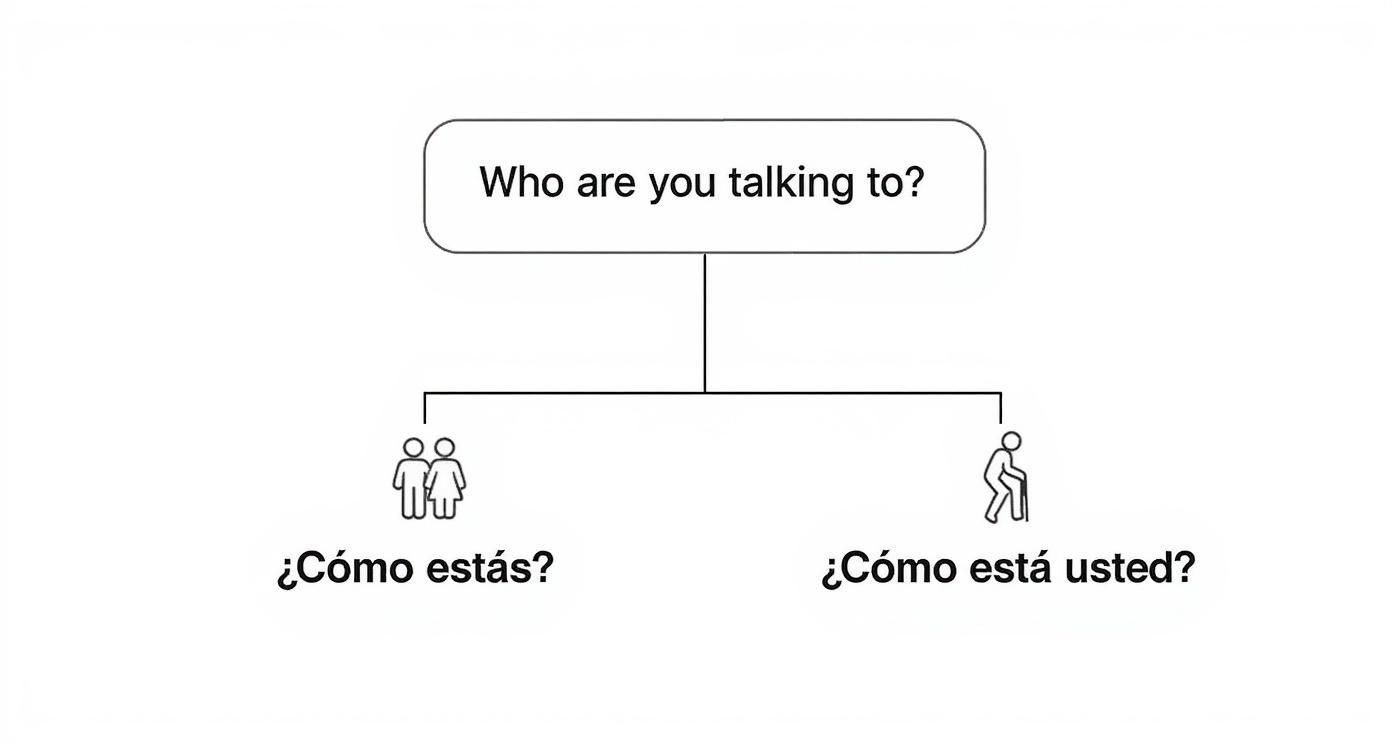
Ultimately, the person you’re speaking to is your guide. Let’s look at the specific situations where one form is clearly the better choice over the other.
When to Use Informal “Tú”
The informal path is your best bet for day-to-day interactions with people you know well. It’s the linguistic version of a relaxed smile or a friendly pat on the back.
You'll want to use ¿Cómo estás? in these common scenarios:
- Friends and Peers: This is for anyone you see as an equal, like a classmate, a colleague you're friendly with, or a friend of a friend.
- Family Members: This covers everyone from your parents and siblings to cousins and your own kids.
- Children and Teenagers: It's standard practice to address anyone younger than you with tú.
- Close Colleagues: In many modern offices, especially among teammates around the same age, tú is the norm. A good tip is to listen first and follow the lead of others.
When to Use Formal “Usted”
Choosing the formal ‘usted’ is a clear and powerful way to show respect. It’s non-negotiable in many professional settings and when speaking to people you don't know or who are in a position of authority.
Opt for ¿Cómo está usted? for these types of interactions:
- Elders: Always address anyone significantly older than you with usted as a sign of deference.
- Authority Figures: This includes your boss, a university professor, a police officer, or any government official.
- Strangers: When you meet someone for the first time, especially if they're older than you, usted is the safest and most polite choice.
- Professional Settings: In a formal business meeting or when speaking to a new client, usted helps maintain a professional boundary.
Key Insight: If you're ever in doubt, always default to usted. It’s far better to come across as overly polite than accidentally disrespectful. Most native speakers will quickly invite you to use tú if they feel comfortable doing so.
Sounding Natural with Casual Greetings
If you only ever use ¿Cómo estás?, it's a bit like sticking to "How do you do?" in English. Sure, it's grammatically correct, but it can feel a little stiff and formal, especially with friends. If you want to really connect with people and sound like you actually speak the language, you’ll need to pick up the casual, everyday phrases native speakers use.
Think of it this way: these phrases are different flavours of the same question. While ¿Cómo estás? is your trusty vanilla, other expressions add a bit of personality and warmth to your conversations. They signal that you've gone beyond just memorising a textbook and are making an effort to understand the culture.
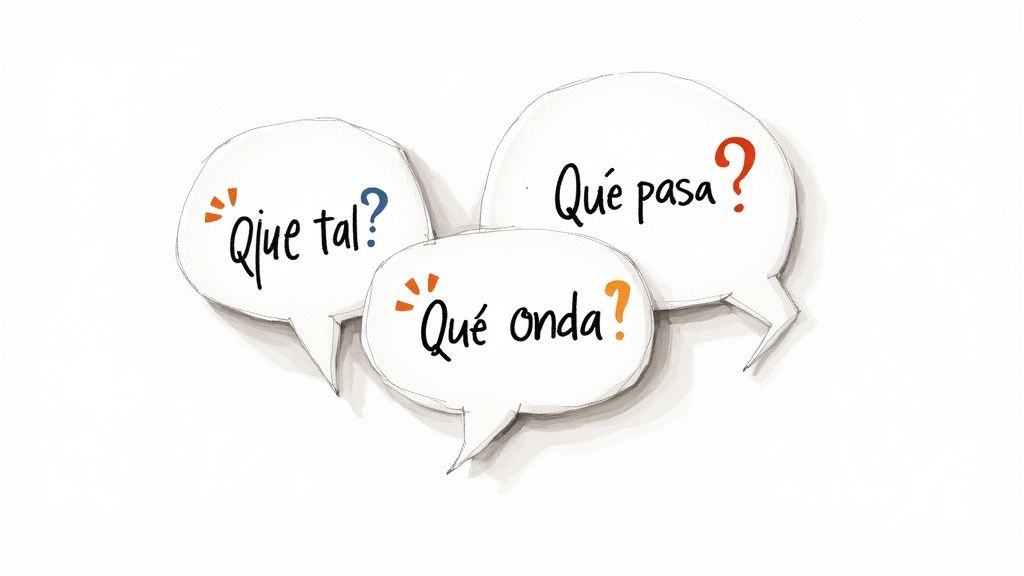
One of the most useful and common alternatives you'll hear is ¿Qué tal?. It's a fantastic, all-purpose greeting that fits into almost any informal situation you can think of.
Key Insight: While ¿Qué tal? literally translates to something like "How is it going?", it's used exactly like "What's up?" or a casual "How are you?". It’s friendly, relaxed, and perfect for friends, colleagues, or even a quick greeting in a shop.
Everyday Slang and Regional Favourites
Once you've got ¿Qué tal? down, you can start dipping your toes into more colloquial greetings. These can change a lot depending on the country, but a few are so common they're understood almost everywhere. Just remember, these are strictly for informal situations with people you know.
- ¿Qué pasa? – This literally means "What's happening?" and is a super common way to say "What's up?". You'll hear this among friends all over the Spanish-speaking world.
- ¿Qué onda? – A classic piece of Mexican slang that basically means "What's the vibe?". Though it screams Mexico, its coolness has caught on, and you'll hear it used by younger people in other regions too.
- ¿Todo bien? – Simply "All good?". It's a quick and easy way to check in on someone.
Figuring out when and how to use these phrases is all about listening and practice. There's no better way to get a feel for them than by actually talking to native speakers. Finding a local group is a great start, and there are plenty of options for a language exchange in Singapore that offer the perfect, low-pressure environment to try out your new greetings.
Answering Like a Native Speaker
Knowing how to ask "how are you" is only half the battle. The real magic happens when you can answer with confidence and then smoothly pass the conversational baton back. Moving beyond the textbook "Bien, gracias" ("Good, thanks") is your key to unlocking more natural and engaging chats.
Just like in English, your response can paint a whole picture of your mood. You don't have to be "great" all the time! Having a few different replies ready to go allows you to be more genuine, which makes your conversations feel far more authentic.
Different Ways To Respond
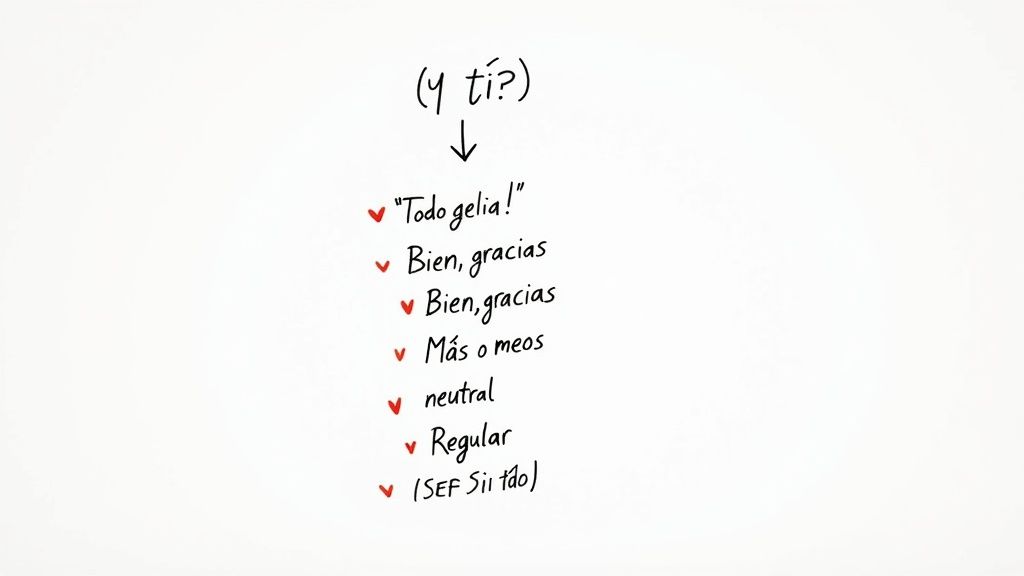
When someone asks how you're doing, your answer can range from fantastic to just plain okay. Here’s a quick look at some common responses you'll hear and can start using right away.
Common Responses and Their Nuances
| Spanish Response | English Translation | Level of Formality |
|---|---|---|
| Muy bien, gracias. | "Very well, thanks." | Universal (Formal/Informal) |
| ¡Todo genial! | "Everything's great!" | Informal |
| No me puedo quejar. | "I can't complain." | Informal |
| Más o menos. | "So-so." / "More or less." | Universal (Formal/Informal) |
| Ahí vamos. | "Getting by." | Informal |
| Regular. | "Okay." / "Fair." | Universal (Formal/Informal) |
These phrases give you the flexibility to be honest about your day, whether you're feeling on top of the world or just getting through it.
Notice how many of these replies relate to how you are at a particular moment. This is where the verb estar comes in. Getting comfortable with the full conjugation of estar is a huge advantage for expressing these temporary states and feelings.
The All-Important Follow-Up
Okay, you've shared how you are. Now what? The absolute most crucial next step is to return the question. Think of it this way: a conversation is a tennis match, and you have to hit the ball back over the net. Simply answering and stopping can feel a bit blunt or even self-absorbed.
Key Takeaway: Always ask back! It’s polite, shows you're interested in the other person, and keeps the conversation flowing. This simple habit is what separates a beginner from someone who can really connect with native speakers.
Your follow-up question just needs to match the level of formality of the original greeting.
- ¿Y tú? — "And you?" (Informal)
- ¿Y usted? — "And you?" (Formal)
Putting it all together, a simple, friendly exchange flows perfectly: "Muy bien, gracias. ¿Y tú?" This two-part rhythm—answer, then ask back—is the backbone of countless daily interactions all across the Spanish-speaking world.
Sounding Like a Local: Greetings and Pronunciation Across the Spanish-Speaking World
Think about how an English speaker from London sounds completely different to someone from Texas. Spanish works the same way. The greetings you hear will change dramatically as you travel from Madrid to Mexico City, and knowing these regional quirks is your ticket to sounding like a local. It’s a small detail that shows you’ve made a real effort to connect.
For instance, the super-casual ¿Qué onda? (literally, "What wave?") is pure Mexican slang. Sure, it’s understood in many places now thanks to TV and music, but using it on the streets of Cancún or Mexico City will get you an appreciative nod.
Travel south to Argentina, and the common ¿Cómo estás? is often replaced with ¿Cómo andás?. This is a classic hallmark of the River Plate dialect. To dive deeper into what makes Argentinian Spanish so unique, check out our guide on the language in Argentina.
Key Insight: Using local greetings is about more than just knowing slang; it's a sign of respect. It shows you appreciate the diversity within the Spanish-speaking world, which almost always leads to warmer, more authentic conversations.
These nuances matter everywhere, even in places you might not expect. In Singapore, for example, a significant 48.6% of Spanish speakers are young adults between 25-34. This is a group that’s often tuned into global culture and travel, making these small linguistic details even more relevant.
Getting the Pronunciation Right
Of course, sounding natural isn't just about what you say, but how you say it. The good news? Spanish pronunciation is often more predictable than English, especially when it comes to vowels.
Here are a couple of quick tips to focus on:
- Crisp, Pure Vowels: Spanish has five clean vowel sounds: A (like "ah"), E (like "eh"), I (like "ee"), O (like "oh"), and U (like "oo"). Unlike in English, they don't slide into other sounds. Practice saying them sharply.
- Softer Consonants: Listen for the 'd' sound in Spanish. When it's between two vowels (like in "cuidado"), it's much softer, almost like the 'th' in the English word "they". The 'b' and 'v' sounds are also nearly identical and much less forceful than their English counterparts.
Getting comfortable with these regional greetings is a practical skill that pays off. To really sharpen your ear and understand the subtle differences, learning how to translate a video from Spanish to English can be a fantastic way to hear and practise replicating the sounds of different dialects.
Frequently Asked Questions About Spanish Greetings
As you start using these Spanish greetings in the wild, you'll naturally run into a few common questions. This is where the textbook knowledge meets the real world. Let's clear up some of those lingering uncertainties so you can handle your conversations with a bit more confidence.
Getting these little details right is what separates someone who just knows the words from someone who actually knows how to use them. It’s all part of building that foundation for smooth, natural chats.
Is It Rude If I Forget to Ask Back?
In a word, yes. It can definitely come across as a bit impolite. Forgetting to return the favour with a quick ¿Y tú? or ¿Y usted? can make the conversation feel a little lopsided, like you're not really interested in the other person.
Think of it as the natural rhythm of a polite chat. Answering their question and then immediately asking it back is a small but crucial gesture that keeps the conversation flowing and shows you care.
What if I Use the Wrong Formality?
Honestly, don't sweat it. Mixing up tú and usted is one of the most common stumbles for anyone learning Spanish. Native speakers have seen it a million times and are usually very forgiving. They'll appreciate the fact you're making an effort in their language.
The golden rule here is: when in doubt, start with the formal usted. It's always safer to be a little too polite than too casual. If the other person is happy to switch to the more informal tú, they'll often signal it themselves.
Can I Just Say Hola Instead?
Of course! Hola is your all-purpose "Hello" and is a perfect way to kick things off. But adding a ¿cómo estás? or ¿qué tal? right after is what turns a simple greeting into the beginning of a real conversation.
In fact, it's very common to stick them together. You'll often hear:
- ¡Hola! ¿Qué tal? ("Hi! How's it going?")
- Hola, ¿cómo está usted? ("Hello, how are you?")
This combo is friendly and shows you're ready to engage. If you ever need to double-check other phrases or expressions on the fly, a good Spanish translation tool can be a real lifesaver. Learning how to properly ask "how are you" is a fantastic first step into the wider world of Spanish conversation.
At Spanish Council Singapore, we focus on building these practical conversational skills from day one. Our native teachers guide you through the nuances of Spanish culture and language, ensuring you learn to speak with confidence. Find out more about our beginner-friendly Spanish classes in Singapore.