How to Say Hi in Spanish Beyond Just a Simple Hola
If you only learn one word in Spanish, make it hola. It's the universal "hi" that works in pretty much any situation, from greeting a shopkeeper to meeting up with friends. Simple and effective.
To sound a bit more natural, you can easily pair it with a greeting for the time of day, like hola, buenos días. It’s a small touch that goes a long way.
Your Essential Spanish Greetings Cheat Sheet
Jumping into a new language always starts with that first "hello." While hola is your master key for unlocking any Spanish conversation, knowing the nuances of different greetings shows you're genuinely trying to connect. It's the difference between a generic wave and a warm, personal handshake.
This guide will walk you through the most practical phrases you can start using right away. We'll cover the essentials so you can greet anyone with confidence, whether you're at a casual coffee meetup or a formal business introduction.
Mastering the Core Greetings
In Singapore, while not as common as other languages, Spanish is definitely gaining traction. In fact, some local language schools reported that in 2023, around 3% of foreign language learners chose to pick up Spanish. For every single one of them, mastering hola is lesson number one.
This handy visual breaks down the three most crucial greetings you’ll need.
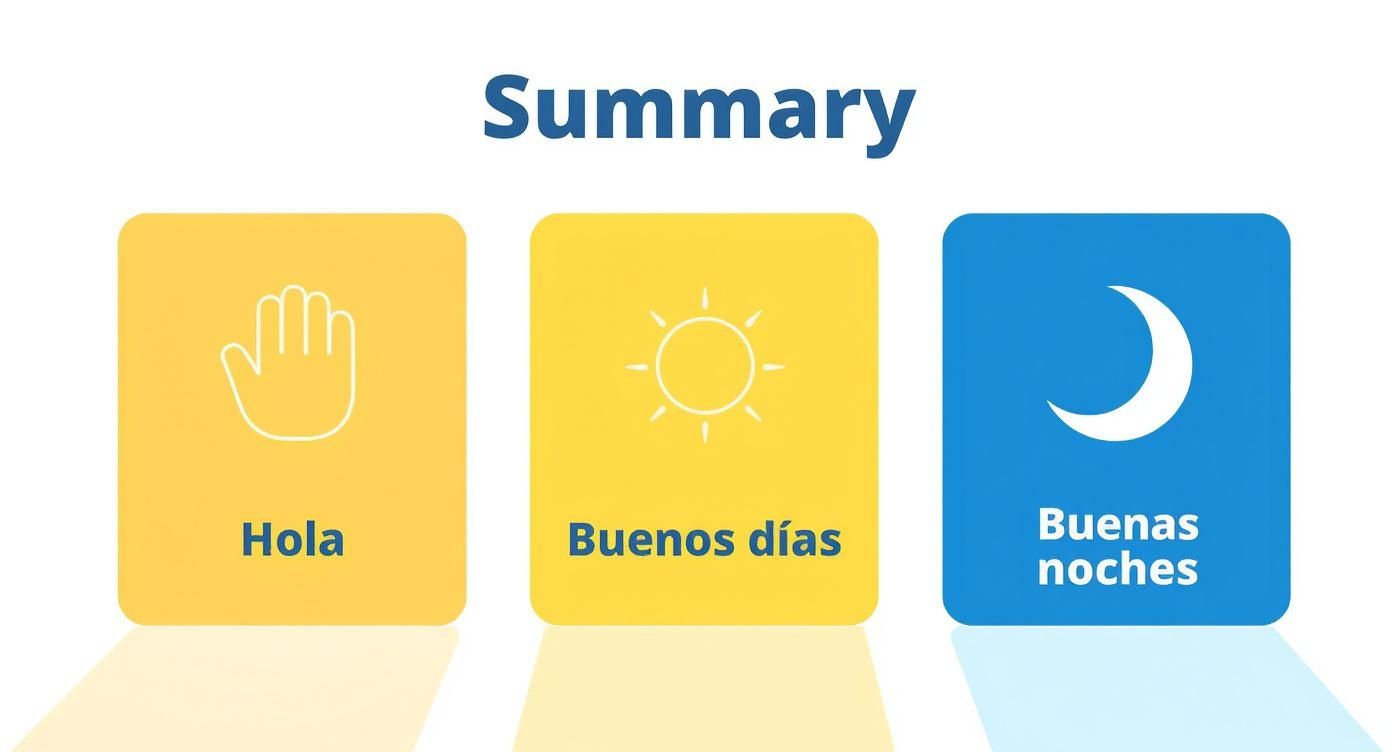
As you can see, hola is your all-purpose greeting, but using buenos días and buenas noches adds a nice touch of context and politeness.
Expert Tip: Using time-specific greetings like buenos días (good morning), buenas tardes (good afternoon), and buenas noches (good evening/night) is a super simple trick to make your Spanish sound more authentic and respectful.
Of course, after the initial greeting, the conversation usually flows into asking how someone is. To keep things moving smoothly, you’ll need the right follow-up phrases in your back pocket. For a deeper dive, check out our guide on the different ways to ask how are you in Spanish.
To make things even easier, here's a quick reference table with the absolute must-knows.
Quick Guide to Basic Spanish Greetings
This table sums up the core greetings, their meanings, and a little guidance on when to use them.
| Spanish Greeting | English Meaning | When to Use | Pronunciation Tip |
|---|---|---|---|
| Hola | Hello | Anytime, anywhere. Formal or informal. | The 'h' is silent, so it's "OH-la". |
| Buenos días | Good morning | From morning until noon. | "BWEH-nohs DEE-ahs". |
| Buenas tardes | Good afternoon | From noon until the evening (around 7-8 PM). | "BWEH-nahs TAR-dehs". |
| Buenas noches | Good evening / Good night | For greetings in the late evening or when saying goodbye for the night. | "BWEH-nahs NO-chehs". |
| ¿Qué tal? | How's it going? | Informal, with friends or people you know well. | "keh TAL". |
Keep this little cheat sheet handy, and you'll be greeting people like a local in no time.
Navigating Casual Conversations Like a Local
Alright, you’ve got the basics down. Now, let’s get you sounding less like you’re reading from a textbook and more like you’ve been chatting with locals for years. The key is knowing which casual phrases to pull out with friends, family, and people your own age.
These aren't just words; they're the glue for friendly, everyday chats. Using them shows you're relaxed and genuinely want to connect, moving past just the polite essentials.
Your Go-To Casual Greetings
In a real conversation, a simple hola is just the opening line. What comes next is what makes it feel natural. Following up with a friendly check-in is what native speakers actually do.
Think of these phrases as your secret weapons for sounding authentic:
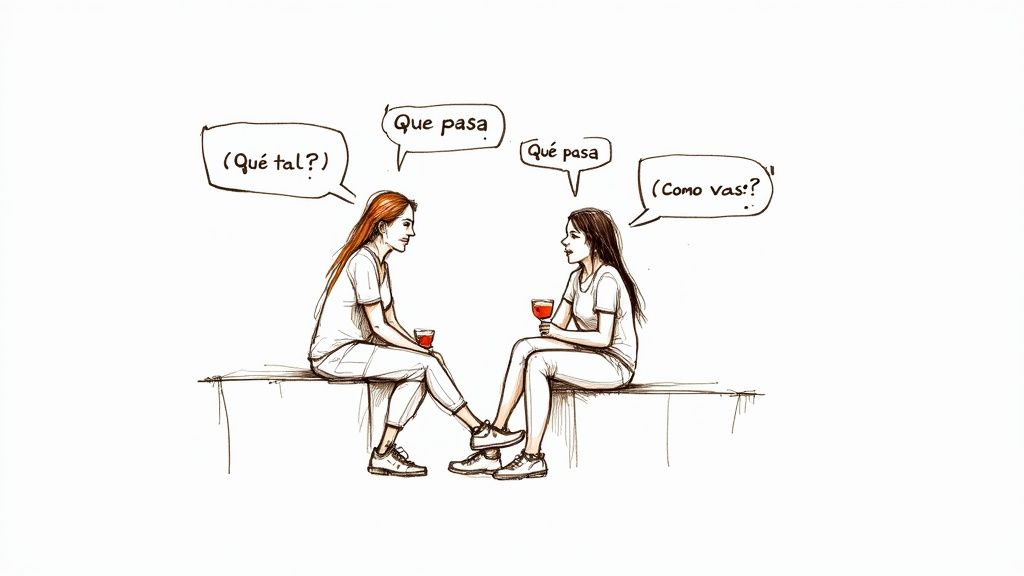
- ¿Qué tal? (keh TAL) – This is your all-purpose, can't-go-wrong greeting. It's the perfect equivalent of "How's it going?" or "What's up?" and fits almost any informal scenario you can think of.
- ¿Qué pasa? (keh PAH-sah) – A bit more laid-back, this one literally means "What's happening?" It’s the kind of thing you'd say to a close friend, just like you’d use "What's up?" or "What's good?" in English.
- ¿Cómo vas? (KOH-moh bahs) – I love this one. It translates to "How are you doing?" but has a really warm, personal feel. It’s a great way to show you actually care about how the other person is doing.
Real-World Dialogue: Picture this: you run into a friend at a café.
You: "¡Hola, Ana! ¿Qué tal?"
Ana: "¡Todo bien! ¿Y tú? ¿Cómo vas?" (All good! And you? How are you doing?)
See how the conversation bounces from one casual phrase to another? That easy, natural exchange is exactly what makes your Spanish feel real and helps you build a genuine rapport.
Mastering Formal Greetings for Professional Respect
Whether you're meeting someone for the first time, speaking with an older person, or navigating a professional setting, your choice of greeting matters. It’s the first signal of respect you send, and it can set the tone for the entire conversation. While you might use casual phrases with friends, formal situations call for a different toolkit.
Your go-to greetings here will always be tied to the time of day: Buenos días (Good morning), Buenas tardes (Good afternoon), and Buenas noches (Good evening). Think of these as your trusted essentials for showing politeness and cultural sensitivity.
Using Usted for Ultimate Respect
The most significant switch you'll make between informal and formal Spanish lies in a single word. You'll drop the casual tú (you) and instead use the formal usted (you). It’s a small change with a huge impact, immediately dialling up the respect in your tone.
This means that when you ask someone how they are, you’ll say, ¿Cómo está usted? instead of the more familiar ¿Cómo estás? This is crucial in business meetings, when talking to your boss, or simply addressing someone you've just met.
A Pro Tip: When in doubt, always start with usted. It's much safer to be a little too formal than to come across as overly familiar. If the other person wants to switch to the more casual tú, they’ll let you know.
This is especially true in Singapore's diverse business world, where proper etiquette is key. When I'm coaching professionals who work with Spanish-speaking partners, I always stress combining Hola with a formal follow-up, like Buenos días, ¿cómo está usted? It’s not surprising that over 70% of Spanish conversational classes in Singapore have dedicated lessons on this formal-informal divide. It really is that important. If you want to dive deeper, you can find more insights about Spanish greetings that build on this foundation.
Putting It All Together in a Professional Scenario
Let’s walk through a quick, realistic example. Imagine you have a morning meeting with a new client, Sra. Garcia. Here’s how you can make a brilliant first impression:
- You: Buenos días, Sra. Garcia. Es un placer conocerla. (Good morning, Mrs. Garcia. It's a pleasure to meet you.)
- Sra. Garcia: Buenos días. El placer es mío. (Good morning. The pleasure is mine.)
- You: ¿Cómo está usted? (How are you?)
This short and simple exchange is perfect. It's professional, respectful, and clearly shows you understand the cultural nuances of formal Spanish. It tells them you’ve taken the time to learn.
Exploring Regional Greetings Across the Spanish-Speaking World
While hola will get you by just about anywhere, the real fun begins when you dive into the regional flavours of Spanish. Just like an English speaker might say "howdy" or "g'day," Spanish is packed with vibrant, local slang that helps you sound less like you're reading from a textbook and more like you actually belong.
Nailing these local phrases is a brilliant way to show you’ve done your homework. It tells people you're not just learning the language, but you're also genuinely interested in their culture. For instance, walk around Spain and you’ll inevitably hear friends call out to each other with a laid-back ¿Qué pasa, tío/tía? – which is basically their way of saying, "What's up, dude?".
A Quick Tour of Latin American Hellos
Once you cross the Atlantic, the greetings shift dramatically. Every country has its own unique twist on saying hello, each one a little reflection of its own culture and history. It's a fascinating thing to experience firsthand.
Here are a few you'll almost certainly come across on your travels:
- Mexico: The classic, cool way to greet someone is ¿Qué onda? It literally means "What wave?", but think of it as their version of "What's the vibe?".
- Argentina: You'll spot an Argentine a mile away when you hear ¿Che, cómo andás? The word "Che" is pure Argentina. To get a better handle on this, check out our guide on the distinctive language of Argentina.
- Colombia: A super common and friendly greeting is ¿Quiubo?, which is just a quick, snappy contraction of the more formal ¿qué hubo? (what was there?).
- Chile: Over in Chile, they have their own unique way of conjugating verbs, so you’ll hear ¿Cómo estai? all the time.
This growing interest in a more authentic, conversational Spanish isn't just a traveller's trend. Here in Singapore, data from the National University of Singapore shows a 37% increase in Spanish course enrolments between 2018 and 2024. The focus is increasingly on practical speaking skills, starting right from these essential greetings. You can also find more useful Spanish phrases in South America on onmycanvas.com.
A Quick Tip on Using Slang: As a learner, my best advice is to listen first. Get a feel for how and when locals your age use these phrases in casual situations. Dropping a ¿qué onda? at the right moment can be a great icebreaker, but using it in the wrong context might just get you a funny look. It’s all about timing
Getting the Sound and Feel Just Right
https://www.youtube.com/embed/3xoPNXnu05o
Knowing the right words to say is only half the battle. How you actually say them—your pronunciation and even your body language—is what truly makes you sound like you know what you're doing.
The good news? Spanish pronunciation is generally more consistent than English. Nail a few key sounds, and you'll immediately sound more natural when you greet someone.
Fine-Tuning Your Pronunciation
Let's start with a classic beginner's mistake. The 'h' in hola is completely silent. Always. It sounds like "OH-la," not "HO-la." Getting this right is a small change that makes a huge difference.
Another tip is to keep your vowels short and crisp. The 'o' in hola or buenos is a clean "oh" sound, not a long, drawn-out "ohww" like we often use in English.
Here are a few other sounds to be mindful of:
- Pure Vowels: This is a big one. Think of them as pure sounds: A is 'ah,' E is 'eh,' I is 'ee,' O is 'oh,' and U is 'oo.' No gliding between sounds.
- The Single 'R': Don't get too stressed about the famously rolled 'rr' for now. The single 'r' you find in a word like tardes is much softer, almost like a 'd' sound in English (think of the 'tt' in "butter").
- The 'LL' and 'Ñ' Sounds: The double L, or 'LL', usually sounds like the 'y' in "yes." The 'Ñ' (that squiggle is called a tilde) is the 'ny' sound you hear in the word "canyon."
Mastering these little nuances is what separates a beginner from someone who's comfortable with the language. If you want a fun way to practise, try some Spanish tongue twisters for kids—they're great for drilling these specific sounds.
It's Not Just What You Say, But What You Do
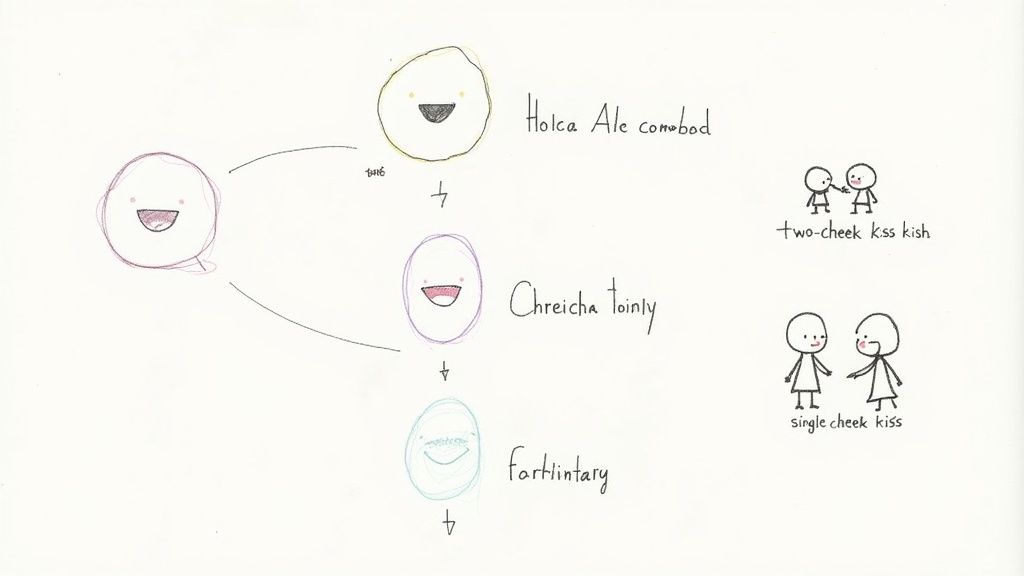
Greetings in Spanish-speaking cultures often feel a bit warmer and more physical. In Spain, it’s very common for women, or for a man and a woman, to greet each other with two light kisses on the cheeks, starting with the right cheek.
Across most of Latin America, this is simplified to just a single cheek kiss.
Of course, in any formal or professional setting, a firm handshake is the universal go-to. Being aware of these small customs shows respect and helps you connect on a deeper level.
If you’d like to get some instant feedback on your pronunciation, you can practice your Spanish with an AI teacher to really nail those greetings.
Common Questions About Spanish Greetings Answered
Once you start trying out your new Spanish phrases, you'll inevitably run into a few tricky situations. It's completely normal. Nailing these little details is what separates a hesitant beginner from a confident speaker.
We've pulled together some of the most common questions we hear from our students to help clear things up. Let's get them sorted so you can spend less time second-guessing and more time chatting.
Can I Just Use Hola in Every Situation?
Absolutely. If you only remember one greeting, make it hola. It's your foolproof, all-purpose hello that works in any context, from a formal business meeting to bumping into a friend at the supermarket. You can't go wrong with it.
That said, if you want to sound more natural and show you’ve got a real feel for the language, it’s a great idea to expand your repertoire. Adding buenos días to your hola in the morning adds a nice touch of politeness. Swapping it for ¿qué tal? among friends shows you're comfortable and relaxed.
What Is the Biggest Mistake Learners Make?
One of the classic tell-tale signs of a beginner is mixing up the time-of-day greetings. Saying buenos días at 7 p.m. is a common slip-up. Just burn this into your memory: buenos días for the morning, buenas tardes for the afternoon, and buenas noches for the evening.
Another pitfall is using super casual slang, like ¿qué onda?, in a professional environment. What sounds cool and friendly with mates can come across as unprofessional or even a bit disrespectful to a potential client or your boss.
Key Takeaway: When in doubt, err on the side of politeness. You can always dial down the formality if the other person uses a more casual tone, but it's much harder to recover from being too familiar.
How Do I Respond When Someone Greets Me?
This is simpler than you think! The golden rule is to mirror the greeting you receive. It keeps the exchange balanced and helps you transition smoothly from a simple "hello" into a real conversation.
Here’s a quick cheat sheet for your responses:
- If they say a simple "¡Hola!", a friendly "¡Hola!" right back is all you need.
- For a casual "¿Cómo estás?" or "¿Qué tal?", the standard reply is "Bien, gracias, ¿y tú?" (Good, thanks, and you?).
- If you're greeted with a formal "¿Cómo está usted?", match it with "Bien, gracias, ¿y usted?".
Having these ready to go will make your interactions feel much more effortless.
At Spanish Council Singapore, we believe that true confidence comes from building a solid foundation. Our native teachers foster a friendly, supportive space where asking questions is encouraged, allowing you to practise real-world Spanish from day one. Find out more about our personalised courses for all ages.