
Embarking on a journey to learn a new language is always an adventure, but some paths are undeniably steeper than others. What truly makes a language difficult for a native English speaker? It's a complex blend of unfamiliar scripts, intricate grammatical cases, tonal nuances, and sentence structures that challenge our fundamental understanding of communication. This guide provides a detailed look into some of the hardest languages to learn, basing our analysis on linguistic distance from English, grammatical complexity, and the estimated hours required for fluency as defined by diplomatic and linguistic institutions.
This article goes beyond a simple list. For each language, from Mandarin to Basque, we will dissect the specific elements that contribute to its renowned difficulty. You'll learn about Mandarin's critical tonal system, Japanese's three distinct writing scripts, and Finnish's labyrinthine case system. More importantly, we provide actionable tips and practical strategies tailored to help you navigate these unique linguistic hurdles.
Whether you're a curious polyglot, a professional in Singapore seeking a new skill, or a parent considering language options for your child, this roundup offers the insights you need. We'll examine the unique challenges and surprising advantages of each language, providing a clear roadmap for the dedicated learner. If you're ready to test your linguistic limits and understand what it takes to master these complex systems, let's explore the Mount Everests of language learning.
1. Mandarin Chinese
Often topping lists of the world’s hardest languages to learn, Mandarin Chinese presents a unique set of challenges for English speakers. Its reputation for difficulty is well-earned, stemming from three core components that are fundamentally different from most European languages.
First is its tonal system. Mandarin has four main tones (plus a neutral tone), where the pitch contour of a syllable changes its meaning entirely. For example, mā (媽, high-level tone) means "mother," while mǎ (馬, falling-rising tone) means "horse." Mastering these tones requires a keen ear and precise vocal control, a skill that is non-negotiable for comprehension. Given the unique tonal nature of Mandarin, it's interesting to consider the challenges Chinese speakers face when learning English pronunciation, which lacks this feature.
Second is the logographic writing system. Instead of an alphabet, Mandarin uses characters (漢字, hànzì), each representing a word or concept. To achieve literacy, you must memorise thousands of these intricate characters. Unlike alphabetic systems where you can sound out a word, you cannot guess a character's pronunciation from its appearance alone.
Finally, while its grammar is simpler in some ways-lacking verb conjugations and noun declensions-its structure and logic are distinct from English, relying heavily on word order and context.
Actionable Tips for Learners
For professionals in Singapore aiming to work with mainland Chinese firms or diplomats preparing for a posting in Beijing, a structured approach is crucial.
- Prioritise Tones Immediately: Use apps like Tone Pair to train your ear from day one. Mimic native speakers and record yourself to compare your pronunciation.
- Use Spaced Repetition Systems (SRS): For memorising characters, tools like Anki are indispensable. They optimise your study time by showing you characters right before you forget them.
- Start with Pinyin: Begin by learning Hanyu Pinyin, the official romanisation system. It provides a solid phonetic foundation and helps bridge the gap between spoken and written Chinese. Learn more about how to improve in Chinese.
- Immerse Yourself: Listen to Mandopop, watch Chinese dramas (C-dramas) with subtitles, and tune into podcasts. This helps internalise the natural rhythm and flow of the language.
2. Japanese
Often considered one of the hardest languages to learn for English speakers, Japanese presents a formidable challenge due to its intricate writing systems and grammatical structure, which are entirely different from Indo-European languages. Its reputation is built on three pillars of difficulty that require dedicated, long-term study.
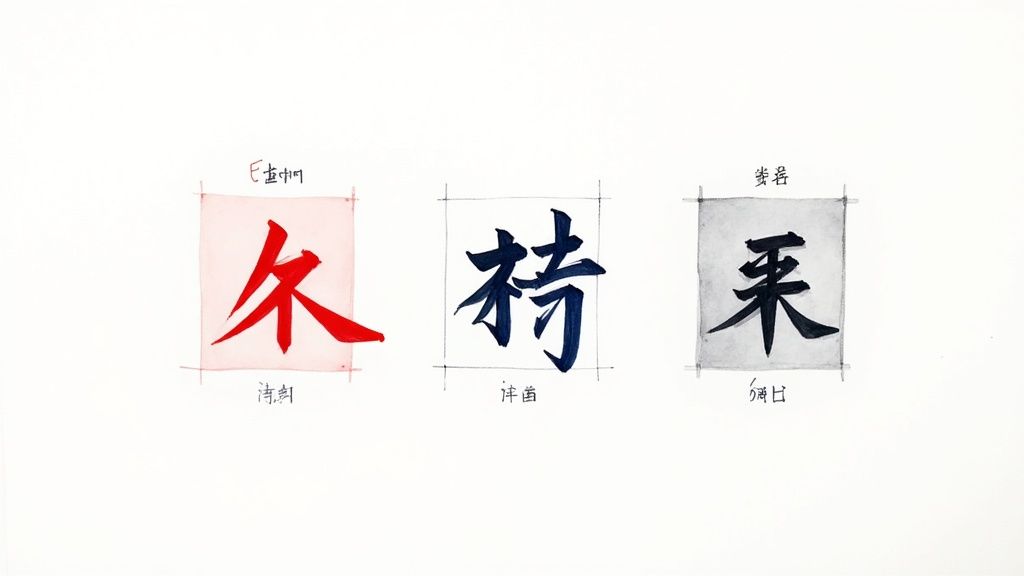
First is the complex triple writing system. Japanese uses three distinct scripts simultaneously: Hiragana (for grammatical endings and native words), Katakana (for foreign loanwords and emphasis), and Kanji (logographic characters borrowed from Chinese). To achieve functional literacy, learners must master both phonetic syllabaries (Hiragana and Katakana) plus at least 2,000 kanji.
Second, Japanese grammar follows a Subject-Object-Verb (SOV) structure, a complete reversal of English's SVO order. This requires a fundamental rewiring of sentence construction logic. The language also relies heavily on particles (e.g., は, が, を) to define the grammatical role of words, a concept with no direct English equivalent.
Finally, the extensive system of honorific speech (敬語, keigo) adds another layer of complexity. The words and verb conjugations you use change dramatically depending on your social relationship with the person you are speaking to, demanding a deep understanding of social context and hierarchy.
Actionable Tips for Learners
For anime enthusiasts wanting to engage with the culture more deeply or tech professionals relocating to a Japanese multinational, a methodical approach is key.
- Master Hiragana and Katakana First: Before touching kanji, dedicate two to four weeks to memorising the two phonetic scripts. They are the building blocks for pronunciation and grammar.
- Learn Kanji with Radicals: Instead of memorising kanji as pictures, learn their component parts (radicals). This reveals patterns and makes it easier to guess the meaning and pronunciation of new characters. Use apps like WaniKani or Kanji Study.
- Focus on Particles Early: Particles are the glue of Japanese sentences. Understand their functions from the beginning to build a strong grammatical foundation.
- Immerse in Keigo Context: Watch interviews, business dramas, or formal news broadcasts to see honorific language used naturally. This provides context that textbooks often lack. For those looking for a structured way to start, exploring online Japanese classes can provide a guided pathway.
3. Korean
Often seen as an intriguing middle ground in Asian language difficulty, Korean offers English speakers a unique mix of deceptive simplicity and profound complexity. Its reputation as one of the hardest languages to learn is built not on a difficult writing system, but on a grammatical framework that is fundamentally alien to speakers of Indo-European languages.
First is its grammar and sentence structure. Korean follows a Subject-Object-Verb (SOV) order, which requires a complete rewiring of how English speakers construct sentences. The language also relies heavily on particles, small grammatical markers attached to nouns and pronouns to indicate their role (e.g., subject, object). Mastering their nuanced use is a significant, long-term challenge.
Second is its system of speech levels and honorifics. Korean has intricate levels of formality embedded directly into its verb conjugations and vocabulary. Choosing the correct ending depends on the age, social status, and relationship to the person you are addressing. This social-linguistic complexity is a constant consideration in every conversation.
The major advantage, however, is the alphabet, Hangul (한글). Created in the 15th century, it is a highly scientific and phonetic system where letters mimic the shape of the mouth when making the sound. Most learners can master reading and writing Hangul within a few hours.
Actionable Tips for Learners
For K-pop and K-drama fans seeking deeper engagement or professionals working in Korean corporations, a targeted learning strategy is key.
- Master Hangul Immediately: This is your biggest advantage. Dedicate your first few study sessions to learning the alphabet. Being able to read (even without understanding) makes the language far less intimidating.
- Focus on Speech Levels Early: Learn the formal polite (-ㅂ니다/습니다) and informal polite (-아요/어요) verb endings from the beginning. These two levels will cover most of your daily interactions.
- Use K-dramas for Natural Speech: Watch dramas with Korean subtitles. Pay close attention to how particles are used and how sentence intonation works in practice. This provides vital context that textbooks often lack.
- Systematically Study Particles and Verbs: Use tools like Anki to create flashcards specifically for verb conjugations and the various grammatical particles. Their functions are core to building correct sentences. You can discover more ways to start learning simple Korean.
4. Arabic
Renowned for its intricate beauty and historical significance, Arabic presents a formidable challenge for English speakers, solidifying its place as one of the hardest languages to learn. Its difficulty stems from a combination of a non-Latin script, complex grammar, and a fundamental linguistic feature known as diglossia, where the formal written language differs significantly from the spoken dialects.

First, the right-to-left script and its cursive, connected letters require a complete rewiring of a learner's reading and writing habits. The alphabet contains several guttural sounds and emphatic consonants that have no equivalent in English, demanding meticulous phonetic practice.
Second is Arabic’s root-based morphology. Most words are derived from a three-letter root that carries a core meaning. For example, the root k-t-b (ك-ت-ب) relates to writing, forming words like kitāb (كتاب, book), kātib (كاتب, writer), and maktab (مكتب, office/desk). Mastering this system is key but requires a different way of thinking about vocabulary.
Finally, the biggest hurdle is diglossia. Learners must decide whether to study Modern Standard Arabic (MSA), the formal language of news and literature, or a colloquial dialect like Egyptian or Levantine for daily conversation. These are often not mutually intelligible, effectively forcing learners to master two distinct linguistic systems to become fully proficient.
Actionable Tips for Learners
For professionals like diplomats preparing for a post in the Middle East or international development workers, a strategic approach is essential. A US military intelligence officer, for instance, would need to prioritise a specific regional dialect over formal MSA.
- Choose Your Focus Early: Decide between MSA for formal communication or a specific dialect (e.g., Levantine, Egyptian, Gulf) for conversational fluency. Your goals will determine this path.
- Master the Alphabet Immediately: Dedicate your initial study time to learning the Arabic script and its unique sounds. Practice writing from right to left consistently until it feels natural.
- Leverage Root Charts: Use visual aids and charts to understand how word families are built from three-letter roots. This will dramatically accelerate your vocabulary acquisition.
- Immerse in Authentic Media: Listen to Arabic music, watch broadcasts from channels like Al Jazeera, and follow dialect-specific TV series to train your ear to the language’s natural rhythm and flow.
5. Finnish
Finnish stands out as one of Europe’s most linguistically isolated languages, presenting a significant learning curve for English speakers. As a member of the Finno-Ugric family, it shares almost no vocabulary or grammatical structure with the Indo-European languages that dominate the continent, making it one of the hardest languages to learn without familiar reference points.

The first major hurdle is its complex agglutinative grammar. Finnish constructs words by "gluing" multiple suffixes onto a root word to convey meaning, often creating extremely long words that would require a full sentence in English. For example, kahvinjuojakin means "the coffee drinker, too."
Secondly, its case system is notoriously extensive. While English relies on prepositions like "in," "on," or "from," Finnish uses 15 grammatical cases, modifying the endings of nouns to show their function in a sentence. Mastering when and how to apply each case ending is a monumental task for learners.
Finally, concepts like vowel harmony add another layer of difficulty. Vowels are divided into groups (front, back, neutral), and all vowels within a single word must belong to the same group. This phonological rule dictates which suffixes can be attached to a word, requiring learners to develop a new kind of phonetic intuition.
Actionable Tips for Learners
For technology professionals moving to Helsinki's vibrant startup scene or academics studying Finno-Ugric linguistics, a systematic approach is essential.
- Tackle Cases Systematically: Create visual charts or mind maps that group the 15 cases by function (e.g., location, possession). Focus on mastering one case at a time with extensive practice before adding another.
- Deconstruct Agglutinative Words: When you encounter a long Finnish word, practise breaking it down into its root and individual suffixes. This turns a memorisation challenge into a logical puzzle.
- Drill Vowel Harmony: Use language apps that have specific exercises for vowel harmony. Listen to native speakers on Finnish media like Yle (Finnish Broadcasting Corporation) and mimic their pronunciation patterns to internalise the rules.
- Use Spaced Repetition for Vocabulary: Since few words are related to English, tools like Anki are crucial for building a strong vocabulary from scratch. Include full phrases in your flashcards to learn case usage in context.
6. Hungarian
Often cited as one of Europe’s most formidable linguistic challenges, Hungarian solidifies its place on any list of the hardest languages to learn. Its difficulty for English speakers stems from its complete isolation from the Indo-European family tree, meaning there are virtually no familiar cognates or grammatical structures to lean on.
First, Hungarian is an agglutinative language. This means it forms complex words by "gluing" multiple suffixes and prefixes onto a root word to convey grammatical information. Where English uses separate words like "in my beautiful houses," Hungarian might express this with a single, long word like szép házaimban.
Second, its grammatical case system is notoriously complex. While English relies on word order and prepositions, Hungarian uses between 18 and 20 cases to define a noun's role in a sentence. For instance, the word ház ("house") can become házban ("in the house"), házból ("from the house"), or házhoz ("to the house"), requiring learners to memorise a vast array of endings for every noun.
Finally, its grammar includes features absent in English, such as vowel harmony, where vowels within a word must belong to the same class (front or back). This rule affects which suffixes are used, adding another layer of complexity to its already demanding structure.
Actionable Tips for Learners
For expatriates relocating to Budapest or academics studying Finno-Ugric systems, a methodical approach is key to untangling Hungarian's complexities.
- Tackle Cases Systematically: Don't try to learn all 18-20 cases at once. Start with the most frequently used ones, like the accusative (-t) and dative (-nak/-nek). Create tables or charts to visualise how nouns change with different case endings.
- Embrace Agglutination Early: Practice building long words by adding one suffix at a time. This helps you deconstruct and understand complex words when you encounter them.
- Focus on Verb Conjugations: Hungarian verbs have definite ("I see the apple") and indefinite ("I see an apple") conjugations. Pay close attention to this distinction from day one, as it is fundamental to constructing correct sentences.
- Immerse with Hungarian Media: Watch Hungarian films and listen to music to get a feel for the language's unique rhythm and vowel harmony. Use platforms like Forvo to hear native speakers pronounce difficult words.
7. Icelandic
While many Scandinavian languages simplified over the centuries, Icelandic stands apart as a linguistic time capsule, preserving much of the complexity of Old Norse. This makes it a fascinating but formidable challenge for English speakers, earning its spot among the hardest languages to learn due to its archaic grammar and intricate inflectional system.
First is its robust case system. Icelandic uses four grammatical cases (nominative, accusative, dative, genitive) that affect nouns, pronouns, adjectives, and numerals. Unlike in English, where word order primarily dictates meaning, Icelandic uses case endings to show a word's function in a sentence. Mastering these declensions is a significant memory-based hurdle.
Second is the concept of three grammatical genders. Every noun is either masculine, feminine, or neuter, and this gender dictates the form of accompanying adjectives and articles. This system, largely absent in modern English, adds another layer of rules that learners must internalise for every single noun.
Finally, its complex verb conjugations and largely unfamiliar vocabulary, which has resisted foreign loanwords, mean that learners have very few cognates or grammatical shortcuts to rely on. The language demands a systematic and dedicated approach to grammar from the very beginning.
Actionable Tips for Learners
For literature enthusiasts studying the original Norse sagas or expats looking to integrate into Icelandic society, mastering this ancient grammar is key.
- Tackle Case Endings Systematically: Create and study declension tables. Visualising how nouns, adjectives, and articles change across the four cases helps tremendously with memorisation.
- Prioritise Gender Agreement: When learning a new noun, always learn its gender. Practise creating short phrases to reinforce the correct adjective endings, for example, stór hestur (a big horse, masc.), stór bók (a big book, fem.), and stórt hús (a big house, neut.).
- Embrace Icelandic Media: Immerse yourself by listening to music from artists like Sigur Rós or watching programmes on RÚV, Iceland's national broadcaster. This will help you absorb the natural rhythm and pronunciation.
- Use Digital Flashcards for Verbs: The verb system is complex. Use a Spaced Repetition System (SRS) like Anki to drill conjugations for different tenses and moods until they become second nature.
8. Polish
As a prominent member of the West Slavic language family, Polish is often cited as one of the hardest languages to learn for native English speakers. Its difficulty stems primarily from its highly complex grammar, which stands in stark contrast to the relative simplicity of English syntax.
First is its daunting grammatical case system. Polish has seven cases: nominative, genitive, dative, accusative, instrumental, locative, and vocative. These cases change the endings of nouns, pronouns, and adjectives based on their function in a sentence. This means a single noun can have over a dozen different forms depending on its gender, number, and case.
Second are the challenging phonetics. Polish is famous for its consonant clusters, which can be difficult for English speakers to pronounce. Words like szczęście (happiness) or chrząszcz (beetle) require mastering sounds and combinations that do not exist in English. The language also features nasal vowels, adding another layer of phonetic complexity.
Finally, Polish has three grammatical genders (masculine, feminine, and neuter), and the masculine gender is further subdivided into animate and inanimate categories. This system affects adjective agreement and verb conjugation, requiring learners to memorise the gender of every noun.
Actionable Tips for Learners
For Slavic language enthusiasts or professionals relocating to Warsaw, mastering Polish requires a disciplined and systematic approach to its complex grammar.
- Create Declension Charts: Visual aids are crucial for mastering cases. Make charts for each noun gender, listing all seven case endings in both singular and plural forms. Review them daily.
- Drill Consonant Clusters: Isolate and practise difficult sound combinations. Use pronunciation guides and listen to native speakers, repeating words like źdźbło (blade of grass) until the sounds feel natural.
- Learn Cases with Prepositions: Many prepositions in Polish govern a specific case. Instead of memorising cases in isolation, learn them in context with prepositions, such as do + genitive (to) or na + locative (on).
- Immerse in Polish Media: Watch Polish films on platforms like Netflix or listen to Polish radio and podcasts. This exposure helps you internalise the natural rhythm and sound patterns of the language, making the complex grammar feel more intuitive over time.
9. Georgian
A true linguistic island, Georgian stands apart from almost all other languages, making it one of the hardest languages to learn for those without prior exposure. Spoken in the Caucasus region, its difficulty arises from its complete isolation and a trio of formidable linguistic features that are profoundly alien to English speakers.
First, Georgian has a unique and beautiful script called Mkhedruli. While phonetic, its 33 letters bear no resemblance to the Latin alphabet, requiring learners to start from scratch. This initial barrier, though surmountable, sets the stage for the deeper challenges ahead.
Second is its agglutinative and ergative-absolutive grammar. Georgian verbs are incredibly complex, changing not only for the subject but also for the direct and indirect objects. A single verb can pack the meaning of an entire English sentence. Furthermore, its ergative alignment, where the subject of an intransitive verb is treated like the object of a transitive verb, forces a fundamental rewiring of a learner's grammatical intuition.
Finally, Georgian boasts a rich consonant system with many sounds, including ejectives, that do not exist in English. These phonemes, combined with complex consonant clusters, present a significant pronunciation hurdle.
Actionable Tips for Learners
For diplomats posted to Tbilisi or linguists studying unique grammatical systems, mastering Georgian requires dedication and a specific strategy.
- Master the Mkhedruli Alphabet First: Dedicate your first week or two exclusively to learning the alphabet. Its phonetic nature makes it a crucial and achievable first step before tackling grammar.
- Deconstruct Verb Paradigms: Use charts and systematic practice to understand how verbs change based on subject, object, and tense. Focus on common patterns before moving to irregulars.
- Utilise Creative Resources: Since mainstream apps offer limited support, seek out specialised resources. Use Forvo for pronunciation, find Georgian tutors on platforms like italki, and explore academic materials on ergativity.
- Immerse in Georgian Culture: Engage with Georgian media to internalise the language's rhythm. Watch programmes from 1TV (Georgian Public Broadcasting), listen to traditional polyphonic singing, and try reading translated Georgian literature. This cultural connection provides crucial motivation.
10. Basque
Known as Euskara by its speakers, Basque is a true linguistic enigma and one of Europe’s oldest and hardest languages to learn. It is a language isolate, meaning it has no demonstrable genetic relationship to any other language family in the world. This total isolation from neighbouring Romance languages like Spanish and French makes it exceptionally challenging for learners, as there are no familiar cognates or grammatical structures to latch onto.
First is its agglutinative and ergative-absolutive system. Unlike the subject-verb-object structure common in English, Basque verbs are conjugated not only for the subject but also for the direct object and even the indirect object, all within a single complex verb. Furthermore, its ergative-absolutive alignment treats the subject of an intransitive verb the same as the object of a transitive verb, a concept profoundly alien to speakers of nominative-accusative languages like English.
Second is the extensive case system. Basque employs at least 12 grammatical cases, each with its own suffix that attaches to nouns to denote their function in a sentence (e.g., location, possession, or movement). This requires learners to memorise a vast array of endings and the specific rules governing their use, adding a significant layer of grammatical complexity that far exceeds what is found in most European languages.
Finally, its vocabulary is entirely unique, sharing almost no roots with other languages. This means every single word must be learned from scratch, with no lexical shortcuts available.
Actionable Tips for Learners
For academics studying language isolation or cultural enthusiasts relocating to the Basque Country, a highly focused and motivated approach is essential.
- Prioritise Grammar and Cases: Unlike tonal languages, Basque's primary challenge is its grammar. Use visual charts and tables to memorise the declension systems for the various cases. Treat this as the foundational pillar of your learning.
- Embrace Cultural Immersion: Since practical utility is limited outside its native region, connect your learning to the culture. Engage with Basque media (EITB television), listen to Basque music, and explore its rich literary tradition to build a strong motivational link.
- Seek Out Native Speakers: Formal courses are rare. Connecting with Basque cultural organisations (Euskal Etxeak) or finding a tutor through platforms like italki is crucial for getting authentic practice and feedback on its complex verb conjugations.
- Use Auditory Resources: For pronunciation, use resources like Forvo to hear native speakers. Listen to Basque radio and podcasts to internalise the rhythm and unique phonetics, which differ significantly from both Spanish and French.
10 Hardest Languages: Difficulty Comparison
| Language | 🔄 Implementation complexity | ⚡ Resource requirements (time & materials) | 📊 Expected outcomes | 💡 Ideal use cases / ⭐ Key advantages |
|---|---|---|---|---|
| Mandarin Chinese | Very high 🔄🔄🔄🔄 — tones + logographic script | ≈2200 hrs; intensive character memorization; Pleco, Anki, HSK | High 📊⭐ — professional proficiency yields major business/diplomacy value | Business & diplomacy; large speaker base; logical grammar; growing digital tools 💡 |
| Japanese | Very high 🔄🔄🔄🔄 — three scripts + keigo | ≈2200 hrs; Hiragana/Katakana → Kanji; Genki, WaniKani, Anki | High 📊⭐ — strong cultural/industry access (tech, media) | Anime/manga & tech; consistent pronunciation; rich media resources 💡 |
| Korean | Moderate‑high 🔄🔄🔄 — SOV grammar, honorifics | ≈1200 hrs; Hangul learnable in days; TTMIK, Naver, Duolingo | Good 📊⭐⭐ — faster conversational gains; professional with longer study | K‑pop/K‑drama fans, business with Korea; Hangul clarity; no tones 💡 |
| Arabic | Very high 🔄🔄🔄🔄 — script, root morphology, dialect split | ≈2200 hrs; learn MSA vs dialect; formal instruction recommended; ArabicPod101 | High 📊⭐ — regional expertise for diplomacy/intelligence | Diplomacy, intelligence, development; wide speaker base; deep cultural access 💡 |
| Finnish | High 🔄🔄🔄 — 15 cases, agglutinative morphology | ≈1100 hrs; case-focused study; Duolingo, YLE resources | Moderate 📊⭐ — professional proficiency feasible with systematic study | Tech/startup culture, relocation; phonetic spelling; logical case system once learned 💡 |
| Hungarian | High 🔄🔄🔄 — 18–20 cases, agglutinative | ≈1100 hrs; heavy declension practice; Duolingo, Anki, Hungarian Lessons | Moderate 📊⭐ — local integration and academic utility | Expats, linguists; phonetic orthography; powerful suffix system 💡 |
| Icelandic | High 🔄🔄🔄 — archaic grammar, genders, inflections | ≈1100 hrs; limited materials; Icelandic Online, Forvo | Moderate 📊⭐ — strong literary/cultural access | Literature enthusiasts, expats; Germanic cognates; rich heritage 💡 |
| Polish | High 🔄🔄🔄 — 7 cases, consonant clusters | ≈1100 hrs; pronunciation drills; Duolingo, Babbel, Memrise | Moderate 📊⭐ — useful regionally; gateway to Slavic languages | Diaspora, Central European expats; phonetic spelling; Slavic gateway 💡 |
| Georgian | High 🔄🔄🔄 — unique alphabet, ergative alignment | ≈1100+ hrs; scarce resources; tutors recommended; Forvo, YouTube | Moderate 📊⭐ — niche regional expertise | Linguists, diplomats, Caucasus expats; unique phonetic script; intellectual challenge 💡 |
| Basque | High 🔄🔄🔄 — ergative + agglutinative + isolate status | ≈1100+ hrs; very limited materials; academic/tutor resources | Limited but solid 📊⭐ — cultural immersion, research value | Researchers, Basque Country expats; unique linguistic challenge; strong cultural ties 💡 |
Choosing Your Challenge: From Difficulty to Fluency
Our journey through the world's hardest languages to learn reveals a profound truth: 'difficulty' is not a monolithic barrier. Instead, it is a complex tapestry woven from diverse threads like unfamiliar scripts, labyrinthine grammar, alien phonetics, and vast cultural distances. From mastering the thousands of characters in Mandarin Chinese and Japanese to navigating the agglutinative case systems of Finnish and Hungarian, each language on this list presents a unique intellectual Everest.
The path from novice to fluent speaker is undeniably steep. Whether it's the consonant clusters of Georgian, the tonal nuances of Mandarin, or the complete linguistic isolation of Basque, the challenges are significant. However, the most critical takeaway from this exploration is that no language is truly 'unlearnable'. The perception of difficulty is often a reflection of the linguistic distance from our native tongue, not an inherent quality of the language itself.
Redefining 'Difficult': The Learner's Mindset
Ultimately, the most significant factor in your success is not the language’s ranking on a difficulty scale but your own personal connection to it. A language learned with passion and a clear purpose will always feel more accessible than one chosen simply for its perceived challenge. The 'hardest language to learn' is often the one you have no motivation to stick with when the initial excitement fades.
Before you commit, ask yourself some crucial questions:
- What is my "why"? Is it for career advancement, to connect with family heritage, or a deep fascination with a particular culture's films, music, or literature? A strong 'why' is the fuel that will carry you through the inevitable plateaus.
- What are my resources? Do I have access to native speakers, quality learning materials, or structured classes? A language like Icelandic might be grammatically complex, but the limited resources can make it even more challenging than, say, Mandarin, for which a wealth of learning tools exists.
- How do I learn best? Are you a visual learner who would benefit from flashcards for Japanese Kanji? Or an auditory learner who needs to listen to Polish radio? Tailoring your strategy to the language's specific challenges and your personal learning style is paramount.
From Theory to Practice: Your Next Steps
Embarking on this linguistic adventure requires more than just willpower; it demands a smart, sustainable strategy. Success hinges on transforming abstract goals into concrete, daily actions. For those ready to take on one of these formidable languages, the initial stages are critical for building a solid foundation and maintaining momentum.
A key part of this process involves optimising how you absorb and recall complex information, such as new vocabulary, grammatical rules, and phonetic distinctions. For those embarking on the challenging journey of learning a new language, understanding how to apply science-backed techniques to better retain information can significantly aid your progress. Techniques like spaced repetition and active recall are not just helpful; they are essential for conquering a language with a steep learning curve.
While this list has focused on the most demanding languages for English speakers, it is important to remember that even a more accessible language like Spanish requires immense dedication to master. The journey is still one of commitment, consistency, and embracing a new way of thinking and speaking. At Spanish Council Singapore, we specialise in guiding learners through every stage of this journey, from mastering verb conjugations to confidently using the subjunctive mood. Our structured, immersive approach with native teachers provides the support and expertise needed to turn aspiration into fluency.
The adventure of learning a new language is one of the most rewarding you can undertake. It reshapes your brain, opens doors to new cultures, and fosters a deeper understanding of the world. Whether you choose to scale the heights of Polish grammar or navigate the more familiar-yet-challenging terrain of Spanish, the destination is always worth the climb. Choose the language that ignites your curiosity, and begin your journey today.
Ready to start your language learning journey with expert guidance? While the languages on this list are fascinating, mastering a globally influential language like Spanish can open up a world of opportunities. At Spanish Council Singapore, our native teachers use immersive methods to make learning effective and engaging for all ages. Explore our courses and discover how we can help you achieve fluency right here in Singapore.