8 Best Resources for Simple Korean Language Learning in 2025
The global fascination with Korean culture, from K-pop to K-dramas, has inspired millions to learn the language. However, the thought of starting can feel intimidating. The good news is that mastering the basics of this beautiful language doesn't have to be complex. The Korean alphabet, Hangeul, is renowned for its logical design, making the initial steps more accessible than you might realise.
With the right tools, you can progress from a complete beginner to confidently ordering bibimbap in Seoul. If you're looking for a structured starting point, our Practical Guide on How to Learn Korean Language for Beginners offers a comprehensive foundation. This guide complements that by cutting through the noise to bring you the 8 best resources specifically curated for mastering simple Korean language skills.
We have analysed everything from gamified apps to structured textbooks and AI-powered tutors to help you find the perfect fit for your learning style. Whether you have five minutes a day on your commute or an hour for focused study, there’s a tool here that will set you on the path to conversational fluency. Let’s explore the platforms that make learning Korean simple, engaging, and highly effective.
1. Duolingo Korean Course
For anyone dipping their toes into the world of Hallyu, the Duolingo Korean Course offers a gamified and highly accessible entry point. This popular mobile and web platform breaks down the complexities of the language into fun, bite-sized lessons. It focuses on repetition and interactive exercises, helping you build a foundational vocabulary and grasp basic sentence structures for a simple Korean language experience.

Many learners find it's an excellent way to start, often mastering essential greetings and survival phrases within a few weeks of consistent use. It’s particularly effective for building a daily study habit, as its streak-and-reward system provides powerful motivation to keep coming back.
How to Maximise Your Duolingo Experience
To get the most out of the platform, consider these actionable strategies:
- Maintain Your Streak: Consistency is key. Commit to at least one lesson daily to keep your learning momentum strong and make vocabulary recall more automatic.
- Utilise 'Stories': Once you have some basics down, engage with the Duolingo Stories feature. This provides valuable context, showing you how words and phrases are used in simple dialogues and narratives.
- Supplement Your Learning: While great for vocabulary, Duolingo can be light on in-depth grammar explanations. Pair it with a dedicated grammar guide or YouTube tutorials to fill in the gaps. For a look at how language apps can be integrated into a broader learning plan, explore different strategies like those used to learn a new language in Singapore.
Pro-Tip: Don't just complete the lessons; actively use the "Tap to Speak" exercises. Speaking the phrases out loud, even if you are alone, significantly improves your pronunciation and builds confidence for real-world conversations.
2. Naver's Learn Korean (TOPIK Guide)
For learners who appreciate a structured and official approach, Naver’s Learn Korean (TOPIK Guide) is an exceptional resource. Developed by South Korea's largest search engine, Naver Corporation, this free online platform offers a comprehensive curriculum designed to align with the Test of Proficiency in Korean (TOPIK) standards. It moves beyond basic phrases, providing detailed grammar lessons, extensive vocabulary lists, and practice exercises complete with audio from native speakers, making it a powerful tool for building a strong foundation in a simple Korean language framework.
This platform is widely used by individuals preparing for official language certification and even by high school exchange students before they travel to Korea. Its methodical progression ensures a thorough understanding of the language, moving from fundamental concepts to more complex structures in a logical sequence, which is ideal for serious, goal-oriented learners.
How to Maximise Your Naver TOPIK Guide Experience
To get the most out of this structured learning platform, integrate these strategies into your study routine:
- Follow the Levels Systematically: The course is organised by TOPIK levels (Beginner, Intermediate, Advanced). Start at the beginning and work your way up to ensure you don't develop any knowledge gaps.
- Utilise Offline Materials: Many lessons come with downloadable PDF summaries. Save these to your device for offline review, allowing you to study grammar rules and vocabulary lists even when you're away from your computer.
- Focus on Audio Repetition: The inclusion of native speaker audio is a key feature. Listen to the audio clips for vocabulary and example sentences repeatedly to perfect your pronunciation and listening comprehension skills.
Pro-Tip: The Naver TOPIK Guide excels at teaching grammar and vocabulary but lacks real-time conversational practice. Combine your self-study on the platform with a language exchange partner to actively apply the concepts you learn and bring your textbook knowledge to life.
3. YouTube: Easy Korean Channel
For learners who thrive on visual and auditory content, the Easy Korean YouTube channel is an invaluable resource. This popular platform features native speakers, including host Hyunwoo Sun, teaching the language through engaging, real-world interactions. The videos often take the form of street interviews, providing an authentic glimpse into how Koreans actually speak, making for a truly dynamic simple Korean language learning experience.
This approach is highly effective for contextual learning, as you see grammar and vocabulary used in spontaneous conversations. Many viewers use the channel to pick up survival phrases before a trip to Korea or to practise natural-sounding expressions with their language exchange partners, moving beyond textbook-style dialogue.
How to Maximise Your Easy Korean Experience
To get the most out of this YouTube channel, integrate these practical strategies into your routine:
- Watch and Re-watch: Start by watching a video with English and Korean subtitles to understand the content fully. Afterwards, watch it again without subtitles to test your listening comprehension and focus on the natural flow of speech.
- Pause and Repeat: Don't be a passive viewer. Actively pause the video and repeat the phrases you hear out loud. This "shadowing" technique is excellent for improving your accent and pronunciation.
- Organise Your Learning: Create your own playlists on YouTube to structure your learning. You could organise videos by topic, such as "Greetings," "Ordering Food," or "Asking for Directions," to create a systematic learning path that suits your goals.
Pro-Tip: Combine viewing with active note-taking. Write down new vocabulary, interesting phrases, and cultural notes from each video. Reviewing your notes before watching the next video will significantly boost retention and help you connect new concepts to what you have already learnt.
4. Talk To Me In Korean (TTMIK) Website & Podcasts
For learners seeking a more structured yet conversational approach, Talk To Me In Korean (TTMIK) is a powerhouse resource. This comprehensive platform combines free podcasts, detailed PDF lesson notes, and video content to create a curriculum that feels both academic and incredibly practical. It excels at breaking down complex grammar into understandable components, making it a go-to for a simple Korean language foundation.
Many successful learners credit TTMIK's logical progression for their success. For example, students often complete the foundational Level 1 and 2 courses before travelling to Korea, equipping them with the confidence to handle basic interactions. The clear, friendly teaching style of the hosts, led by founder Hyunwoo Sun, makes grammar feel less intimidating and more like a conversation with friends.
How to Maximise Your TTMIK Experience
To get the most out of this rich platform, consider these actionable strategies:
- Follow the Core Curriculum: Start with the free "Essential Korean" course (Level 1, Lesson 1) and progress systematically. The lessons are designed to build upon each other, so skipping ahead can create gaps in your understanding.
- Integrate Podcasts into Your Routine: Listen to the audio lessons during your commute or while doing chores. This passive learning reinforces pronunciation and helps familiarise your ears with the natural flow and rhythm of spoken Korean.
- Use the PDFs for Active Study: Don't just listen; download the accompanying PDF for each lesson. Review the grammar rules, study the example sentences, and complete the sample dialogues to solidify your knowledge.
Pro-Tip: Engage with TTMIK's supplementary content. Their "Iyagi" (story) series features natural-speed conversations between native speakers, which is excellent for improving your listening comprehension once you have a few levels of grammar under your belt.
5. Memrise Korean Courses
For learners who thrive on memory science and real-world context, Memrise offers a powerful, video-based approach to learning Korean. This platform leverages spaced repetition, an evidence-based technique that presents new vocabulary at increasing intervals, to embed words and phrases firmly into your long-term memory. It makes for a very efficient way to build a foundation in simple Korean language.
What truly sets Memrise apart are its short video clips of native speakers using the exact words and phrases you are learning. This unique feature helps you connect vocabulary with authentic pronunciation, intonation, and accents from the very beginning. Many students find they can build a solid 500-word vocabulary within just a few months of consistent, daily use.
How to Maximise Your Memrise Experience
To get the most out of this effective platform, consider these actionable strategies:
- Trust the Spaced Repetition System: Commit to 15-20 minutes of daily reviews. The algorithm is designed to show you words right before you forget them, which is the most effective way to strengthen memory.
- Focus on 'Learn with Locals' Videos: Pay close attention to the native speaker videos. Mimic their pronunciation and intonation to train your ear and mouth for real conversations. This method provides practical exposure that goes beyond textbook learning.
- Choose Official Courses First: Start with the official, Memrise-created Korean courses. These are professionally structured and quality-controlled, ensuring you learn accurate and relevant vocabulary before exploring community-made content. Integrating this with other learning resources can be powerful, much like strategies used to learn a new language in Singapore.
Pro-Tip: Use the "Difficult Words" feature actively. When you encounter a word that just won’t stick, mark it. Memrise will then give you extra practice on these specific items until they become second nature.
6. Papago Learning (Naver's Interactive Platform)
Developed by Naver, the tech giant behind South Korea’s leading search engine, Papago Learning leverages advanced AI for an interactive and modern approach to language acquisition. It goes beyond simple translation, offering personalised learning paths, AI-driven dialogue practice, and real-time pronunciation feedback. This makes it an excellent tool for those who want to actively speak and refine their accent, turning a simple Korean language foundation into conversational confidence.

This platform is particularly effective for learners who want to bridge the gap between passive knowledge and active use. Users often report significant pronunciation improvement within just 4-6 weeks of consistent practice, as the AI partners provide a safe space to make mistakes and improve before engaging in real conversations. It’s a powerful method popularised by the Korean tech innovation community for its practical application of AI.
How to Maximise Your Papago Learning Experience
To get the most out of this innovative platform, integrate these strategies into your routine:
- Practise Dialogue Simulations Daily: The core strength of Papago Learning is its AI conversation partners. Make it a daily habit to complete at least one dialogue simulation to build speaking fluency and comfort.
- Utilise Real-Time Pronunciation Feedback: Pay close attention to the speech recognition feedback. Use it to adjust your accent and intonation in real-time, focusing on the specific sounds the AI identifies as needing improvement.
- Review Weak Vocabulary Areas: The platform’s AI identifies words and phrases you struggle with. Regularly review these personalised weak points to reinforce your memory and turn them into strengths.
Pro-Tip: Use a good-quality headset with a microphone when practising. This ensures the speech recognition technology can accurately capture and analyse your pronunciation, giving you much more precise and helpful feedback for rapid improvement.
7. Textbook: 'Korean Made Simple' by Billy Go
For learners who prefer a structured, self-paced approach, the 'Korean Made Simple' textbook series by Billy Go is an exceptional resource. This book is specifically designed for absolute beginners, systematically breaking down the language into manageable lessons. It begins with teaching Hangul, the Korean alphabet, and progressively builds upon that foundation with essential grammar, vocabulary, and practical dialogues, making for a truly simple Korean language learning journey.
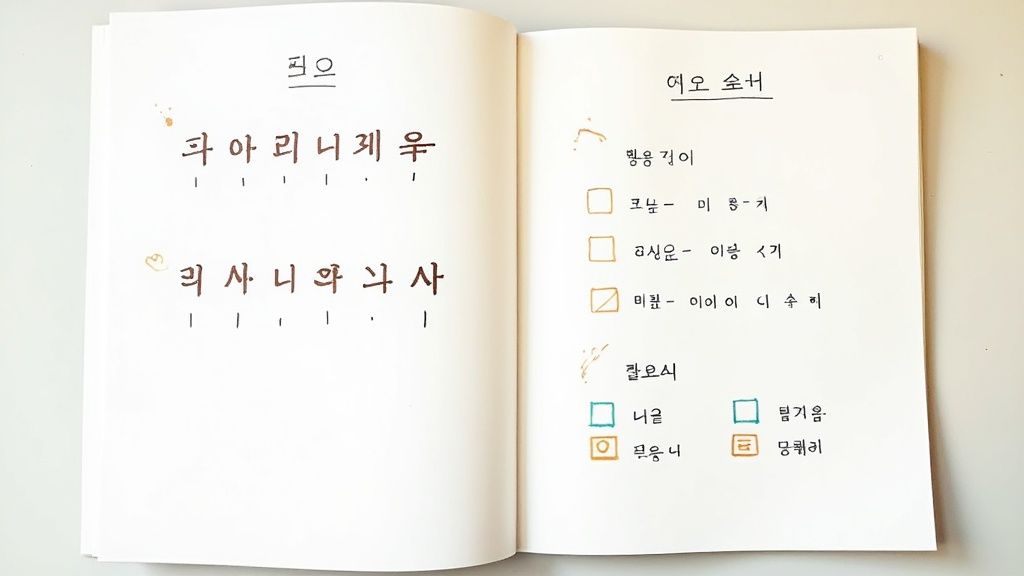
Many self-taught learners appreciate its clear, conversational explanations that feel like a private tutoring session. The book's logical progression allows many to read Hangul confidently within a few days and complete the beginner-level content in as little as six to eight weeks with consistent study. It provides the solid grammatical foundation that many apps lack.
How to Maximise 'Korean Made Simple'
To get the most value from this textbook, adopt a methodical study routine:
- Follow the Sequence: The book is structured for cumulative learning. Resist the temptation to skip ahead; each chapter builds directly on the previous one.
- Complete All Exercises: Actively complete the workbook exercises at the end of each chapter before moving on. This reinforces the concepts and helps commit them to memory.
- Use the Audio Files: The series comes with downloadable audio files. Use them extensively to practise your listening comprehension and mimic the pronunciation of a native speaker.
- Watch the Videos: Author Billy Go offers free accompanying video lessons on his YouTube channel, 'Go! Billy Korean'. Watching these videos provides valuable pronunciation modelling and further clarifies complex points.
Pro-Tip: Dedicate 30-45 minutes daily to your study sessions rather than cramming for hours once a week. This consistent, spaced repetition is far more effective for long-term retention and building a strong language habit.
8. Language Exchange: Tandem App & HelloTalk
Once you have a basic grasp of Hangul and some vocabulary, language exchange apps like Tandem and HelloTalk are transformative tools. These platforms connect you directly with native Korean speakers who want to learn your language, creating a mutually beneficial partnership for a practical, simple Korean language experience. This method moves you from passive learning to active, real-world application.
Many learners find that after just a few weeks of consistent practice on these apps, their confidence in speaking and understanding conversational nuances skyrockets. You can engage through text, voice messages, or even video calls, getting immediate feedback on your pronunciation and sentence structure from a native speaker.
How to Maximise Your Language Exchange Experience
To get the most out of these powerful platforms, consider these actionable strategies:
- Prepare Before You Connect: Don't jump in completely empty-handed. Build a foundation with a tool like Duolingo or Talk To Me In Korean first. Having basic greetings and introductory phrases ready will make your initial interactions much smoother.
- Set Clear Goals for Each Session: Before starting a conversation, decide on a small goal. This could be anything from learning three new food-related words to practising how to ask for directions. This focused approach makes your practice sessions more productive.
- Embrace Corrections: The main benefit of a language partner is getting corrected. Actively ask your partner to point out your mistakes and take notes on their feedback. Don't be afraid to sound silly; it is a crucial part of the learning process, similar to the immersive strategies people use to learn new languages in Singapore.
Pro-Tip: Schedule regular, short sessions rather than infrequent, long ones. Consistency is more effective for language retention. A 15-minute chat three times a week will build your skills faster than a single one-hour call once a month.
Simple Korean: 8-Resource Comparison
| Item | Complexity & Process 🔄 | Resources & Cost 💡 | Expected Outcomes ⭐ / 📊 | Ideal Use Cases | Key Advantages ⚡ |
|---|---|---|---|---|---|
| Duolingo Korean Course | Low 🔄 — guided, gamified micro-lessons | Mobile/web; free with ads or premium; low daily time | ⭐ Good for basic phrases & vocab; 📊 steady habit formation | Complete beginners wanting low-commitment daily practice | ⚡ Bite-sized lessons, motivating gamification, large community |
| Naver's Learn Korean (TOPIK Guide) | Moderate 🔄 — structured curriculum aligned to levels | Web; free; downloadable PDFs and audio | ⭐ High for grammar & exam prep; 📊 strong TOPIK readiness | Learners preparing for TOPIK or systematic grammar study | ⚡ Comprehensive native-authored content, free and thorough |
| YouTube: Easy Korean Channel | Low 🔄 — episodic videos, informal progression | Free video content; needs internet/device | ⭐ Good for listening & colloquial phrases; 📊 cultural exposure | Visual learners seeking natural speech and cultural context | ⚡ Authentic native speech, free and highly accessible |
| Talk To Me In Korean (TTMIK) Website & Podcasts | Moderate 🔄 — structured lessons + podcasts | Free core content; optional paid courses/PDFs | ⭐ Balanced grammar + conversation; 📊 practical proficiency | Learners wanting structured yet flexible conversational focus | ⚡ Multiple modalities (audio/video/text), strong pedagogy |
| Memrise Korean Courses | Low–Moderate 🔄 — SRS-focused repetition workflow | Mobile/web; free basic, subscription for full features | ⭐ Excellent for vocabulary retention; 📊 measurable word growth | Learners prioritizing rapid vocabulary acquisition | ⚡ Spaced repetition + native videos; engaging review games |
| Papago Learning (Naver's Interactive Platform) | Moderate–High 🔄 — AI-driven adaptive dialogues | App/web; may need stable internet; newer platform | ⭐ Strong for pronunciation & speaking confidence; 📊 faster speaking gains | Tech-savvy beginners focused on speaking and accent work | ⚡ Real-time speech feedback, personalized AI paths |
| Textbook: "Korean Made Simple" by Billy Go | Moderate 🔄 — linear, self-paced study plan | One-time purchase (book/eBook) + free videos/audio | ⭐ Strong foundation (Hangul + grammar); 📊 consistent progression | Self-motivated beginners wanting systematic study offline | ⚡ Clear step-by-step lessons, durable reference material |
| Language Exchange: Tandem & HelloTalk | High 🔄 — partner-dependent, variable structure | Apps; free basic with premium options; internet required | ⭐ High for conversational fluency; 📊 rapid speaking confidence (variable) | Learners ready for real conversation practice & cultural exchange | ⚡ Authentic interaction, immediate corrective feedback, flexible scheduling |
Choosing Your Path to Korean Fluency
You have now explored a curated selection of powerful resources, each offering a unique gateway into the world of the Korean language. From the gamified, bite-sized lessons of Duolingo to the structured, in-depth curriculum of Talk To Me In Korean, the path to learning is more accessible than ever. We have seen how platforms like Memrise can supercharge your vocabulary acquisition and how YouTube channels like 'Easy Korean' can immerse you in authentic, real-world conversations and cultural nuances.
The journey from beginner to confident speaker is not about finding a single "best" resource, but about building a personalised learning system that works for you. The most effective learners often create a dynamic toolkit, blending different methods to cover all bases. This approach ensures your learning remains engaging, comprehensive, and tailored to your specific goals and preferences.
Crafting Your Personalised Learning Strategy
The key takeaway is that consistency triumphs over intensity. Committing just 15-20 minutes daily will yield far greater results than a marathon session once a week. To build this sustainable habit, consider combining resources from our list:
- For Grammar Foundations: Start with a structured curriculum like Talk To Me In Korean (TTMIK) or the 'Korean Made Simple' textbook. These resources provide the essential framework and rules of the language.
- For Vocabulary Reinforcement: Supplement your grammar studies with apps like Memrise. Use its spaced repetition system to drill new words and phrases until they become second nature.
- For Listening & Pronunciation: Tune into TTMIK's podcasts during your commute or while doing chores. Actively watch 'Easy Korean' videos to connect sounds with real-life situations and native speakers.
- For Practical Application: Once you have a basic grasp, dive into language exchange apps like Tandem or HelloTalk. There is no substitute for real-time conversation to solidify what you have learnt.
This blended approach ensures you are developing a well-rounded skill set. Mastering simple Korean language is not just about memorising words; it is about understanding context, practising pronunciation, and building the confidence to speak. For those seeking an even more personalised approach to structuring their study, considering an AI learning path generator can offer a customized educational roadmap tailored to your progress and goals.
Your Adventure Awaits
Embracing the Korean language opens doors to a vibrant culture, from enjoying K-dramas without subtitles to navigating the bustling streets of Seoul with confidence. Each phrase you master is a step closer to a deeper connection with over 80 million speakers worldwide. The resources we have outlined provide the map; your curiosity and dedication will steer the journey. Embrace the small victories, celebrate your progress, and remember that every mistake is a learning opportunity. Your adventure into the beautiful and logical world of Hangul starts now. Which tool will you try first?
Hwaiting (화이팅)!
Inspired by the joy of mastering a new language? While your Korean journey begins, remember that multilingualism opens up a world of opportunities. At Spanish Council Singapore, we apply the same principles of immersive, structured, and engaging learning to help students of all ages master Spanish. Explore our courses and discover another rich culture and language with our expert native tutors.