A Friendly Guide to Saying Hello in Spanish
Saying hello in Spanish is wonderfully simple: your go-to word is Hola. Think of it as your universal key to starting a conversation. It works in any Spanish-speaking country, at any time of day, and in pretty much any situation you can imagine.
Your First Spanish Words for Saying Hello
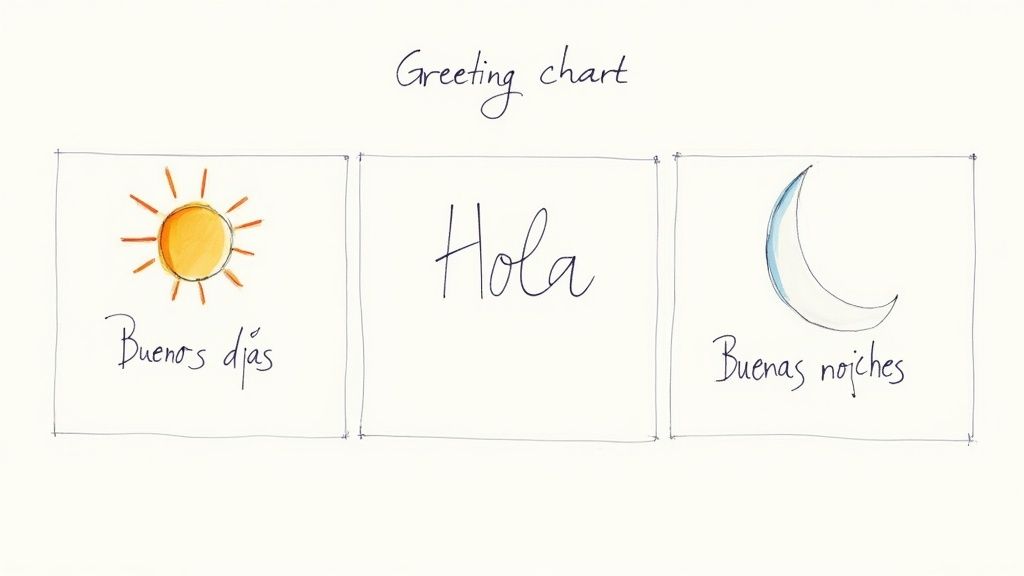
While a friendly Hola is always a safe bet, you'll sound much more like a local if you use greetings that match the time of day. It’s a small touch that shows you’ve put in a bit of effort. If Hola is like a quick wave, then using a time-specific greeting is more like a warm, confident handshake. It just sets a better tone for the whole chat.
Greetings Based on the Time of Day
There are three essential phrases every beginner needs to tuck into their memory. These are a bit more polished than a simple Hola and you'll hear them everywhere—from the person making your morning coffee to a new colleague at work. Honestly, once you nail these, you'll start to see why so many people feel that https://spanish.sg/blog/is-spanish-easy-to-learn.
Here are the heavy hitters you’ll need:
- Buenos días (BWEH-nos DEE-ahs) – This means "good morning." You'll use this from the moment you wake up until lunchtime, which is typically around 1 or 2 PM.
- Buenas tardes (BWEH-nas TAR-des) – Meaning "good afternoon," this is your greeting from lunchtime until the sun starts to set, usually around 7 or 8 PM.
- Buenas noches (BWEH-nas NO-ches) – This handy phrase works for both "good evening" and "good night." Use it when you arrive somewhere in the evening, and also when you're leaving or heading off to bed.
A Quick Grammar Tip: Did you notice that días is masculine (buenos), while tardes and noches are feminine (buenas)? It's a small detail, but getting it right is a nice touch that shows you're paying attention.
To get these phrases to really stick, it helps to see them in action. Reading some fun beginner Spanish stories is a great way to see how these greetings are used in real conversations, which helps lock them into your memory for good.
Essential Spanish Greetings at a Glance
To make it even easier, here’s a quick-reference table. Keep this handy, and you’ll never be stuck for the right greeting.
| Spanish Greeting | English Translation | When to Use |
|---|---|---|
| Hola | Hello | Universal; any time of day, formal or informal |
| Buenos días | Good morning | From morning until lunchtime (approx. 1-2 PM) |
| Buenas tardes | Good afternoon | From lunchtime until sunset (approx. 7-8 PM) |
| Buenas noches | Good evening/night | From sunset onwards; used for both greeting and leaving |
This table covers the absolute basics. With these four phrases, you're officially equipped to start almost any conversation in Spanish. Pretty great, right?
Beyond Hola: Greetings for Real Conversations
While Hola is your trusty key, adding a few conversational openers will truly unlock genuine interactions. Think of it like this: Hola gets you through the door, but asking "How are you?" invites someone to sit down and have a real chat. These follow-up greetings are the true heart of daily communication in Spanish.
They add a personal touch and show you're genuinely interested in connecting, not just reciting words from a textbook. Mastering them is what takes you from simply saying hello in Spanish to actually starting a conversation.
Casual Greetings for Everyday Chats
After you've said your initial Hola or Buenos días, the most natural next step is to ask how the other person is doing. This is where you can start to adapt your language to the situation, choosing between a few incredibly common and friendly options.
These phrases are basically the bread and butter of casual Spanish conversation:
- ¿Cómo estás? (KOH-moh es-TAHS) – This is your go-to, standard way to ask, "How are you?" It’s friendly, versatile, and perfect for friends, family, and colleagues you know well.
- ¿Qué tal? (keh TAHL) – A bit more informal and extremely common, this is like asking, "What's up?" or "How's it going?" It’s relaxed and a great choice for classmates or peers.
- ¿Qué pasa? (keh PAH-sah) – This is the most casual of the three, translating to something like "What's happening?" You'd save this one for close friends in a very informal setting.
Key Takeaway: The greeting you choose really sets the tone. ¿Cómo estás? is a friendly and safe bet for most informal situations. Keep ¿Qué tal? and especially ¿Qué pasa? for people you already have a rapport with to avoid sounding overly familiar.
Picking up on these subtle differences is a big part of making a good impression. And with Spanish being such a global language, these small points of etiquette are valuable everywhere. It's the second most spoken language in the U.S., with over 41 million speakers, and its popularity is only growing worldwide. This trend is mirrored in places like Singapore, where learning Spanish opens up doors to massive cultural and economic communities across Latin America and Spain. You can read more about the global spread of the Spanish language to understand its importance in international communication.
Putting It All Together With Examples
Seeing how these greetings flow in a real conversation is the best way to get the hang of them. The social context—who is talking to whom—is everything, as it dictates which phrase is the best fit. A student bumping into a classmate will sound very different from an employee greeting their boss.
Let's walk through a couple of scenarios to see how this plays out.
Scenario 1: Two teenage friends meeting at school
- Ana: ¡Hola, Carlos! ¿Qué tal? (Hey, Carlos! What's up?)
- Carlos: ¡Hola, Ana! Todo bien. ¿Y tú? ¿Qué pasa? (Hey, Ana! All good. And you? What's happening?)
Scenario 2: A young professional greeting an older colleague
- Javier: Buenos días, Señora Martinez. ¿Cómo está usted? (Good morning, Mrs. Martinez. How are you?)
- Sra. Martinez: Buenos días, Javier. Estoy muy bien, gracias. ¿Y tú? (Good morning, Javier. I'm very well, thank you. And you?)
Did you catch the shift to the formal ¿Cómo está usted? in the second example? It’s a small change that shows a huge amount of respect. We’ll dive deeper into that important distinction next.
Navigating Respect with Usted vs Tú
English keeps things simple with one word for "you." Whether you’re chatting with your best mate or your new boss, "you" is all you need. Spanish, on the other hand, weaves respect and social context right into its grammar with two main forms: the informal tú and the formal usted.
Getting this right is less about ticking a grammar box and more about showing you understand the culture. Think of it as the difference between calling someone by their first name versus using "Mr." or "Ms." It’s a subtle but powerful way to build a real connection.
Choosing the wrong one can be a bit of a social blunder. Using tú when usted is expected might seem a little too forward, or even rude. But using usted with a good friend could feel strangely cold and distant. It's all about reading the room.
The Informal Tú: For Friends, Family, and Familiar Faces
You'll find yourself using tú in most of your day-to-day, relaxed chats. It’s the warm, friendly "you" that closes the distance between people.
Save tú for these situations:
- Friends and Peers: Anyone you're on a casual, first-name basis with.
- Family Members: From your parents and siblings to your cousins.
- Children and Teenagers: It’s standard practice to address young people with tú.
- People Your Own Age: In most social settings, tú is the go-to choice among peers.
When you use tú, the verb that follows changes slightly. For instance, asking "How are you?" becomes: “Hola, ¿cómo est*ás?”* See that "s" on the end? That's the little grammatical signal that you're in informal territory.
The Formal Usted: For Respect and Professionalism
Usted is your key to showing politeness and maintaining a respectful distance. It's essential for any formal or professional interaction.
Reach for usted when you're speaking to:
- Elders: Anyone significantly older than you, as a sign of respect.
- Authority Figures: Think bosses, professors, police officers, or government officials.
- Strangers: Especially in professional or service environments, like with a shopkeeper, a bank teller, or a doctor.
With usted, the greeting looks a bit different: “Buenos días, ¿cómo est*á usted?”* Notice the verb está drops the "s," which instantly signals a more formal, respectful tone.
Pro Tip: When in Doubt, Default to Usted. If you’re ever unsure which to use, always start with usted. It's far better to come across as a bit too polite than unintentionally disrespectful. Often, the other person will simply say, “Puedes tutearme,” inviting you to switch to the more casual tú.
To truly get a handle on Spanish greetings, you need to appreciate these deeper cultural layers. For an interesting look into how different approaches tackle cultural sensitivity in greetings, this article is a great resource.
The choice between formal and informal greetings is a fundamental part of speaking Spanish respectfully. Let's break it down.
Choosing Your 'You': Formal vs Informal Greetings
| Context | Informal (Tú) | Formal (Usted) | When to Use |
|---|---|---|---|
| Pronoun | tú | usted (often abbreviated as Ud.) | The core of the choice. |
| Example Question | ¿Cómo te llam*as?* (What's your name?) | ¿Cómo se llam*a usted?* (What's your name?) | Use with family, friends, peers. |
| Example Answer | ¿Y tú? (And you?) | ¿Y usted? (And you?) | Use with elders, strangers, authority. |
| Verb Form | 2nd person singular (-as, -es) | 3rd person singular (-a, -e) | Note the different verb endings. |
Mastering this distinction is a major step towards sounding like a natural and considerate Spanish speaker.
What About Groups? The Plural Forms
When you’re talking to more than one person, things change again. In most of Latin America, it’s simple: ustedes is used for every group, whether it's your friends or a board of directors.
Spain, however, adds another layer with vosotros. This is the plural of tú, used when you're talking to a group of friends, family, or children—basically, any group you'd address individually with tú. For formal groups in Spain, you still use ustedes.
How Hello Changes Around the World
Spanish isn't a monolith. It’s a living, breathing language spoken across more than 20 countries, and each one puts its own spin on it. Think of Hola as your universal key—it works everywhere, no questions asked. But learning the local greetings? That’s like knowing the secret handshake. It shows you've made an effort and opens the door to a much warmer connection.
These regional phrases are more than just slang; they’re little snapshots of the local culture and personality. Using them turns a simple "hello" into a real moment of connection, showing respect and genuine curiosity.
Exploring Greetings Across Latin America
Latin America is a vast mosaic of cultures, and its language reflects that beautifully. While a friendly ¿Cómo estás? is understood from Tijuana to Tierra del Fuego, you'll find that locals often have their own go-to greetings for daily chatter.
Here are a few of my favourites:
- Mexico: ¿Qué onda? (keh OHN-dah) – This literally means "What wave?", but it's the most common way to say "What's up?" among friends. It's got a cool, relaxed feel that's unmistakably Mexican.
- Argentina: ¿Che, cómo andás? (cheh KOH-moh an-DAHS) – The word Che is pure Argentina, used like "hey" or "mate." Paired with andás (their unique way of saying "how are you doing"), it's the sound of a friendly Buenos Aires street corner.
- Costa Rica: ¡Pura vida! (POO-rah VEE-dah) – More than just a greeting, "pure life" is the national motto. Ticos use it to say hello, goodbye, and that everything’s fantastic. It’s the soul of Costa Rican culture in two words.
- Chile: ¿Cómo estai? (KOH-moh es-TYE) – Chilean Spanish has a rhythm all its own, and this super common, informal "How are you?" is a perfect example of its unique cadence.
Dropping one of these into conversation can make a huge impact. Just imagine the surprise and smile you'll get when you greet a new friend from Mexico with a confident ¿Qué onda?. It instantly breaks the ice.
The sheer scale of the Spanish-speaking world is incredible. In South America alone, Spanish is the primary language for around 210 million people—that's almost half the entire continent!
This flowchart is a great little cheat sheet for one of the trickiest parts of any greeting: navigating the formal versus the informal.
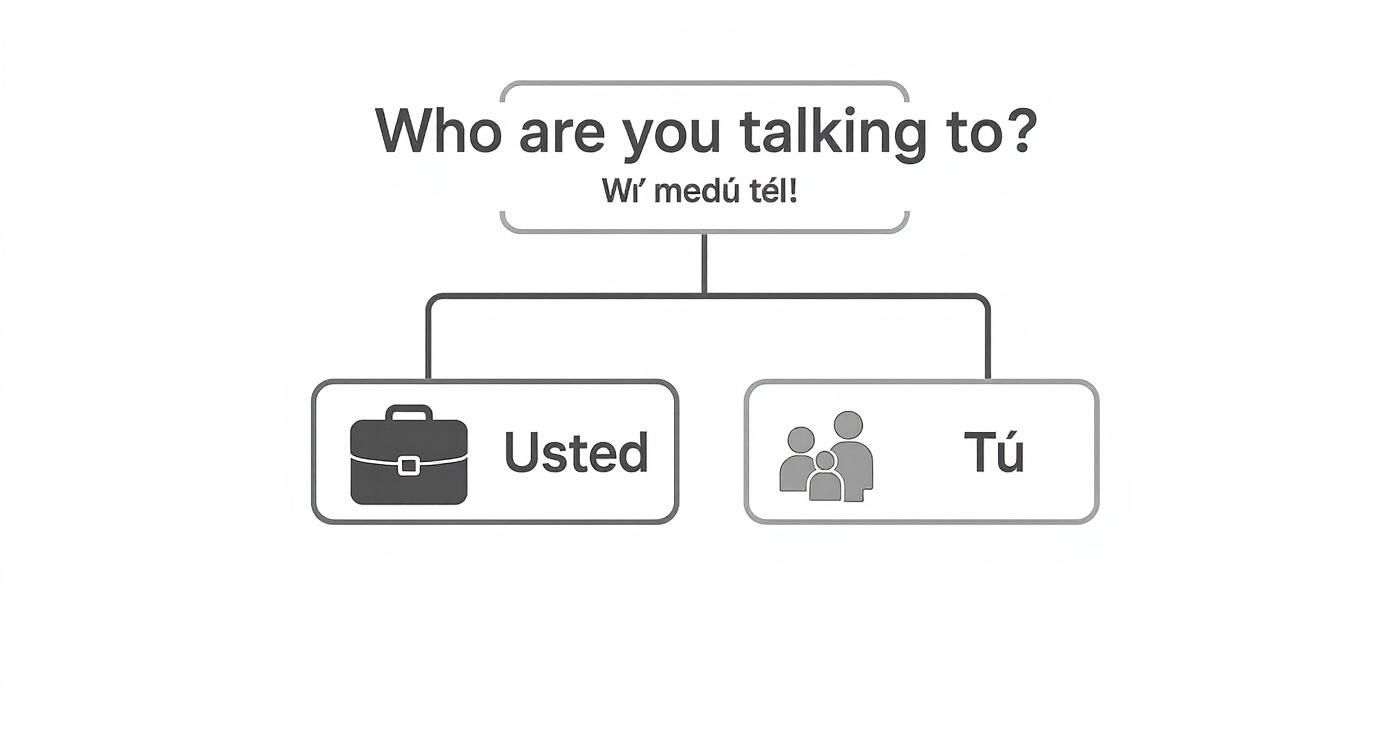
As you can see, it really boils down to your relationship with the person. Are they a boss or an elder (Usted) or a buddy (Tú)?
A Quick Look at Greetings in Spain
Over in Spain, while many greetings overlap with Latin America, they definitely have their own distinct flavour. The differences are fascinating clues to their separate cultural histories.
One of the most common greetings you'll hear from Madrid to Seville is a simple, cheerful ¡Buenas! (BWEH-nas). It’s a handy, all-purpose shorthand for Buenos días, Buenas tardes, or Buenas noches.
It’s friendly, efficient, and used all the time. This kind of casual shortcut is a perfect example of how language evolves through everyday use.
Getting to know these regional quirks is one of the most rewarding parts of learning the language. To see just how diverse it gets, you can read more about the different countries that speak Spanish and what makes each of them unique.
How to Respond and Keep the Conversation Going
A greeting is really just the start. Saying Hola opens the door, but knowing how to respond and volley the conversation back is what really gets you talking. It’s the difference between a quick nod and a real, human connection.
So, someone's just asked you, “¿Cómo estás?”. What now? Your answer sets the tone for the rest of the chat. The good news is, the most common replies are incredibly simple and easy to remember. They give a quick update on how you're doing while politely passing the conversational torch right back.
Standard Replies to How Are You
Think of these as your go-to phrases. You'll use them all the time. The key ingredient in each one is asking "and you?" at the end—that’s what keeps the back-and-forth alive.
- Bien, gracias. ¿Y tú? (bee-EN, GRA-thee-as. ee TOO?) – "Good, thanks. And you?" This is your bread and butter. It’s polite, friendly, and perfect for almost any situation.
- Muy bien, gracias. (MOO-ee bee-EN, GRA-thee-as) – "Very good, thanks." A great choice when you're genuinely feeling fantastic and want to share a little of that positive energy.
- Más o menos. (mas oh MEH-nos) – "So-so." or "More or less." This one’s a bit more candid. It’s a casual way to say things aren’t amazing but aren't awful, either. People will often ask you what's up after you say this.
These little phrases are the building blocks of any smooth Spanish exchange. For a much deeper dive into all the different ways to ask and answer this question, you should definitely check out our complete guide on saying "how are you" in Spanish.
Keeping the Dialogue Flowing
Okay, so you’ve both said you’re doing well. Now what? This is where conversations can fizzle out if you’re not careful. To avoid that awkward silence, you just need a couple of easy follow-up questions ready to go.
Think of these as your secret weapon for showing you're actually interested in the other person.
The Golden Rule of Conversation: Always toss the question back! The phrase ¿Y tú? (informal) or ¿Y usted? (formal) is your best friend. It’s not just polite, it's expected, and it keeps things moving without any effort.
Let's look at how this plays out in a real chat.
Mini-Dialogue Example
- Maria: ¡Hola, Pablo! ¿Qué tal?
(Hey, Pablo! What's up?) - Pablo: ¡Hola! Muy bien, gracias. ¿Y tú?
(Hey! Very good, thanks. And you?) - Maria: Bien también. Oye, ¿qué tal tu día?
(Good too. Hey, how's your day going?) - Pablo: Bastante ocupado con el trabajo. ¿Y el tuyo?
(Pretty busy with work. And yours?)
See how that works? By asking simple things like “¿Qué tal tu día?” (How is your day?) or “¿Qué has hecho hoy?” (What have you done today?), you open the door to a proper discussion about work, family, or weekend plans. This is exactly how you build friendships and turn a simple hello in Spanish into a real conversation.
Common Greeting Mistakes to Avoid
When you're first learning to say hello in Spanish, it’s completely normal to make a few little mistakes along the way. Think of it as part of the adventure! Knowing what common slip-ups to watch out for can help you feel much more confident and sound more natural from the get-go.
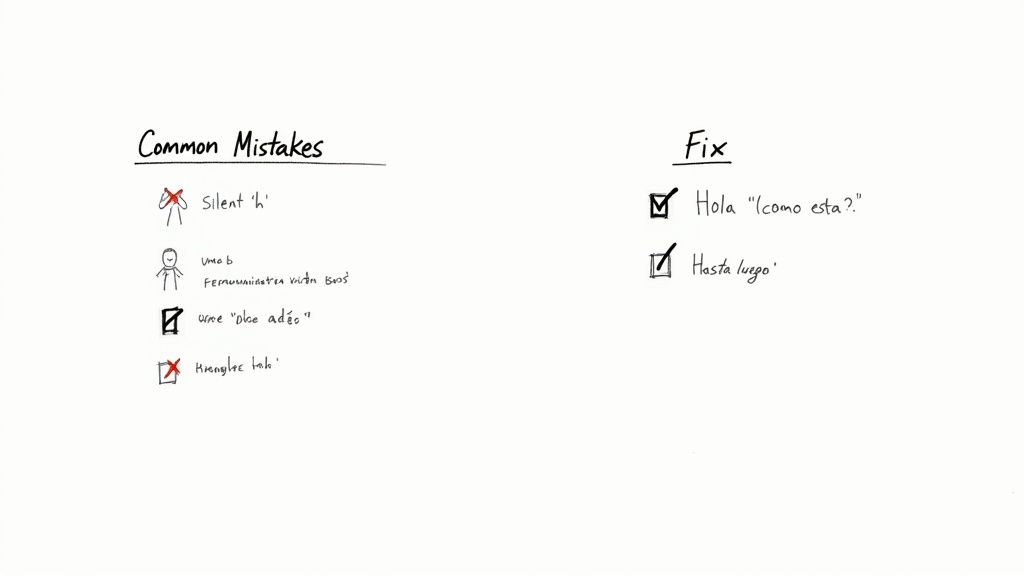
The classic beginner mistake? Pronouncing the 'h' in hola. In Spanish, the 'h' is completely silent, so it should always sound like “o-la.” Saying "ho-la" is a dead giveaway that you're new to the language.
Another hurdle is getting the formal and informal greetings mixed up. Tossing out a casual ¿Qué tal? to a new boss or an elderly person might seem a bit too familiar. If you're ever unsure, your safest and most respectful bet is to start with the more formal ¿Cómo está usted?
Getting Timings and Farewells Right
It’s not just what you say, but when you say it. A common blunder is using buenos días (good morning) deep into the afternoon. This greeting is really just for the morning, typically until about lunchtime. Once noon or 1 PM rolls around, you’ll want to switch over to buenas tardes.
Saying goodbye properly is just as important as saying hello. Many learners default to adiós, but it can sound a bit dramatic and final—almost like you don't expect to see the person ever again.
For everyday goodbyes, it’s much more common to use phrases like hasta luego (see you later) or nos vemos (we'll see each other). They feel a lot friendlier and are perfect for daily situations.
By side-stepping these simple errors, you'll find your Spanish greetings sound instantly more authentic. It's these small details that really make a huge difference in everyday chats.
Got Questions About Spanish Greetings? We’ve Got Answers.
Learning a new language always throws up a few curveballs, and greetings are no exception. Let's tackle some of the most common questions that pop up, so you can say hello with total confidence.
Is the H in Hola Really Silent?
Yes, 100% of the time. The letter ‘h’ in Spanish is a silent one unless you see it paired with a ‘c’ to make the “ch” sound (like in chocolate). Think of it as one of the golden rules of Spanish pronunciation.
So, when you see Hola, just say "o-la". Nailing this little detail is a super simple way to make your Spanish sound much more natural right from the get-go.
When Should I Use Buenos Días, Tardes, or Noches?
Figuring out the right time for these greetings is easier than you think. It's all about the rhythm of the day, which in many Spanish-speaking cultures revolves around mealtimes and sunlight.
Here's a simple breakdown:
- Buenos días is your go-to for the morning. Use it from the moment you wake up until lunchtime, which is usually around 1 or 2 PM.
- Buenas tardes is for the afternoon and early evening. It starts after lunch and carries you through until it gets dark, around 7 or 8 PM.
- Buenas noches does double duty. It means "good evening" when you're arriving somewhere at night, but it also means "good night" when you're leaving or heading to bed.
A great way to remember is to tie them to your daily routine: you start the day with días, spend the afternoon on your tardes, and end with noches.
Can I Just Stick to Hola for Everything?
Absolutely. If you're ever unsure which greeting to use, Hola is your fail-safe. It's the universal greeting that works in any Spanish-speaking country, at any time of day, whether you're chatting with a friend or meeting someone for the first time.
While using other greetings shows you're picking up the finer points of the language, you can never go wrong with a friendly Hola. It’s always a warm and welcome start to any conversation.
Ready to move beyond greetings and start having real conversations? At Spanish Council Singapore, our native teachers make learning fun and effective for kids, teens, and adults. Let us help you reach your fluency goals. Find the perfect Spanish class for you today