Your Guide to How Are You in Spanish Language
If you’ve just started learning Spanish, one of the first phrases you'll pick up is how to ask someone how they're doing. The most common way you'll hear is ¿Cómo estás?, but there's a crucial detail that often trips up new speakers: formality.
Spanish has a built-in system for showing respect, and it all comes down to how you say "you". This isn't just a grammar lesson; it's a window into the culture itself.
Getting the Formality Right: Tú vs. Usted
In English, we just use "you" for everyone. Simple, right? But Spanish makes a key distinction between the informal tú (for friends, family, and people your own age) and the formal usted (for elders, authority figures, and people you've just met).
Think of it this way: using the wrong one can send an unintended message. Calling a new boss tú might come off as a bit too casual, even disrespectful. On the flip side, using usted with a close friend could make things feel strangely distant and cold.
Nailing this difference is one of the quickest ways to sound more natural and show you’ve got a handle on the cultural nuances. It’s a small detail that makes a huge impression.
The core idea is simple: informal language is for peers and friends, while formal language is reserved for showing respect to elders, authority figures, or people you've just met.
To help you get it right every time, here’s a quick-reference table. It breaks down the two most common greetings and spells out exactly when to use each one.
Quick Guide to Spanish Greetings
This table gives you a clear, at-a-glance look at the most common ways to ask "how are you" and the specific situations where each one fits best.
| English Phrase | Informal Spanish (Tú) | Formal Spanish (Usted) | When to Use |
|---|---|---|---|
| How are you? | ¿Cómo estás? | ¿Cómo está usted? | Informal: Friends, family, peers, children. Formal: Elders, strangers, authority figures, clients. |
Having this distinction down will help you navigate your first conversations with confidence, ensuring you always set the right tone.
Navigating Formal and Informal Spanish Greetings
One of the first, and most important, social hurdles you'll encounter in Spanish is deciding between the informal ‘tú’ and the formal ‘usted’. This isn't just a grammar point; it's a direct reflection of social awareness and respect. The whole difference boils down to one simple verb change: ¿Cómo estás? (informal) versus ¿Cómo está usted? (formal).
Think of it this way. You’re catching up with a friend from your class over coffee. You’d naturally ask, ¿Cómo estás? It’s casual, friendly, and builds a sense of connection. But what if you're meeting your partner's grandparents for the first time? In that scenario, defaulting to the more respectful ¿Cómo está usted? is the way to go. It shows you understand and respect their age and position.
When to Use Formal vs. Informal You
Figuring out when to use tú or usted can feel a bit tricky at first, especially as social rules can change from place to place. My best advice? If you're ever in doubt, just start with usted. It's always better to come across as a little too polite than overly familiar.
Often, if a person is comfortable with a more casual approach, they'll let you know. You might hear them say, "Puedes tutearme," which is a friendly invitation to switch to the informal 'tú'.
This little guide can help you make the right call.
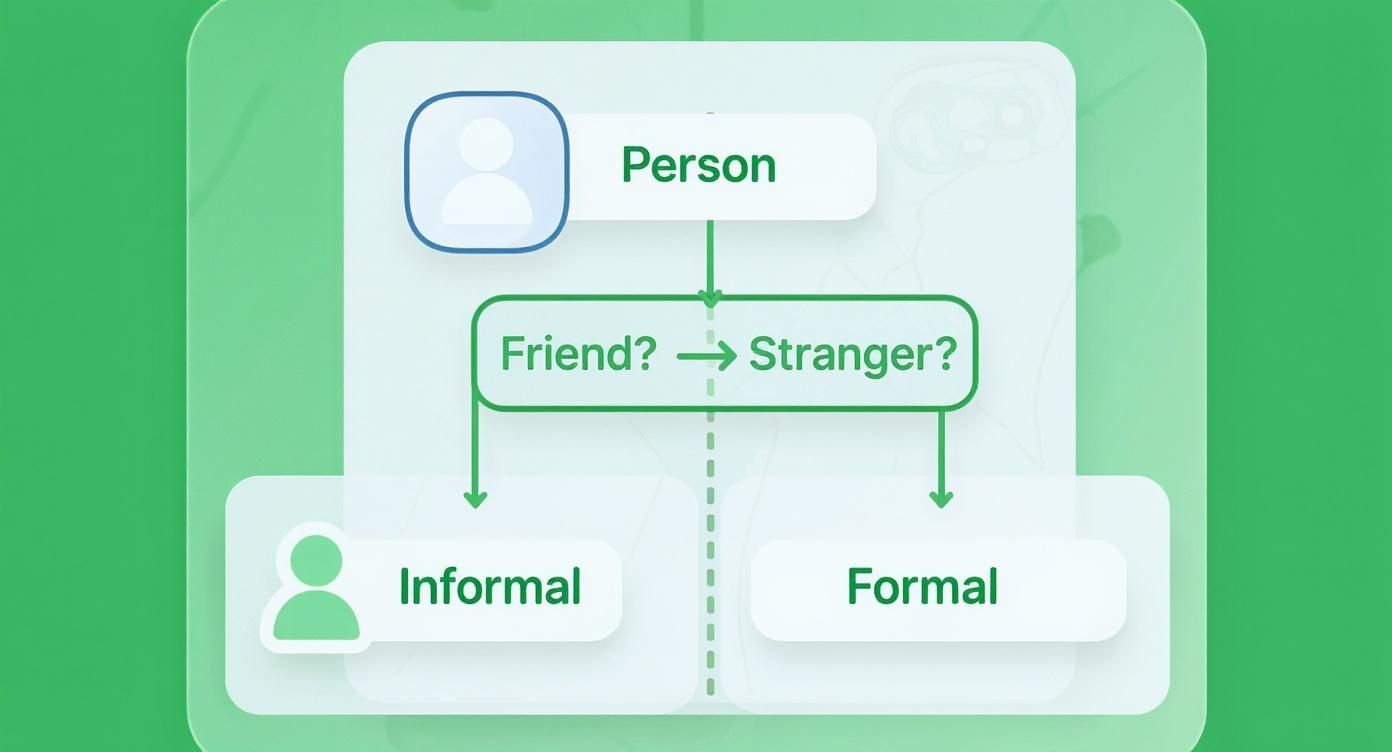
As you can see, your relationship with the person is everything. Stick to informal greetings for friends and people your age, but switch to formal for strangers, elders, and anyone in a position of authority.
Keep in mind that this can also change depending on where you are. In some parts of Latin America, it's common to hear tú used much more broadly, even with service staff. In Spain, however, usted is still the standard for showing respect in professional settings and when speaking to older individuals. For a deeper dive into regional specifics, you can explore pronoun usage in Argentina in our other article.
My Key Takeaway: Getting the formality right isn’t just about being grammatically correct—it’s about showing you respect the culture. When you’re not sure, lead with the formal ¿Cómo está usted? and let the other person set the tone. It's a small gesture that makes a huge difference in your first impression and can lead to much smoother conversations. Mastering this one concept is a massive step towards sounding more natural.
Responding Like a Native Spanish Speaker
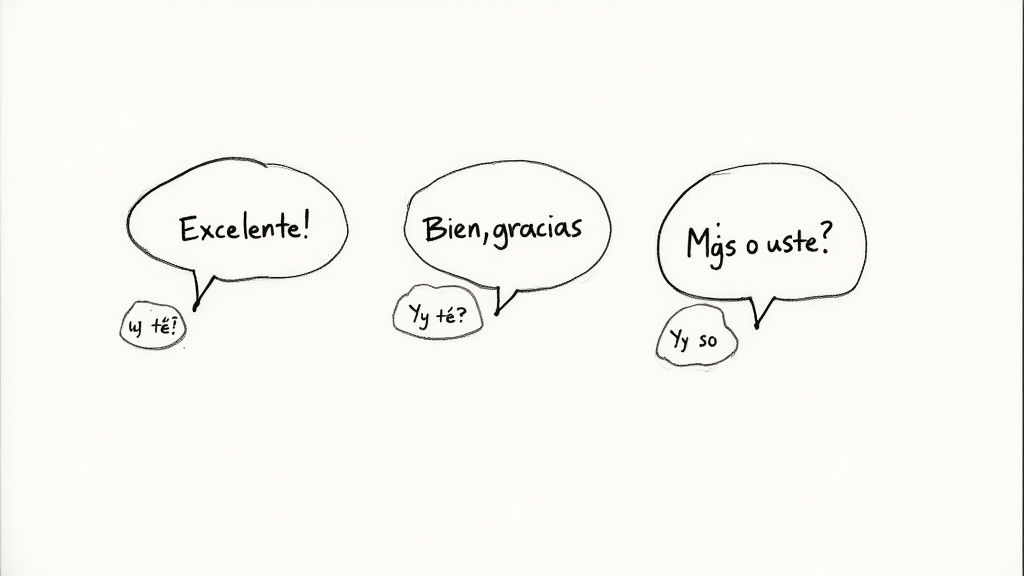
So, you’ve mastered asking someone how they are. Great! But what happens when they ask you back? Your answer is just as important for keeping the conversation feeling natural and engaging.
Sure, you could just say "Bien, gracias" ("Fine, thank you"). It's grammatically perfect and everyone will understand you. But if that's the only reply you ever use, you'll sound like you're reading from page one of a textbook. Real conversations are more colourful than that.
Learning a few different replies is one of the quickest ways to sound more fluent. It shows you're not just reciting phrases but are actually present in the conversation.
Beyond a Simple Bien
Let's look at some other ways to answer, ranging from when you're on top of the world to when you're just getting by. Think of these as adding more tools to your conversational toolkit.
A few really useful options include:
- ¡Excelente! / ¡Genial! – This is your go-to when you're feeling "Excellent!" or "Great!" It's full of positive energy and perfect for when you're genuinely having a fantastic day.
- Muy bien. – Simply "Very well." This is probably the most common step-up from a basic "Bien," adding a little more warmth to your reply.
- Más o menos. – Literally "More or less," but it really means "So-so." It's an honest and perfectly normal response for those days when things are just okay.
- No muy bien. – A straightforward "Not very well." It’s a polite and clear way to signal that you’re not doing so great.
Notice a pattern? All these phrases rely on the verb 'estar,' which we use for temporary conditions like moods and feelings. If you want a deeper dive into how it works, our guide on the full conjugation of estar is a great resource.
The real secret to a natural conversation isn't just in your answer—it's in what you do next. Always, always return the question. It’s the conversational glue that shows you’re interested in the other person and keeps things from coming to an awkward halt.
Keeping the Conversation Going
Once you’ve shared how you are, it’s polite to pass the baton. How you do this depends entirely on who you're talking to.
In an informal situation, like with a friend or someone your age, a simple "¿Y tú?" (And you?) is perfect.
But if you’re in a more formal setting—chatting with an older person, a boss, or someone you've just met—you’ll want to use "¿Y usted?" (And you?). It’s the same question, just with that added layer of respect. Nailing this little detail really shows you’ve got a good handle on the nuances of Spanish culture.
To make things even clearer, here’s a quick-reference table with some common replies and the correct follow-up for each situation.
Common Responses to 'How Are You' in Spanish
| Spanish Response | English Meaning | Follow-up Question (Informal) | Follow-up Question (Formal) |
|---|---|---|---|
| ¡Excelente! | Excellent! | ¿Y tú? | ¿Y usted? |
| Muy bien | Very well | ¿Y tú? | ¿Y usted? |
| Más o menos | So-so | ¿Y tú? | ¿Y usted? |
| Regular | Okay / Fair | ¿Y tú? | ¿Y usted? |
| No muy bien | Not very well | ¿Y tú? | ¿Y usted? |
Having these responses ready will not only make you sound more like a native speaker but will also give you the confidence to handle these everyday exchanges with ease.
Beyond the Basics: Sounding More Natural in Spanish
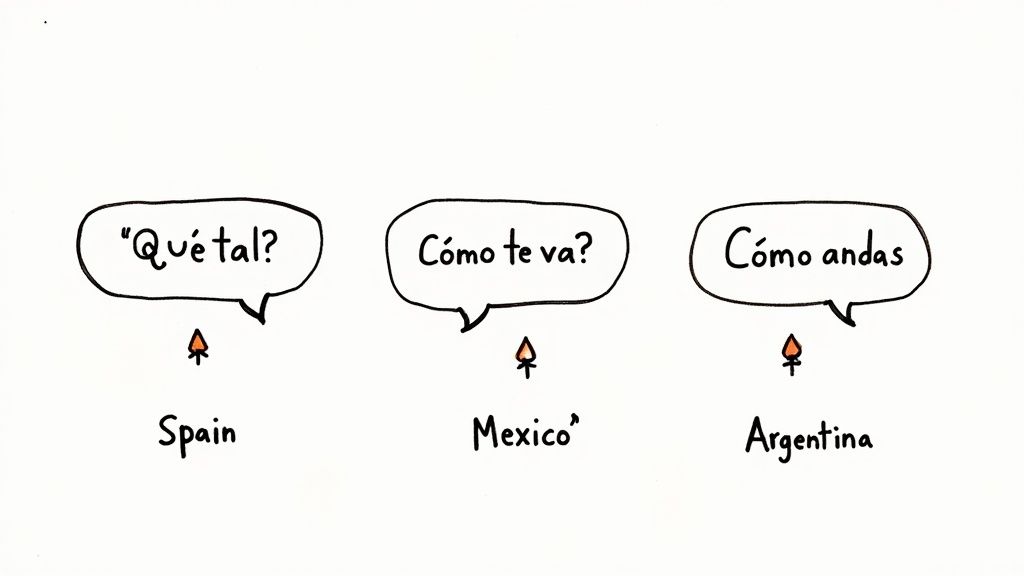
Once you've got ¿Cómo estás? down, the real fun begins. It's time to sprinkle some variety into your greetings to sound less like you're reading from a script and more like a seasoned speaker.
Using these different phrases is like having a toolkit for conversations. Each one has a slightly different feel and using them correctly is a fantastic way to show you really understand the nuances of spoken Spanish.
Take ¿Qué tal?, for example. It's incredibly common, especially in Spain, and is a wonderfully versatile phrase. Think of it as a casual "How's it going?" or "What's up?" It’s so versatile, in fact, that it can even replace "Hello" and often doesn't need a long-winded answer.
More Personal and Casual Ways to Ask
Ready to go a bit deeper? Let's look at a few other options that will make you sound more authentic, especially when you're talking with friends or people you're familiar with.
- ¿Cómo te va? This literally means "How's it going for you?" It's a nice way to ask about how things are going in someone's life in a more personal way.
- ¿Qué hay de nuevo? The classic "What's new?" This is perfect for catching up with a friend you haven't seen for a while.
- ¿Cómo andas? This translates to something like "How are you getting on?" or "How are you doing?" It has a warm, friendly feel and is often used between close friends checking in on one another.
Expert Tip: Using these variations shows you have a real feel for the language. It tells people you've moved past simple memorisation and are actively engaging with the natural flow of a Spanish conversation.
Although Spanish is spoken worldwide, its local context can change. Here in Singapore, while not an official language, there's a growing community of speakers, particularly among expatriates. Interestingly, research shows that the 25-34 age group accounts for nearly half (48.6%) of Spanish speakers locally.
The best way to get comfortable with these phrases is to use them. Try finding a conversation partner to practise with. This kind of real-world application is invaluable for mastering the subtle differences in tone and context. If you're looking for ideas, our guide on finding a https://spanish.sg/blog/language-exchange-singapore can help you get started.
Sidestepping Common Mistakes and Cultural Blunders
Knowing the right words to ask how are you in Spanish language is one thing, but getting a feel for the unspoken social rules is what really helps you connect. One of the most common trip-ups for learners is getting the expected level of detail in a response completely wrong.
In many Spanish-speaking countries, asking "how are you?" can be a simple, almost rhythmic part of a greeting—not always a genuine inquiry. Launching into a five-minute monologue about your day can catch someone off guard and make things a bit awkward. Most of the time, a quick, breezy "Bien, ¿y tú?" is the perfect reply.
Of course, with a close friend, just saying "bien" and nothing else might feel a little distant. It really all comes down to context.
Key Takeaway: Read the room. If it's a casual chat with a shopkeeper or someone you've just met, keep your answer short and sweet. Save the in-depth life updates for your close mates who are genuinely asking for the details.
Another classic mistake is mixing up the formal and informal. Using the casual tú with someone older or in a position of authority can sound disrespectful, even if you have the best intentions.
Navigating Social Cues
Here are a few common situations to handle with care, so you can make a great impression every time:
- TMI with strangers: When a cashier asks ¿Qué tal?, they're just being polite. It’s not an invitation for a detailed rundown of your entire week. A simple, cheerful response is all you need.
- Being too informal, too soon: When in doubt, start with the formal usted. This goes for anyone older, anyone in a professional setting, or anyone you’re meeting for the first time. It’s far better to be invited to use the more familiar tú than to backtrack after being too casual.
- Forgetting to return the favour: A conversation can come to a screeching halt if you don't ask back. Always cap off your response with a quick "¿Y tú?" or "¿Y usted?". It keeps the conversation flowing.
Getting these nuances right is a game-changer. This is especially true in a multicultural place like Singapore, where the linguistic scene is dominated by English—which 48.3% of residents speak at home. Spanish isn't nearly as common, so your effort to learn its cultural etiquette will be noticed and appreciated. You can find more details on Singapore's language demographics on Wikipedia.
Questions That Always Come Up with Spanish Greetings
As you start using these phrases, you'll naturally run into a few common questions. Sorting these out is what turns a clunky greeting into a smooth, confident conversation starter. Let's dig into the queries I hear most often from students.
Can I Use Informal Greetings with Strangers?
This is a big one. When in doubt, always err on the side of caution. Starting with the formal ¿Cómo está usted? is your safest bet, especially if you're talking to someone older or you're in a professional setting like an office or a shop.
That said, in many parts of Latin America, it's very common for younger people to jump straight into the informal tú with each other. The best advice I can give is to simply listen. If the other person addresses you with tú, take that as your cue to switch. It shows you're paying attention and can adapt to the social dynamic.
My Pro Tip: Pay attention to how the other person addresses you. If they use the informal tú with you, feel free to use it back. It's a natural way to mirror their level of formality.
What's the Real Difference Between ¿Qué tal? and ¿Cómo estás?
This trips up a lot of learners. Think of it this way: ¿Cómo estás? is a direct translation of "How are you?" It's a genuine question about someone's state of being.
On the other hand, ¿Qué tal? is far more casual and flexible. It’s closer to asking "What's up?" or "How's it going?" It's incredibly common, especially in Spain, and often works as a standalone "Hello" where a detailed response isn't always expected. It's a brilliant, friendly phrase for informal situations.
What if I'm Not Doing Well?
You don't always have to reply with "Bien, gracias." Being honest is perfectly fine. If you're having a so-so day, you have a few simple options:
- No muy bien (Not very well)
- Más o menos (So-so)
- Un poco cansado/a (A little tired — remember to match the ending to your gender)
From there, how much you elaborate really depends on who you're talking to. With a good friend, you might share more. In a more formal or casual chat, giving a brief, honest answer like this is completely polite and socially acceptable.
At Spanish Council Singapore, we focus on these real-world conversational skills from day one. Our native teachers guide you through the cultural nuances so you can speak Spanish with confidence. Discover our engaging Spanish classes in Singapore.