Parents’ or Parent’s A Quick Grammar Guide
Stuck on whether to write parents' or parent's? You're not alone. It’s a classic grammar tripwire, but the fix is surprisingly simple. It all boils down to one question: are you talking about one parent, or more than one?
The apostrophe’s location is the only clue your reader gets. Get it right, and your meaning is crystal clear. Get it wrong, and you might be telling a very different story.
One Parent or Two? That's the Question
Think of it this way. The apostrophe signals ownership. First, figure out who owns the thing you're talking about. Is it a single mum or dad? Or are you referring to both of them?
If it's just one person, the apostrophe goes before the s (parent's). If it's two or more people, the apostrophe lands after the s (parents'). Simple as that. A single parent's car belongs to one person; your parents' house belongs to them as a unit.
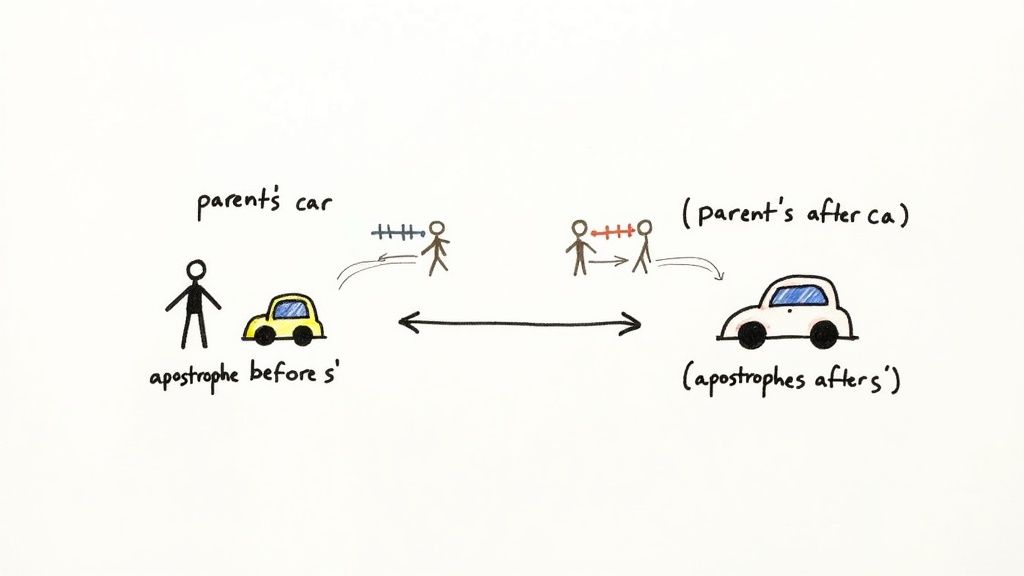
Quick Guide Parent's vs Parents'
Sometimes, seeing it laid out side-by-side makes all the difference. Here’s a quick reference table to help you nail it every time.
| Term | Meaning | Example Sentence |
|---|---|---|
| Parent's | Singular Possessive (belongs to one parent) | My parent's advice was very helpful. |
| Parents' | Plural Possessive (belongs to two or more parents) | The school needs all the parents' signatures. |
Once this fundamental difference clicks, you'll find yourself using the correct form without a second thought. It's one of those small details that makes your writing look polished and professional.
When to Use the Singular Possessive Parent's
When you’re talking about something that belongs to just one parent, parent’s is the word you need. It’s a simple rule: the apostrophe lands right before the 's' to show that an object, idea, or responsibility belongs to one mother or one father.
Think of it as putting a spotlight on a single person. Using parent's clearly points to one individual's schedule, their advice, or their car. For instance, you might discuss a single parent's challenges with juggling work and home life, or you might hear a child say, "That's my parent's book." In both scenarios, we know we're only talking about one person.
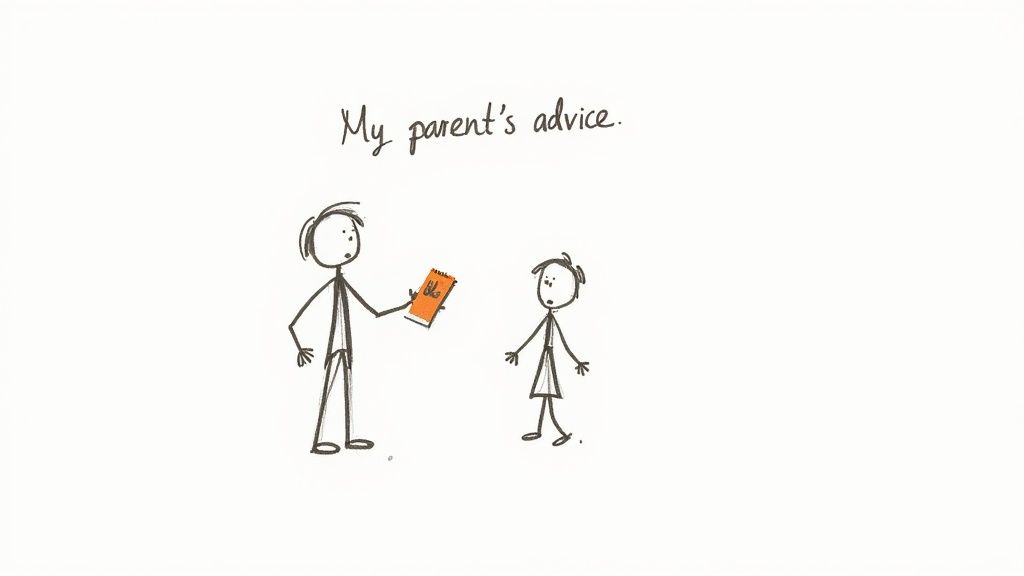
Unpacking Singular Possession
Getting this right is all about making your writing crystal clear. It leaves no room for guessing how many people you mean. Just ask yourself a quick question: "Does this belong to one parent?" If the answer is a definite yes, then parent's is your choice.
The key takeaway is simple: One parent = apostrophe + s ('s). This is a fundamental rule in English grammar that applies to any singular noun, not just 'parent'.
Let’s look at a few more real-world examples to drive the point home:
- "What is your parent's opinion on the new school policy?" (You're asking about the view of just one parent.)
- "The teacher needed a parent's signature on the permission slip." (A signature from any single parent is sufficient.)
- "A parent's journey is full of unexpected joys." (This refers to the journey of an individual parent.)
Clear communication like this is essential everywhere, from friendly chats to professional emails. A strong command of grammar can make a real difference in how your ideas are received, which is why many professionals look to sharpen their skills with something like a business English course in Singapore.
You'll also see this rule in action in titles of books and articles, such as A Parent's Guide to Knuffle Bunny, where the content is written for an individual reader. Once you've got this down, understanding the plural form is the next natural step.
Alright, let's tackle the plural possessive: parents'.
This is the one you need when you're talking about something that belongs to more than one parent. Think of it as the "team" possessive—it signals that the ownership is shared.
The trick is all in where you put the apostrophe. Since the word "parents" is already plural, you don't need to add another 's'. You just stick the apostrophe on the end, right after the existing s. Easy peasy.
It's All About Shared Ownership
Getting parents' right is how you show that something is a joint effort or a shared possession. If you're talking about the house both your mum and dad own, you'd say, "my parents' house." It belongs to them together.
This also works when you're referring to a whole group of parents, like all the parents at a school. A notice might read, "The headmaster is asking for all parents' cooperation." This means he needs help from the entire group, not just a single parent.
Here's the golden rule to remember: Multiple parents = s + apostrophe (s'). This simple shift from the singular form makes it crystal clear that you're talking about shared ownership.
Let's see this in action with a few real-world examples. In each case, we're talking about more than one parent.
- "The school held a meeting to gather the parents' feedback on the new curriculum." (This is feedback from the whole group of parents.)
- "What is your parents' anniversary?" (You're asking about the one anniversary they share.)
- "After a long debate, the parents' final decision was to cancel the trip." (A group of parents made a collective choice.)
- "A parents' work is never done." (This refers to the general, ongoing job of all parents everywhere.)
Nailing this little detail makes your writing not just grammatically sound, but also a lot more precise. It's a small change that makes a big difference.
Seeing the Difference with Real-World Examples
Grammar rules can feel a bit abstract until you see them in action. When it comes to parent's vs. parents', the placement of that tiny apostrophe completely changes the story you're telling. It’s the difference between talking about one person and talking about a team.
Let's look at a simple, everyday example: a car.
If you write, "My parent's car is parked outside," you're pointing to a car owned by just one of them—either your mum or your dad. The ownership is singular.
Now, change it to, "My parents' car is parked outside." Suddenly, the meaning shifts. This sentence tells us the car belongs to both of them; it's a shared family asset. That small grammatical tweak signals the move from individual to joint ownership.
Singular vs. Plural in Everyday Contexts
This distinction pops up everywhere. Picture a scene at a local school.
- Singular: "The teacher requested a parent's help with the decorations." (Any single parent will do.)
- Plural: "The teacher appreciated the parents' help with the decorations." (A group of parents chipped in.)
If you ever feel stuck, this quick flowchart can help you decide which one to use.
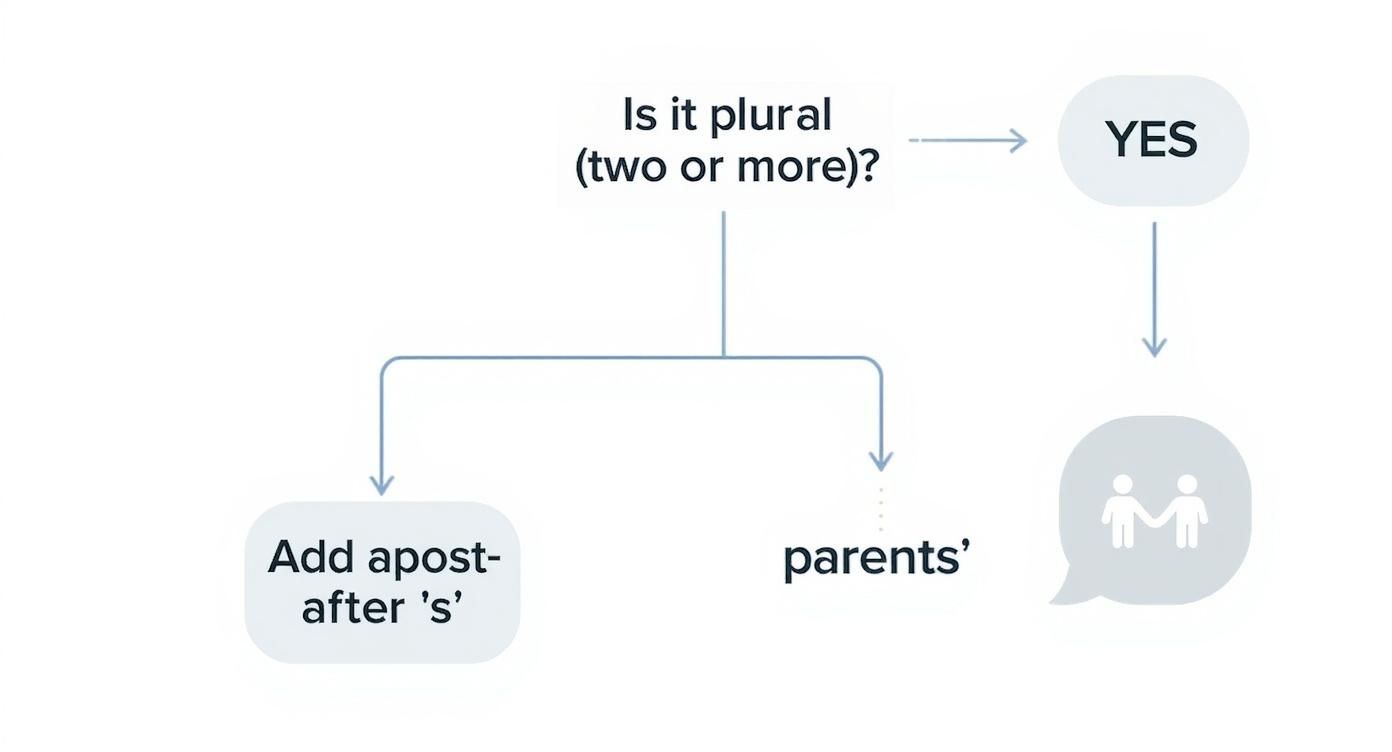
As the chart shows, if you're talking about more than one person, that apostrophe always lands after the 's'.
Reflecting Family Dynamics
The choice between parent's and parents' can also subtly reflect real-world family situations. In Singapore, for instance, a parent's journey is starting later than it used to. The median age for mothers at their first birth has climbed to 31.6 years, as more people build their careers before starting a family. This demographic trend shapes a parent's decisions and goals. You can find more details in this report on Singapore's population trends on channelnewsasia.com.
A single apostrophe is a small detail with a big job. It clarifies ownership and tells your reader exactly who you are talking about—one person or a collective group.
Getting this right moves the rule from a dry grammar point to a practical tool for clear communication. Whether you’re writing about a single parent's achievement or a collective parents' agreement, you can now do it with confidence and precision.
Common Mistakes and How to Avoid Them
It’s easy to get tangled up with apostrophes, especially with words like parent's and parents'. Even seasoned writers sometimes pause to get it right. But once you can spot the common trip-ups, you'll find yourself using them correctly without a second thought.
https://www.youtube.com/embed/GSF2cmnQACA
The most common mistake is simply mixing them up. We type quickly and our brain is often one step ahead of our fingers, so it's easy to write parent's when talking about both Mum and Dad, or parents' when you only mean one of them.
The best way to avoid this? Just stop for a second and ask yourself a simple question: "How many parents am I actually talking about?" One parent means parent's. Two or more means parents'.
Another frequent slip-up is leaving the apostrophe out altogether. Writing "parents" makes it a simple plural, indicating more than one parent, but it doesn't show that they own something.
Incorrect vs Correct Examples
Let's put these side-by-side to see the difference in action.
- Incorrect: All the student's parent's were invited. (This is doubly confusing, suggesting one student and one parent).
- Correct: All the students' parents were invited. (Here, "parents" is just a plural—no ownership is implied).
- Correct: The parents' meeting is on Tuesday. (The meeting belongs to all the parents, so the apostrophe goes after the 's').
Think of the apostrophe as a little flag that signals ownership. If you leave it out, you're just counting heads. Placing it correctly tells your reader who something belongs to.
This isn't just about grammar; it connects to real-world context. For instance, a parent's journey is often supported by strong family resilience. Here in Singapore, a notable 39.1% of parents report high family resilience, which shows a collective strength in facing challenges. This kind of support system is a huge part of modern parenting.
You'll even spot this common confusion in titles for articles and books. A guide titled A Parents Guide To Nurturing Your Child's Mental Health is a perfect example. To be grammatically precise, it should really be "A Parent's Guide" (for one parent) or "A Parents' Guide" (for multiple parents).
Getting these little details right makes a big difference in how clear your writing is. It's a fundamental skill, and one that's always worth sharpening, sometimes even in dedicated English classes for adults in Singapore.
Frequently Asked Questions About Possessives
Even when you've got the hang of parents' vs. parent's, a few oddball questions always seem to surface. Let’s clear up these common sticking points so you can handle any possessive with total confidence.
Think of this as your go-to guide for those slightly tricky situations that catch even seasoned writers off guard.
What About Names That End in S?
Ah, the classic grammar dilemma. When you're dealing with a singular name that already ends in 's', like James or Tess, you actually have a couple of correct options.
You can simply add an apostrophe after the 's', or you can add an apostrophe and another 's'.
- James' car is blue. (This is perfectly fine.)
- James's car is blue. (This is also correct and often what people prefer because it’s clearer when spoken.)
The most important thing here is consistency. Just pick one style and use it for the entire piece you're writing. For the plural, it's much more straightforward. If you're talking about the Jones family, their house is simply "the Joneses' house."
Do These Rules Apply to Other Words?
They sure do! The logic you've learned for parent's and parents' is a universal rule in English grammar. The same principles work for any other noun, whether it's singular or plural.
A couple of examples will make this crystal clear:
- One child's toy (singular possessive) vs. multiple children's toys (plural possessive).
- One boss's decision (singular possessive) vs. multiple bosses' decisions (plural possessive).
This is one of those wonderfully consistent rules that makes English a little less chaotic. Once you master it for "parent," you've basically got the key to using possessives correctly for thousands of other words.
The core principle is always the same: first, figure out if you're talking about one or more than one. Then, just apply the right apostrophe rule to show who owns what.
Nailing this basic concept is a huge step towards clearer, more professional writing. If you're keen to build on this and really sharpen your grammar, guided practice in online English language classes can be a fantastic way to build that rock-solid confidence.
Ready to expand your language skills beyond English? At Spanish Council Singapore, we offer engaging Spanish lessons for all ages. Start your journey to fluency today!