
Best language courses singapore: Find your ideal program
Here's your complete guide to finding the best language courses in Singapore. In a city that's a true melting pot, picking up a new language isn't just a hobby—it's one of the smartest moves you can make for your career and social life. This guide will walk you through everything you need to know to find a programme that actually works for you.
Why Singapore is the Perfect Place to Learn a New Language
Singapore’s unique character as a global hub makes it an incredible place to learn a new language. It’s not just the mix of cultures you see everywhere; it's an economic powerhouse where being multilingual gives you a real edge. Whether you're in business, finance, tech, or tourism, the ability to connect with people in their own language is a seriously valuable skill.
This city is essentially a living classroom. Think about it: you could be practising your Mandarin while ordering food at a hawker centre, using your Japanese to impress a client, or chatting in Spanish at a weekend festival. The chances to use what you learn are all around you, which is the best way to turn textbook knowledge into real, confident conversation.
What’s in it for You?
Signing up for a language course here is a direct investment in yourself. The payoff goes way beyond just adding a line to your CV.
- Boost Your Career: A lot of multinational companies in Singapore are looking for people who can connect with different markets. Speaking languages like Mandarin, Spanish, or Japanese can fast-track you to better roles and even international opportunities.
- Connect with More People: Learning a language helps you understand the communities around you on a much deeper level. You start to get the nuances of different traditions and points of view, which makes your social life a lot richer.
- Keep Your Brain Sharp: It's been shown over and over that learning another language is great for your brain. It helps with memory, problem-solving, and can even keep you sharper as you get older.
In Singapore, you don't have to look for opportunities to practise a new language—they find you. Every conversation, from grabbing a coffee to closing a deal, is a chance to build your confidence and fluency.
Finding Your Way Forward
With so many schools and learning styles out there, figuring out where to start can feel a bit much. How do you find the right fit for your schedule and your goals? Don't worry, that's what this guide is for.
We'll break down the pros and cons of online versus in-person classes so you can see what works for your lifestyle. We’ll also give you a simple checklist for picking a good school, looking at things like the quality of the teachers and how their courses are structured.
Most importantly, we’ll show you why a proven, structured learning path is the fastest way to get fluent. Let’s get you started on the right foot.
Choosing Your Learning Style: In-Person vs. Online Courses
So, you’re ready to learn a new language in Singapore. That’s fantastic! The very first big decision you’ll make is how you want to learn: in a physical classroom or online?
There’s no single right answer here. It really comes down to what works for you—your personality, your schedule, and how you learn best. Think of it as choosing between the vibrant, social energy of a traditional classroom and the incredible convenience of learning from anywhere.
In-person classes are brilliant if you thrive on structure and face-to-face interaction. Being in the room with your teacher and classmates creates a real buzz, making it easier to stay motivated. It’s perfect for those who like a set weekly routine and enjoy the camaraderie that comes from learning together.
On the other hand, online courses offer a kind of flexibility that’s hard to beat. You can join your class from home, the office, or even a quiet café, easily slotting lessons into a packed schedule. This is a huge plus for busy professionals and parents juggling a million things.
Your reason for learning—whether it's for your career, a love for the culture, or making new friends—can point you toward the best environment for your goals.
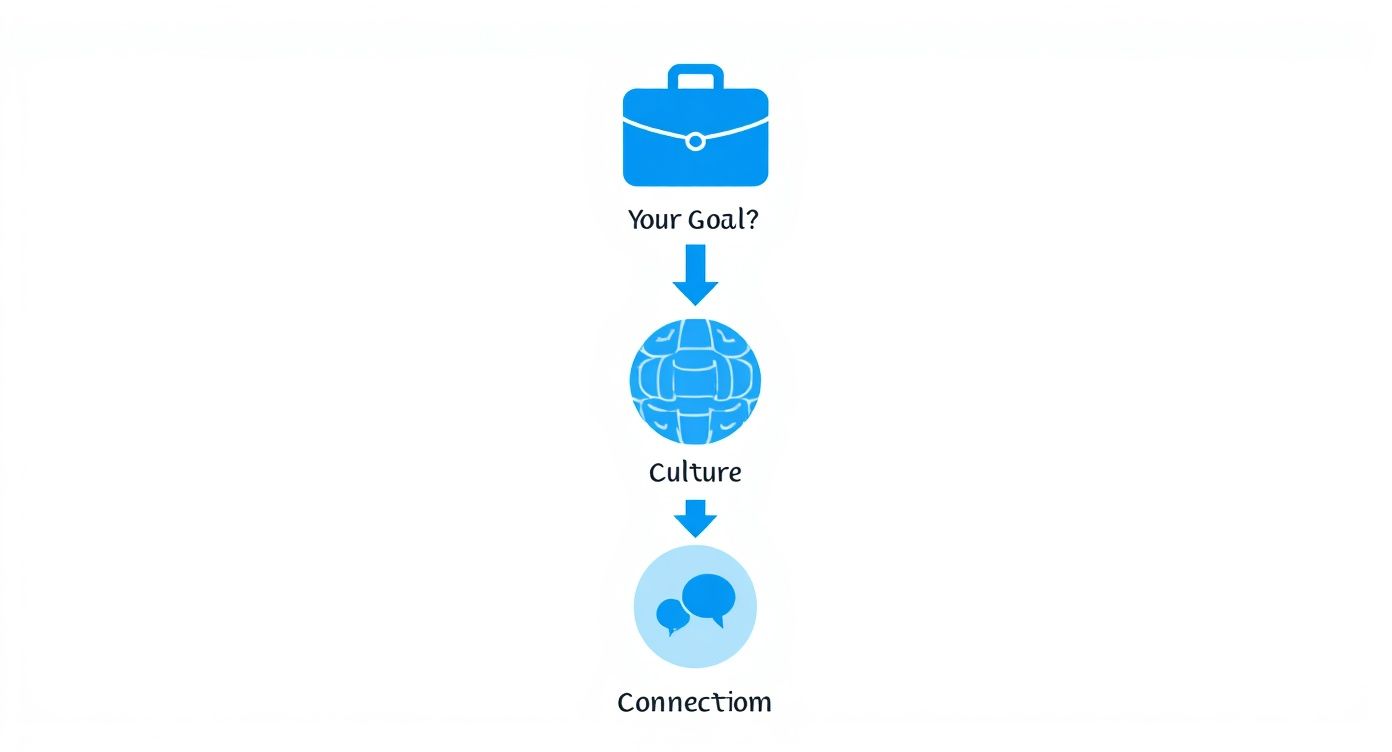
Ultimately, whether you’re aiming for a promotion or want to connect more deeply with another culture, there’s a learning format that will feel like a perfect fit.
The Rise of Online Language Education
Let's be clear: online learning is no longer just a convenient backup. Here in Singapore, it has become a powerful and popular way to learn.
The local online education market was valued at around $400 million in 2023, and it's not slowing down. Experts predict it could soar to $4.83 billion by 2033, which shows just how much people are embracing digital-first learning.
This boom is driven by more than just convenience; it’s about quality. In fact, Singapore boasts one of the highest online course completion rates in the world, with roughly 85% of learners seeing their programmes through to the end. That figure alone tells you that a well-designed online course can be just as effective as sitting in a classroom.
If you're curious about what makes virtual learning so successful, check out our detailed guide on the benefits of taking an online class in Singapore. It’s packed with practical tips to help you get the most out of your digital language journey.
Comparing In-Person and Online Language Learning Formats
To help you decide, let's put the two options side-by-side. Seeing the pros and cons clearly can make the choice a lot easier.
| Feature | In-Person Courses | Online Courses |
|---|---|---|
| Interaction | Get direct, real-time feedback and enjoy spontaneous chats with your teacher and classmates. | Communicate through video calls, chat boxes, and online forums. It's interactive, but different. |
| Flexibility | You get a fixed schedule and location. This creates a solid routine that many people need. | Learn from anywhere with an internet connection. Timetables are often more flexible or even self-paced. |
| Immersion | The classroom setting helps you focus and encourages you to actively participate without home distractions. | You need the self-discipline to create your own quiet, dedicated space for learning. |
| Resources | You'll use physical textbooks, whiteboards, and engage in hands-on group activities. | You get access to a huge range of digital tools, from interactive apps and videos to online quizzes. |
| Social Aspect | It's easier to build strong personal bonds and a real sense of community through shared classroom experiences. | You can connect with a global community of learners and have access to a wider variety of tutors. |
| Cost | You’ll often have extra costs like commuting and physical materials, which can add up. | Generally more affordable because there are fewer overheads for the school. Plus, you save on travel. |
In the end, choosing the right format comes down to knowing yourself. Are you the kind of person who needs the structure of a weekly class to stay on track? Or do you do your best work when you have the freedom to manage your own time?
The best learning environment is simply the one that removes friction and keeps you showing up. Whether that’s a classroom full of energy or the focused quiet of your study, pick the path that makes learning feel less like a chore and more like a part of your life.
By thinking about these points and how they align with your own lifestyle, you can confidently pick the format that will set you up for success. Whether you choose the dynamic energy of in-person language courses in Singapore or the unmatched convenience of an online programme, the most important thing is to find a method that keeps you excited and engaged, week after week.
What to Look for in a Great Language School
Trying to choose a language course in Singapore can feel a bit like navigating a maze. With so many options, all promising quick results, how do you see past the glossy brochures and find a school that will actually help you learn?
It really comes down to looking beyond the sales pitch. Think of it like picking a personal trainer. You wouldn't just go for the one with the fanciest gym; you’d check their qualifications, their training philosophy, and their track record. The same logic applies here. A great language school is built on a solid foundation of quality teaching, a well-thought-out curriculum, and a genuinely supportive environment.
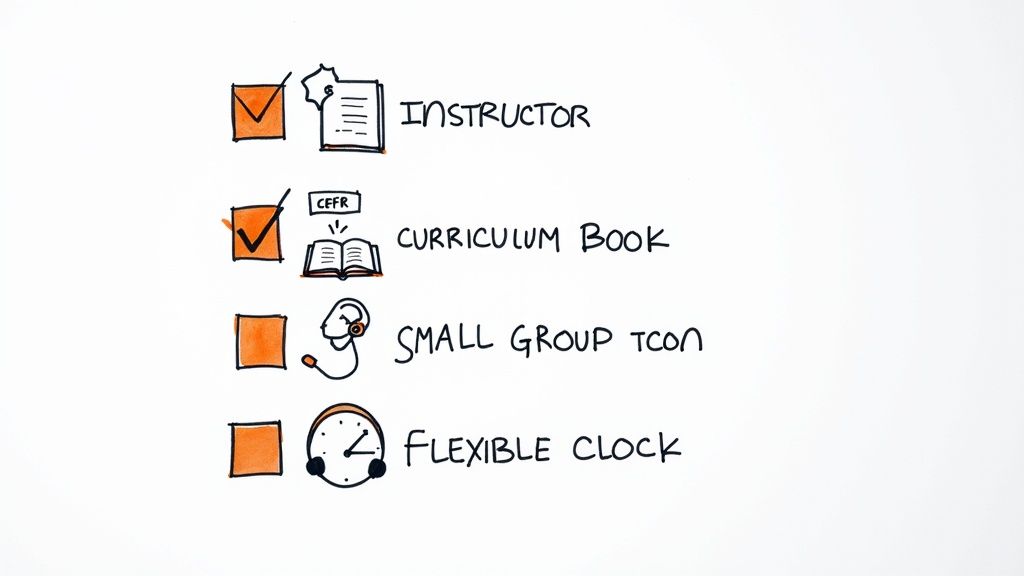
Let's break down the key things you should be asking about before you enrol. This will help you make a choice you feel good about.
Instructor Quality and Expertise
Honestly, your teacher is probably the most important part of your learning journey. A fantastic instructor does more than just walk you through grammar rules; they make the language come alive and get you excited to learn.
When you're checking out a school, get specific with your questions about their teaching staff. Are they native speakers? This is a big one. It's crucial for picking up authentic pronunciation, natural phrasing, and those little cultural details that non-native speakers often miss.
But being a native speaker isn't the whole story. Do they have actual teaching qualifications, like a degree in education or a recognised language teaching certificate?
A great teacher is both a native speaker and a trained educator. They don't just know the language; they know how to teach it effectively, breaking down complex ideas into simple, manageable steps.
This combination is the secret sauce. You’re learning from someone who not only speaks the language perfectly but also knows exactly how to guide you towards speaking it well, too.
Curriculum and Learning Framework
A school’s curriculum is basically its roadmap for your success. A jumble of random worksheets and activities isn’t going to get you very far. You want a programme built on a structured, internationally recognised framework.
A key standard to look for is the Common European Framework of Reference for Languages (CEFR). It’s a bit of a mouthful, but this system (which ranges from A1 for absolute beginners to C2 for mastery) gives you a clear and consistent way to track your progress. A CEFR-aligned curriculum makes sure you're building your skills in a logical order, covering all the essentials:
- Speaking: Plenty of chances for practical, real-world conversation.
- Listening: Hearing the language as it’s actually spoken by natives.
- Reading: Working with texts that are interesting and right for your level.
- Writing: Practising how to get your ideas across clearly and correctly.
The materials themselves should be modern and engaging. Think less dry, dusty textbooks and more interactive digital tools, videos, and content that’s culturally relevant. This practical focus is what helps you take what you learn in the classroom and actually use it in the real world.
Class Size and Learning Environment
The atmosphere you learn in makes a huge difference. One of the most critical factors here is class size. It's just too easy to get lost in the crowd in a massive, lecture-style class, and you’ll get almost zero personal attention.
For language learning, small group classes are almost always better. They create a comfortable, low-pressure setting where you feel more confident to speak up, ask questions, and even make mistakes—which is a huge part of learning! With fewer students, the instructor can offer personalised feedback and adjust the lesson to match the group's specific needs and speed.
Before you commit, ask if the school offers trial classes. Any reputable place will be happy to let you sit in on a lesson. It’s the perfect way to get a feel for the teacher's style, the dynamic of the class, and the overall vibe. Our guide on choosing the right language school in Singapore has more tips on what to look for during a trial. Finally, check if their scheduling has some flexibility, so you can find a class that fits into your life without the stress.
Why a Structured Learning Method Matters
Starting a new language is an adventure, but like any journey, you need a map. Too often, learners try to cobble together a plan from apps, YouTube videos, and random online articles. It feels like progress at first, but soon enough, they hit a wall, and that initial excitement fades into frustration.
This is where a structured learning method completely changes the game.
Think about it like building a house. You wouldn't just start throwing up walls and hope for the best, right? You'd lay a solid foundation first and follow a proper blueprint. A structured curriculum is that blueprint for language learning. It guides you logically from one concept to the next, making sure you don’t have any gaps in your knowledge.
This systematic approach is the key to avoiding those frustrating plateaus that plague so many self-learners. Instead of just memorising a random list of phrases, you develop a real, intuitive feel for how the language actually works—from the simplest words to complex, natural conversations.
The Problem with Unstructured Learning
Going it alone can feel liberating at first, but without a clear path, it’s easy to get lost and lose motivation. You might learn how to order a coffee, but then freeze when you need to ask for directions. You might know a bunch of nouns, but have no idea how to string them together into a proper sentence.
This pick-and-choose approach leaves you with Swiss cheese knowledge—full of holes. And the data backs this up. For over 60% of adults, the lack of a systematic guide is the single biggest roadblock to learning a new language. This leads to a massive 50% dropout rate for learners without a clear educational plan. On the other hand, research shows that learners in structured courses boost their vocabulary and conversation skills by an average of 50% simply because the curriculum is so well-designed. You can learn more about how adults can improve their English learning through structured methods on iworldlearning.com.
A structured method takes the guesswork out of learning. It ensures you’re not just learning what to say, but also why you’re saying it that way.
The Core Components of an Effective System
So, what makes a structured system work so well? It’s much more than just a textbook and a weekly class. The best language courses in Singapore weave together a few essential elements to create a learning experience that actually sticks.
- Progressive Skill Building: Each lesson is a stepping stone. You master the alphabet and basic greetings before you tackle sentence structure. You get comfortable with the present tense before diving into the complexities of the past or future. Everything builds on what came before.
- Balanced Practice: True fluency isn't just about speaking. A great course makes sure you get consistent practice in all four key areas: speaking, listening, reading, and writing. This way, no skill gets left behind.
- Regular Assessments and Feedback: Structured courses have built-in checkpoints, like short quizzes or conversational exercises. This isn't about passing a test; it's about getting targeted feedback from your instructor to fix small mistakes before they become bad habits.
This well-rounded approach is designed to turn you into a confident communicator who can understand and be understood in the real world.
A structured learning method is your assurance that every hour you invest is moving you closer to your goal. It transforms random effort into focused, measurable progress, building both your skills and your confidence step by step.
From Theory to Real-World Fluency
At the end of the day, the goal is to use the language outside the classroom. A structured method is built for exactly that. It's all about practical application, right from lesson one.
Instead of just drilling grammar rules, your lessons are based on real-life situations. You’ll find yourself role-playing ordering food at a restaurant, booking a hotel, or taking part in a business meeting. This kind of contextual learning is powerful because it connects new words and grammar to actual experiences, making them far more memorable.
This is how you build what experts call "communicative competence"—the ability to use language effectively to get things done. You don't just know the words; you know how to use them to navigate social and professional situations with confidence. That’s the true sign of fluency, and it’s the reward you get for committing to a structured path.
Preparing for Language Proficiency Exams
For a lot of people, learning a new language isn't just a hobby—it’s a calculated move with a very specific goal. Often, that goal has an acronym attached to it, like IELTS, JLPT, TOPIK, or DELE. These aren't just letters; they're official certificates that can unlock university admissions, new immigration pathways, or a major career boost.
If your ambition is tied to a specific score on one of these tests, a general conversation class simply won’t cut it. You need specialised exam preparation.
Think of it this way: it’s the difference between going for a casual jog in the park and training for a marathon. While both involve running, the marathoner follows a strict, highly structured plan focused on pacing, endurance, and race-day strategy. Exam prep courses work the same way. Their one and only objective is to arm you with the precise skills and strategies needed to perform your best under pressure.

These programmes do more than just teach you the language; they teach you how to master the exam itself. The approach is laser-focused on the unique challenges of each test, from navigating tricky question formats to managing the clock effectively, so you walk in on exam day feeling completely prepared.
What Makes Exam Prep Courses Different
General language classes are designed to build broad, everyday communication skills. The goal is to get you comfortable chatting in real-world situations. Exam preparation, on the other hand, is an entirely different ball game. It’s all about surgical precision.
These courses break the test down into its core components, training you to handle each section with confidence. Instructors don't just teach you vocabulary; they teach you the words most likely to show up on the test. They don’t just practise conversation; they drill you on the specific speaking tasks you'll encounter, whether that’s a structured interview or a short presentation.
Here’s where these specialised language courses in Singapore really give you an edge:
- Strategic Test-Taking: You’ll learn proven techniques for tackling confusing multiple-choice questions, writing high-scoring essays under a time limit, and acing listening sections where you only get one shot to hear the audio.
- Time Management Drills: The ticking clock is one of the biggest hurdles in any proficiency exam. Prep courses put you through timed simulations of the real thing, training you to allocate your time wisely so you don't run out of steam and leave easy marks behind.
- Understanding the Grader's Mindset: Great instructors know the exam’s scoring criteria inside and out. They can show you exactly what the examiners are looking for, helping you frame your answers in a way that maximises your score.
This kind of focused training helps demystify the entire process, turning a daunting exam into a predictable challenge you know how to beat.
Choosing the Right Exam Preparation Programme
Not all exam prep courses deliver on their promises. When your future career or education hangs in the balance, it’s crucial to pick a programme with a track record of real results. The best courses offer far more than just a quick review of the material; they provide a complete support system to build both your skills and your confidence.
The goal of a great exam prep course is not just to teach you the language, but to make the exam format feel second nature. When you walk into the test centre, there should be no surprises—only familiar tasks you have practised to perfection.
As you look at your options, hunt for a school that provides authentic practice and expert guidance. Don't be shy about asking specific questions about their resources and instructor experience to make sure you're getting the best possible preparation.
Here’s a checklist of what to look for:
- Access to Authentic Mock Exams: The programme absolutely must provide full-length practice tests that accurately mirror the difficulty, format, and timing of the real exam. This is the only way to track your progress and pinpoint your weak spots.
- Instructors with Exam Expertise: Your teacher needs to be more than just a native speaker. You want someone with specific, hands-on experience preparing students for your target exam. They should know its quirks and common pitfalls like the back of their hand.
- Detailed Performance Feedback: It’s not enough to just take a practice test. The school should give you personalised feedback, showing you exactly where you went wrong and offering clear, actionable advice on how to improve.
- Focus on All Four Skills: A solid course will give dedicated time to all four language skills—speaking, listening, reading, and writing. You need to be well-prepared for every single section of the exam, with no weak links.
Your Next Steps to Language Fluency
So, you've seen what Singapore offers when it comes to language courses. We've walked through the buzz of a physical classroom and the convenience of learning from your own home. Now it’s time to take all that information and turn it into a real plan.
The next part of your journey is all about you. It starts with getting crystal clear on your "why." Are you learning a language to climb the career ladder, to dive headfirst into a new culture on your travels, or simply to connect with family and friends? Once that motivation is locked in, picking the right learning format becomes so much easier—you can find a course that slots into your life, not one that turns it upside down.
Creating Your Personalised Action Plan
Let's be honest, self-study is tough. Committing to a proper course is often the one thing that separates those who dream of speaking a language from those who actually do. It gives you a clear roadmap, expert guidance, and that gentle nudge of accountability to keep you going.
To make the choice less daunting, here's a simple checklist to guide you.
- Define Your Primary Goal: Get specific. Write down exactly what you want to do. Is it acing the DELE exam? Or maybe it's as simple as ordering food confidently on your next holiday. A clear goal acts like a compass.
- Choose Your Ideal Format: Think about your daily routine and how you learn best. Do you thrive on face-to-face interaction, or do you need the flexibility of an online class? There’s no right or wrong answer, only what’s right for you.
- Shortlist Potential Schools: Pick two or three schools that tick the important boxes: qualified, native-speaking teachers, a curriculum aligned with the CEFR, and small class sizes for personal attention.
- Book a Trial Lesson: I can't stress this enough—it's non-negotiable. You need to get a feel for the teacher's style and the class atmosphere before you commit your time and money.
- Speak with an Education Advisor: Have a real conversation. A good advisor won’t just push the most expensive option; they’ll listen to your goals and help you find the perfect starting point.
From Learning to Application
Remember, the classroom is just the beginning. The real magic happens when you start using the language out in the world. A great way to do this is to find a language exchange in Singapore, where you can practise what you've learned in a totally relaxed, real-life setting.
The journey to mastering a new language is a marathon, not a sprint. Every lesson, every conversation, and every mistake is a step forward. With the right approach and the perfect course, you are well on your way to unlocking a world of new opportunities.
As your skills grow, you’ll discover that a new language opens doors you never even knew existed. For instance, high proficiency can lead to professional work with multilingual media. If you're curious, you can see how this plays out in tasks like translating Spanish video to English. It all starts with choosing the right course—your launchpad to these exciting ventures.
Still Have Questions? Let’s Clear Things Up
It’s completely normal to have a few questions buzzing around before you dive into a language course. Here are some quick, straightforward answers to the things we get asked most often.
What's the Typical Cost for a Language Course in Singapore?
This is the big one, isn't it? The price really depends on the language you choose, the school’s reputation, and whether you go for group or private classes.
For a standard group class—think a 10 or 12-week term—you can expect to pay somewhere between S$300 and S$800. If you're looking for one-on-one attention, private lessons usually run from S$50 to S$120 per hour. My advice? Always ask about package deals; many schools offer a discount if you sign up for a longer period.
Can I Use My SkillsFuture Credit for Language Lessons?
Yes, you certainly can! A lot of the best language schools in Singapore are approved SkillsFuture Credit providers. This is a brilliant government initiative that helps Singaporeans aged 25 and over offset the cost of upgrading their skills.
Just keep an eye out for the SkillsFuture logo on a school's website. If you don't see it, don't be shy—give their admissions team a call to check which of their courses are eligible.
Using your SkillsFuture credits is one of the smartest ways to make your language learning goals happen. It really helps lower the financial hurdle, making high-quality education accessible to more people.
How Long Until I'm Actually Fluent?
Ah, the million-dollar question! The honest answer is: it depends. It comes down to a few things—how complex the language is for an English speaker, how much time you put in each week, and your own natural knack for it.
To give you a rough idea, getting to a decent conversational level in a language like Spanish (that’s a B1 on the official CEFR scale) could take around 500-600 hours of focused learning. For something trickier with a completely new writing system, like Mandarin or Japanese, you might be looking at 1,500-2,000 hours to feel truly comfortable. A good programme will always be upfront about this and give you a realistic timeline.
Ready to start your Spanish learning journey with a structured, effective method? At Spanish Council Singapore, our native, certified teachers are here to guide you every step of the way. Explore our courses and book a trial lesson today!