Regions of spain: Explore Spain’s Diverse Regions and Cultures
Spain is a vibrant tapestry woven from 17 autonomous communities and two autonomous cities, each boasting its own distinct cultural, linguistic, and even political identity. Getting to know these regions is the real key to unlocking the incredible diversity of Spanish life—from the food and festivals to the languages and local customs.
What Are Spain’s Autonomous Regions?
The best way to understand the regions of Spain is to stop thinking of the country as one single place. Instead, picture it as a collection of unique nations living under one flag. Each of the 17 autonomous communities operates a bit like a mini-country, complete with its own government, parliament, and control over important areas like healthcare and education. This unique political setup comes from the Spanish Constitution of 1978, which formally recognised the country's profound historical and cultural diversity.
This decentralised system means that travelling from Andalusia in the south to the Basque Country in the north can feel like crossing an international border. You'll immediately notice the architecture change, hear different languages spoken on the street, and taste culinary traditions that have been shaped over centuries.
The Hierarchy of Spanish Regions
Spain’s administrative structure is layered in a clear hierarchy. At the very top, you have the nation of Spain. This is then divided into the 17 autonomous communities. These communities are then broken down further into 50 provinces, which act as the core administrative units.
This diagram helps visualise the relationship between the national government, the powerful autonomous communities, and the local provinces.

You can see how power flows from the national level down to the regional and provincial governments, giving each community a significant say in its own local affairs.
Why This Matters for Learners and Travellers
For anyone visiting Spain or learning the language, this regionalism is a huge deal. The Castilian Spanish you'll hear in Madrid isn't quite the same as the Spanish spoken in Seville or Bilbao. What's more, in regions like Catalonia, Galicia, and the Basque Country, Spanish is a co-official language alongside Catalan, Galician, and Basque. Being aware of these distinctions will make your travel experience so much richer.
Recognising regional identity is more than just a travel tip; it's a sign of cultural respect. Acknowledging that someone is Catalan, not just Spanish, shows an appreciation for the local history and pride that define the many regions of Spain.
This is just one part of the rich linguistic puzzle found across the Spanish-speaking world. For a wider view, you might want to check out our guide on the other countries that speak Spanish and their own unique dialects. And as you plan your trip through Spain's varied landscapes, a guide to the best places to stay in Spain can help you find the perfect home base for your adventures.
Exploring Northern Spain's Green Coast

Forget everything you think you know about Spain. Up north, there are no sun-scorched plains or flamenco rhythms. Instead, you'll find España Verde, or 'Green Spain'—a land where emerald hills crash into a wild Atlantic, misty mountains hide ancient secrets, and life is deeply entwined with the sea.
This lush, dramatic coastline along the Bay of Biscay is home to four distinct autonomous communities: Galicia, Asturias, Cantabria, and the Basque Country. Each brings its own unique character to the table, making a trip here feel like you’ve discovered a completely different country from the Mediterranean south. It's rugged, profoundly beautiful, and has a soul all its own.
The cooler, wetter weather is what gives the region its name and its breathtaking landscapes. For travellers, this translates to stunning coastal hikes, enchanting forests, and picture-perfect fishing villages that feel wonderfully untouched by time.
Galicia Where Celtic Roots Run Deep
Tucked away in the northwestern corner, Galicia feels more Celtic than Castilian. You can hear it in the skirl of the gaitas (bagpipes) and see it in the ancient stone settlements dotting the landscape. They even have their own language, Galician (Gallego), which sounds like a gorgeous melody somewhere between Spanish and Portuguese.
Of course, the spiritual heart of Galicia is Santiago de Compostela. This is the finish line for the hundreds of thousands of pilgrims who walk the Camino de Santiago every year. While the city’s cathedral is breathtaking, the real magic is in the streets, buzzing with the shared energy of accomplishment.
Beyond the pilgrimage, Galicia is an absolute paradise for seafood lovers. The culinary scene is a direct reflection of its wild coastline, with everything from tender octopus (pulpo a la gallega) to prized goose barnacles (percebes) on the menu.
Asturias and Cantabria Cider and Caves
Moving east along the coast, you’ll find Asturias, a region of almost impossibly beautiful scenery. It’s a land of contrasts, defined by the jagged peaks of the Picos de Europa National Park on one side and a deep-rooted cider-making tradition on the other. You haven't really been to Asturias until you've seen a bartender pour sidra from a great height to aerate it just right.
Visiting an Asturian sidrería (cider house) is more than just having a drink; it's a cultural experience. The ritual of the pour, the specific glass, the lively, communal atmosphere—it’s a tradition that perfectly captures the proud, sociable spirit of the Asturian people.
Right next door, Cantabria offers a similar mix of soaring mountains and pristine sea. But this region holds some of humanity's oldest treasures. It's home to caves like Altamira, often called the "Sistine Chapel of Paleolithic Art," which hides some of the world's most important prehistoric paintings. For a great home base, the elegant coastal city of Santander is perfectly placed for exploring both beaches and mountain villages.
The Basque Country A Unique Cultural Nation
And then there's the Basque Country, or Euskadi. It is truly a world apart. The region is home to one of Europe's oldest languages, Basque (Euskera), a linguistic mystery with no known relatives on Earth. This unique language is the bedrock of a fiercely independent and proud cultural identity.
In recent decades, the region has masterfully blended its ancient traditions with a bold, modern vision. Some unmissable highlights include:
- Bilbao: Once an industrial hub, it was completely revitalised by the iconic Guggenheim Museum, a jaw-dropping masterpiece of modern architecture.
- San Sebastián (Donostia): A stunningly beautiful coastal city celebrated for its world-class food scene, especially the famous pintxos—small, edible works of art that are a social ritual in themselves.
- Coastal Towns: Charming fishing villages like Getaria and Zarautz offer spectacular scenery and a welcome, slower pace of life.
For anyone learning Spanish, Northern Spain is both a fascinating challenge and a rich opportunity. Castilian Spanish is spoken everywhere, but you’ll be surrounded by the distinct sounds of Gallego and Euskera. Taking the time to learn just a few words in the local language—a simple "kaixo" (hello) in Basque goes a long way—will be warmly appreciated and truly deepen your connection to this incredible part of Spain.
Exploring the Heart of Central Spain
Welcome to the Meseta Central, the vast, high plateau that forms the very soul of Spain. This is where modern Spain was born, where the Castilian Spanish language we learn today was shaped, and where you'll find a landscape of stark, beautiful contrasts. The regions here—the Community of Madrid, Castile and León, and Castilla-La Mancha—offer a journey through monumental history, classic literature, and a deeply-rooted cultural identity.
If you're learning Spanish, this is ground zero. The accent here, especially in cities like Salamanca and Valladolid, is often held up as the clearest, most "standard" form of Castilian Spanish. It makes Central Spain the perfect place to tune your ear and master pronunciation without the strong regional accents you’ll hear elsewhere.
This whole area is like a living museum. You'll find ancient Roman foundations holding up magnificent medieval cathedrals and grand Renaissance palaces. It's a place where you can literally walk through the pages of history, from the multicultural melting pot of medieval Toledo to the golden age of Salamanca's university, one of the oldest in the world.
Madrid: The Energetic Epicentre
Right in the middle of it all sits the Community of Madrid, a dynamo of culture, politics, and art. It might be small in size, but its influence is massive. The capital city itself is a buzzing metropolis that truly never sleeps, famed for its world-class art museums like the Prado and Reina Sofía, its legendary nightlife, and the beautiful oasis of Retiro Park.
But there’s more to Madrid than just the city buzz. A short trip out of the centre reveals quiet historic towns and peaceful mountain scenery. To really get a feel for the region, check out some of these unforgettable day trips from Madrid, which showcase the true character of the surrounding countryside.
Castile and León: Land of Castles and Kings
Stretching north and west of Madrid, you'll find Castile and León, the largest of all Spain's autonomous communities. Its name says it all: this is the "Land of Castles." Majestic fortresses are scattered across its vast, windswept plains, standing as silent reminders of centuries of conflict and power. This region was the driving force behind the Reconquista and the heart of the formidable Kingdom of Castile.
The cities here are absolute treasures, each with its own story:
- Salamanca: Home to a breathtaking Plaza Mayor and a world-renowned university, its sandstone buildings practically glow at sunset.
- Segovia: Instantly recognisable by its colossal Roman aqueduct, fairy-tale Alcázar (castle), and mouth-watering roast suckling pig (cochinillo asado).
- Ávila: Famous for being completely encircled by perfectly preserved 11th-century walls that you can still walk along today.
The province of Segovia itself offers a fascinating glimpse into the region's history. Its population swelled from just over 6,600 inhabitants in 1842 to nearly 51,000 by 1981—a huge change reflecting centuries of migration from the countryside into the cities. You can learn more about Segovia's demographic story on Wikipedia.
Castilla-La Mancha: The Land of Don Quixote
Head south of Madrid and you’ll enter Castilla-La Mancha, an arid, sparsely populated landscape made famous forever by Miguel de Cervantes' masterpiece, Don Quixote. This is where you'll find those iconic windmills silhouetted against an endless blue sky, just as the knight errant imagined them to be giants.
Visiting Castilla-La Mancha really does feel like stepping inside a novel. The stark beauty of the plains, the historical weight of cities like Toledo, and the simple pleasure of tasting authentic Manchego cheese connect you directly to the soul of Spanish literature and history.
Toledo, the region's historic capital, is an absolute must-see. It’s known as the "City of Three Cultures" for a reason; for centuries, Christians, Muslims, and Jews lived together here, leaving behind an incredible architectural tapestry of mosques, synagogues, and churches. Beyond its rich history, the region is also the world's largest producer of wine, and of course, it’s home to the iconic Manchego cheese, made from the milk of the local Manchega sheep.
Touring the Sun-Drenched Mediterranean Coast
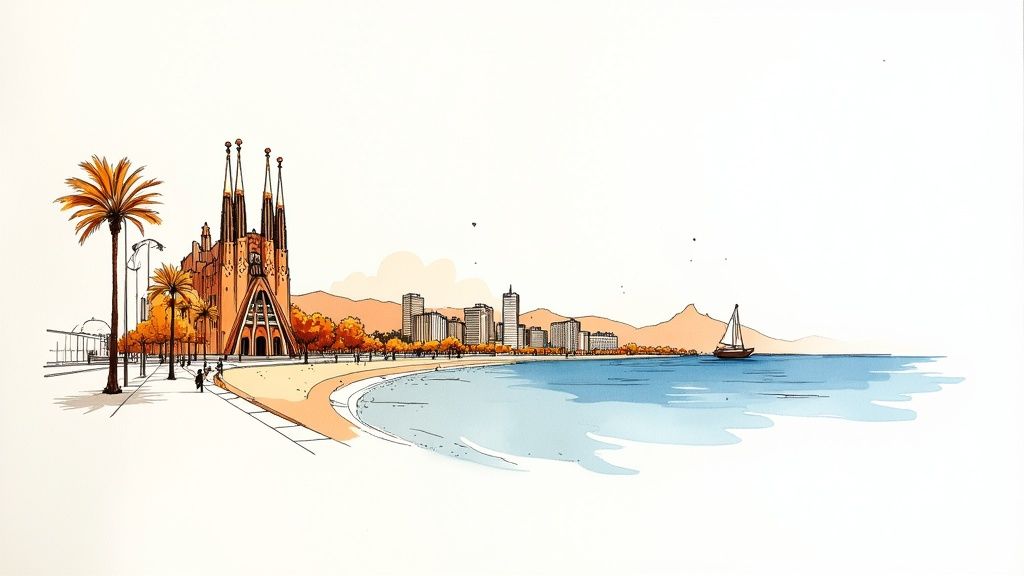
As we leave the vast central plateau, we head east to Spain’s legendary Mediterranean coast. This is the Spain you see on postcards—endless sun-drenched beaches, dazzling azure waters, and cities that practically thrum with life. But there’s so much more to this coastline than just a holiday escape. It’s a rich tapestry woven from ancient history, fierce regional pride, and distinct languages that truly set it apart from the rest of the country.
Our journey starts in the proud northeast corner with Catalonia, then winds south through the Valencian Community and Murcia before we hop over to the Balearic Islands. For anyone learning Spanish, this stretch is especially fascinating. You’re stepping into a proudly bilingual world where Castilian Spanish exists side-by-side with Catalan, offering a real-world lesson in how co-official languages shape daily life.
Catalonia: A Nation Within a Nation
Catalonia is one of Spain’s most fiercely independent regions, boasting a unique cultural identity that’s deeply connected to its own language, Catalan. Wander through its capital, Barcelona, and you'll see street signs, read menus, and overhear conversations in both Catalan and Spanish. This isn’t just a dialect; it’s a full-fledged Romance language spoken by over 9 million people.
Barcelona is the region's glittering centrepiece, celebrated for the fantastical architecture of Antoni Gaudí, like the still-unfinished masterpiece, the Sagrada Família. But venture beyond the capital and you’ll discover the ancient Roman ruins in Tarragona and the rugged, breathtaking beauty of the Costa Brava. Even the food reflects this distinct character, from the simple perfection of pa amb tomàquet (bread with tomato) to wildly inventive culinary creations.
For travellers, making a small effort with the local language goes a long, long way in Catalonia. Learning a few basic phrases like 'Bon dia' (Good day) or 'Gràcies' (Thank you) is a simple but powerful gesture of respect that the locals will always appreciate.
The Valencian Community: Home of Paella
Moving south along the coast, we arrive in the Valencian Community, a region whose name is practically synonymous with one of Spain’s most iconic dishes: paella. You can find it all over the country, of course, but Valencia is its undisputed birthplace. The authentic, traditional recipe here is made with chicken, rabbit, and local beans—a world away from the seafood-heavy versions popular elsewhere.
The region’s capital, also named Valencia, is a brilliant study in contrasts. It's home to the stunningly futuristic City of Arts and Sciences complex, which sits alongside a charming old town and a magnificent central market. This is also where the explosive Las Fallas festival takes place every March, where enormous papier-mâché sculptures are paraded through the streets before being spectacularly set ablaze.
Much like its northern neighbour, this region has its own language, a dialect of Catalan known locally as Valencian, which shares co-official status with Spanish. You'll spot it on public signs and hear it spoken, though Spanish tends to be more dominant here than Catalan is in Barcelona.
Murcia and The Balearic Islands
Further down the coast is the often-overlooked Region of Murcia. Known as the huerta (orchard) of Europe, its incredibly fertile plains produce a staggering amount of the continent's fresh fruit and vegetables. Its coastline, the Costa Cálida ("Warm Coast"), is famous for the Mar Menor, a huge saltwater lagoon that's a paradise for water sports enthusiasts.
Finally, out in the sparkling Mediterranean, we find the Balearic Islands, an archipelago where each island has its own distinct personality.
- Mallorca: The largest of the islands, it offers everything from the dramatic Serra de Tramuntana mountain range to beautiful beaches and the elegant capital city of Palma.
- Menorca: A much quieter, more reserved island, it’s recognised as a UNESCO Biosphere Reserve and is known for its pristine, untouched coves and ancient prehistoric stone monuments.
- Ibiza: While famous for its world-class nightlife and legendary DJ scene, Ibiza also has a tranquil side, with quiet villages, yoga retreats, and stunning natural parks.
Across all of these Mediterranean regions, food is absolutely central to life. There's a huge emphasis on fresh seafood, perfectly cooked rice dishes, and small plates made for sharing. To really get a feel for this custom, it helps to learn more about the art of ordering at a traditional Spanish tapas bar and see how it brings people together. This social side of dining is a core cultural experience, whether you're in a bustling Barcelona bar or a sleepy seaside town in Murcia.
Finding the Soul of Southern Spain
Head south and you'll find the Spain that lives in the global imagination—a passionate, sun-drenched land where history feels alive and the rhythm of life slows down. We're talking about Andalusia and its rugged neighbour, Extremadura.
This is the region that gave the world flamenco, tapas, and the classic imagery of bullfighting. It’s the source of so many Spanish stereotypes, but the reality you’ll discover on the ground is infinitely richer and more captivating. The South’s identity was forged over centuries, most powerfully by nearly 800 years of Moorish rule. That legacy isn't just tucked away in museums; it’s carved into the architecture of its greatest cities and lingers in the air, from the sun-baked olive groves to the iconic whitewashed villages (pueblos blancos) dotting the hills.
Andalusia: A Land of Passion and Heritage
Andalusia is the Spain you’ve likely dreamt of. It's a massive region made up of eight distinct provinces, each with its own flavour, but together they pack a cultural punch like nowhere else. This is where you can feel the gut-wrenching emotion of an authentic flamenco performance, jostle for space in a noisy tapas bar, or get lost in palaces straight out of a storybook.
A few cities here are absolute must-sees for any visitor:
- Seville: The region’s vibrant capital, famous for the scent of orange blossoms that fills its streets. It’s home to the largest Gothic cathedral in the world and the breathtaking Alcázar palace.
- Granada: Tucked against the stunning Sierra Nevada mountains, this city is the guardian of Spain's most-visited monument: the magnificent Alhambra Palace.
- Córdoba: Once the capital of a powerful Moorish caliphate, its historic heart is the mesmerising Mezquita-Cathedral—a mosque of staggering beauty with a full cathedral built right inside it.
- Málaga: This lively port city on the Costa del Sol is more than just beaches. It's the birthplace of Pablo Picasso and boasts a fantastic mix of art, history, and seaside energy.
The essence of Andalusia is perfectly captured by the word ‘duende’. In flamenco, it describes that raw, indescribable moment of pure emotion and artistic truth. It’s not something you can learn; you just have to feel it—and that perfectly sums up the soul of this region.
Extremadura: The Rugged Frontier
Just west of Andalusia lies Extremadura, one of Spain’s least-visited yet most rewarding regions. It’s a land of vast, open landscapes, untamed nature, and a powerful sense of history. Many of Spain’s most famous conquistadors hailed from here, and you can still see the grand palaces they built with riches from the New World in cities like Cáceres and Trujillo.
But Extremadura's real crown jewel is its Roman heritage. The city of Mérida was once the capital of the Roman province of Lusitania, and today it boasts some of the most spectacular Roman ruins in Spain. With a magnificent theatre, soaring aqueducts, and ancient temples still standing, walking through the city feels like stepping back 2,000 years in time.
Tuning Your Ear to the Andalusian Dialect
For anyone learning Spanish, Andalusia is the perfect place to get your ear accustomed to one of the most common and distinct dialects. The accent, known as Andaluz, is famously melodic and fast-paced, with a few quirks that might throw you off at first but are key to understanding the locals.
The most obvious feature is how the 's' and 'z' sounds are handled. It's called seseo, where the 'c' (before an 'e' or 'i') and the 'z' are both pronounced like a soft 's'. This is different from the 'th' sound you hear in Central Spain. So, a word like gracias will sound more like "gra-see-as" instead of "gra-thee-as".
You'll also notice that Andalusians often drop the final 's' from words. A common greeting like “buenas tardes” (good afternoon) can sound more like "buena tarde". Similarly, the 'd' often vanishes from words ending in '-ado', turning cansado (tired) into "cansao". Picking up on these patterns won't just improve your comprehension; it will help you connect with the famously warm and welcoming people of Southern Spain.
A Guide to the Spanish Islands
Spain’s vibrant character doesn't just stop at the mainland's edge. It sails out across the waves to two spectacularly different archipelagos, each forming its own autonomous community: the Balearic Islands in the Mediterranean and the Canary Islands out in the Atlantic.
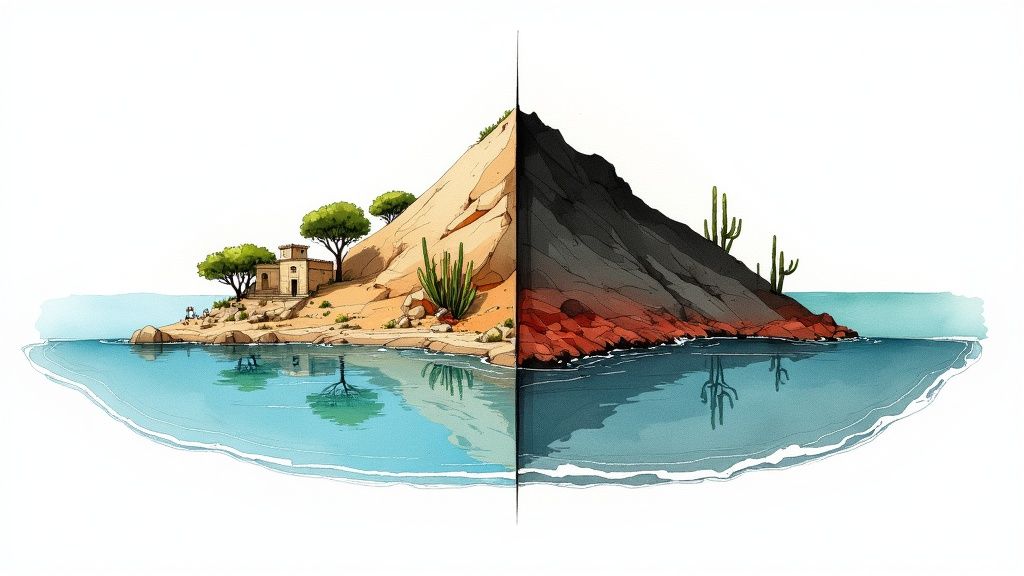
While both promise sun and sea, they couldn’t be more different. The Balearics are the picture-perfect Mediterranean dream. Think turquoise coves and that classic European summer buzz. The Canaries, on the other hand, sit off the coast of Africa, a subtropical world shaped by volcanic fire with a climate that feels like spring all year round.
The Mediterranean Balearic Islands
Closer to home, the Balearic Islands—Mallorca, Menorca, Ibiza, and Formentera—are steeped in Mediterranean culture. They are famous for their stunning sheltered coves, known as calas, charming old towns, and an infectious energy. Each island has its own distinct flavour.
- Mallorca: The giant of the group, offering everything from the dramatic Serra de Tramuntana mountains to buzzing beach resorts and the sophisticated capital, Palma.
- Ibiza: Yes, it’s a world-renowned party destination, but it also has a quieter, bohemian side filled with peaceful villages and yoga retreats.
- Menorca: A more laid-back affair, this island is a UNESCO Biosphere Reserve, celebrated for its wild, unspoiled landscapes.
Here, Catalan is spoken right alongside Spanish, a constant reminder of the islands’ deep cultural ties to Spain's eastern coast. This irresistible charm makes the Balearics a perennial favourite for holidaymakers across Europe.
The Atlantic Canary Islands
Head over 1,000 kilometres south of mainland Spain, and you'll find a completely different world. The Canary Islands, an archipelago of eight main islands including Tenerife, Fuerteventura, Gran Canaria, and Lanzarote, are all about raw, volcanic beauty. It’s a place of black sand beaches, surreal lava fields, and pockets of lush, subtropical forest.
The star of the show is Mount Teide on Tenerife. It’s not just a mountain; it’s Spain’s highest peak and an enormous volcano that dictates the entire island's geography. Over on Fuerteventura, you'll find vast, windswept beaches that feel more like the Sahara than Spain, making it a paradise for windsurfers and kiteboarders.
For anyone learning Spanish, the Canarian dialect is a real treat. They drop the 'th' sound (a phenomenon called seseo) and use words and rhythms that sound much closer to Latin American Spanish. It's like finding a linguistic bridge between two continents.
Exploring these two island groups really drives home the sheer scope of the regions of Spain. From the familiar blues of the Mediterranean to the wild, volcanic frontier of the Atlantic, the islands offer a brilliant contrast and add another fascinating layer to Spain’s rich and diverse story.
Common Questions About the Regions of Spain
When you start digging into the different parts of Spain, a few questions always pop up, especially for travellers and language students. Getting a handle on these makes exploring the country's incredible diversity that much richer.
One of the biggest questions is always about language. Yes, Castilian Spanish is the official language for the whole country and you can get by with it anywhere. But it’s far from the only language spoken. In fact, there are four other co-official languages with histories just as deep.
What Languages Are Spoken Where?
Getting to know the linguistic map of Spain is your first step to really connecting with the local culture. Here are the main languages you'll come across:
- Castilian Spanish: The one you can use everywhere, from north to south.
- Catalan: Co-official in Catalonia, the Balearic Islands, and the Valencian Community.
- Galician (Gallego): Spoken in Galicia, it actually sounds quite a bit like Portuguese.
- Basque (Euskera): The unique language of the Basque Country and parts of Navarre. It's a true linguistic mystery with no known relatives!
You certainly don't have to be fluent in the local tongue, but a small effort goes a long way. Dropping a simple 'Bon dia' (Good day) in Barcelona is a fantastic way to show respect, and locals really appreciate it.
Where’s the Best Place to Learn Spanish?
If your main goal is to nail the language, some parts of Spain have a reputation for having a very clear, standard accent.
People often say the purest, most "standard" Castilian accent comes from the region of Castile and León. Cities like Salamanca and Valladolid are famous for this, making them a fantastic choice if you want to really sharpen your pronunciation.
Madrid is another top-notch option. You get a similarly clear accent but with all the buzz and learning resources of a huge capital city.
Of course, the Spanish you'll hear in Spain is quite different from what you'd find across the Atlantic. For a fascinating comparison, you can read about the unique quirks of the Spanish language in Argentina and see just how much pronunciation and vocabulary can change.
At Spanish Council Singapore, we don't just teach a language; we bring the diverse cultures and dialects of the entire Spanish-speaking world into our lessons. Ready to begin? Explore our courses with expert native teachers at https://spanish.sg.