A Guide to the Days of the Week in Spanish
Learning the days of the week in Spanish is one of those first, essential steps you take on the road to fluency. Getting these seven words down—lunes, martes, miércoles, jueves, viernes, sábado, and domingo—is a game-changer. Suddenly, you can schedule appointments, make plans with friends, and chat about your daily routine.
It’s a small piece of vocabulary that unlocks a huge part of everyday conversation.
Your Quick Guide to the Spanish Weekdays
Before we jump into the grammar rules and interesting origins behind the words, let's start with a simple, practical overview. Think of this as your go-to cheat sheet. It gives you exactly what you need to start using the words right away, building a solid foundation for everything else we'll cover.
This quick-reference table is perfect for beginners who just need the basics, fast. It lays out each Spanish day, its English equivalent, and an easy-to-follow phonetic guide to help you sound natural from the very first try.
Quick Guide to Spanish Days and Pronunciation
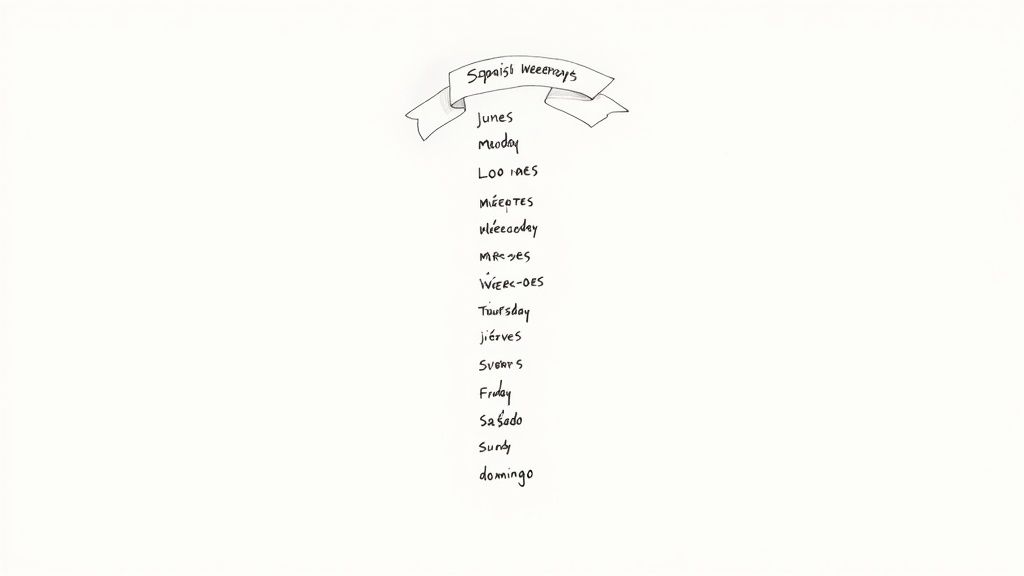
Memorising new vocabulary can feel like a chore, but a clear visual aid really helps cement the words in your mind. The table below lays out all seven days of the week in Spanish, so you can see everything at a glance.
| Spanish Day | English Translation | Phonetic Pronunciation |
|---|---|---|
| lunes | Monday | loo-ness |
| martes | Tuesday | mar-tess |
| miércoles | Wednesday | mee-air-koh-less |
| jueves | Thursday | hway-vess |
| viernes | Friday | vee-air-ness |
| sábado | Saturday | sah-bah-doh |
| domingo | Sunday | doh-ming-goh |
Keep this table handy on your phone or print it out. A little bit of practice each day, and you'll have them memorised in no time.
A Simple Memory Trick to Get You Started
Struggling to remember the order? A mnemonic device can be a lifesaver. These are just clever memory aids that link new information to a phrase or idea you already know, making it much easier to recall.
Try this fun little phrase: "Lazy Monkeys Make Jokes Very Slowly Daily." Each word's first letter lines up perfectly with the first letter of the Spanish day of the week, starting with lunes and going all the way through to domingo.
This trick gives your brain a simple pattern to latch onto, turning what feels like a random list of words into a memorable sequence. Of course, as you get more comfortable with the language, you won't need it anymore. But for now? It’s a fantastic tool to get you started on the right foot.
With this foundation set, you're ready to dig a little deeper into the grammar and culture behind these essential words.
Uncovering the Stories Behind the Spanish Weekdays

Learning the days of the week in Spanish isn’t just about memorising a new set of words. It’s like opening a secret history book filled with tales of planets, gods, and ancient Roman traditions. Every name has a story, connecting our modern calendar all the way back to the cosmos as seen by ancient observers.
When you understand the 'why' behind the words, the vocabulary suddenly clicks. This historical context gives you a powerful memory anchor, making the names much easier to remember and even more fun to use.
The Planetary Connection from Monday to Friday
For the most part, the Spanish weekdays owe their names to Roman mythology and astronomy. The Romans named the days after the seven celestial bodies they could see with the naked eye, each of which they linked to one of their most powerful gods. This fascinating tradition is still alive and well in the Spanish language today.
Here's a breakdown of how it all connects:
- Lunes (Monday): This comes from dies Lunae, or "day of the Moon." The link is easy to spot in the Spanish word for moon, luna.
- Martes (Tuesday): Named for Mars, the fiery Roman god of war. It comes from the Latin dies Martis, "day of Mars."
- Miércoles (Wednesday): This day honours Mercury, the swift messenger of the gods. Its origin is dies Mercurii, or "day of Mercury."
- Jueves (Thursday): This one gets its name from Jupiter, the king of all gods. It's derived from dies Jovis, meaning "day of Jove (Jupiter)."
- Viernes (Friday): Dedicated to Venus, the goddess of love and beauty, from the Latin dies Veneris, "day of Venus."
This ancient history is woven into the daily lives of millions. In South America alone, Spanish is the main language in nine countries, spoken by nearly 210 million people—that's about half the continent's population! So, these celestial echoes are a huge part of the cultural fabric. You can discover more insights about the languages spoken in South America to see just how widespread this influence is.
The Weekend: A Story of Rest and Religion
While the work week is all about the planets, the weekend takes a different turn, drawing its meaning from deep-seated religious traditions.
The names for Saturday and Sunday break the planetary pattern, instead reflecting a deep cultural emphasis on rest and worship that has shaped weekly routines for centuries.
Sábado (Saturday) actually comes from the Hebrew word "Sabbath," which means a day of rest. This was adopted into Latin as sabbatum and eventually evolved into the Spanish sábado.
And finally, we have domingo (Sunday). Its roots are in the Latin term Dominicus, which translates to "the Lord's day." This name was chosen to signify the Christian day of worship, and it replaced the original pagan name, dies Solis (day of the Sun).
Mastering the Grammar for Spanish Weekdays
So, you’ve memorised the seven days of the week in Spanish—fantastic! That’s the first big step. Now, let's look at how to actually use them in a real conversation. Spanish grammar for weekdays has a few key differences from English that often trip up beginners, but I promise the rules are refreshingly simple once you get the hang of them.
Nailing these little details is what will make you sound less like someone reading from a textbook and more like a natural speaker. It’s the bridge between knowing the words and knowing how to build sentences with them. Let’s break down the essentials.
Why Spanish Weekdays Are Always Masculine
First up, a simple rule with no exceptions: in Spanish, every single day of the week is a masculine noun. This might feel a bit strange at first, but it's just one of those things you learn to accept. Think of it this way—a day (el día) is masculine, so it makes sense that the days themselves are too.
Because they're all masculine, you'll always use masculine articles in front of them:
- el for a single day (the)
- los for multiple days or recurring days (the, plural)
For instance, "The meeting is on Monday" becomes La reunión es el lunes. See how we use el? This is true for every day, all the way from lunes to domingo. Simple, right?
Making the Days of the Week Plural
Here’s another rule that’s much easier than it seems. How do you say things like "I have class on Mondays" or "We go out on Fridays"? Your first instinct might be to add an ‘s’ to the end of the day, but Spanish makes it even simpler for most of the week.
The days from lunes (Monday) to viernes (Friday) already end in '-s'. This is a huge clue! It means their singular and plural forms look exactly the same. The only thing you change is the little word in front of it.
The Trick to Plurals: To make a weekday plural, just switch the article from el to los. The day's name stays the same… unless it's the weekend.
Let's see it in action:
-
Singular: el lunes (on Monday)
-
Plural: los lunes (on Mondays)
-
Singular: el viernes (on Friday)
-
Plural: los viernes (on Fridays)
The weekend days are the only ones that play by different rules because they don't end in '-s'. For these, you do exactly what you’d expect: just add an '-s' at the end.
- sábado becomes sábados
- domingo becomes domingos
Other Essential Grammar Rules
There are just a couple more small but super important rules that will make your Spanish sound polished and correct.
The first is capitalization. In English, we always capitalize the days of the week. In Spanish, you don't. The days of the week are not capitalized unless they happen to be the very first word in a sentence. This rule also applies to months, so it’s a good one to remember. If you're curious about similar rules, you can also learn how to write numbers in Spanish in our detailed guide.
The second point is about saying "on" a certain day. A common mistake for English speakers is to directly translate "on Monday" to en lunes. This is incorrect. In Spanish, the article—el or los—already does the job of "on." So, el martes means "on Tuesday," and los sábados means "on Saturdays." You never need to add en.
Here's a quick table to bring all these rules together.
Spanish Weekday Grammar Rules
| Grammar Rule | Singular Example (Monday) | Plural Example (Mondays) | Key Tip |
|---|---|---|---|
| Masculine Article | La clase es el lunes. (The class is on Monday.) | Las clases son los lunes. (The classes are on Mondays.) | Always use el for one day and los for multiple days. |
| Pluralization | el lunes (ends in -s) | los lunes (no change to the word) | For lunes to viernes, only change the article. Add -s to sábado and domingo. |
| Preposition "On" | Tengo una cita el miércoles. (I have an appointment on Wednesday.) | Salimos los viernes. (We go out on Fridays.) | Don't use en! The article (el/los) already means "on". |
| Capitalization | Nos vemos el jueves. (See you on Thursday.) | El viernes es mi día favorito. (Friday is my favourite day.) | Never capitalize days of the week unless they start a sentence. |
Thinking about these four simple rules—masculine articles, plurals, no en, and no capitals—will quickly become second nature and make your Spanish sound much more authentic.
Using Spanish Weekdays in Real Conversations
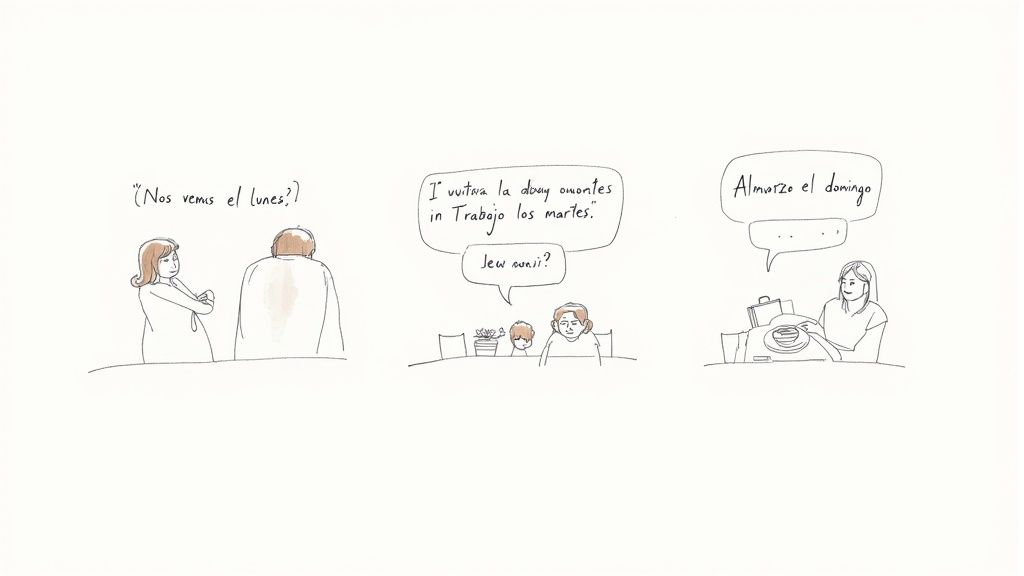
Knowing the rules is one thing, but actually using them in a natural conversation is a whole different ball game. Let’s close that gap and put the days of the week in Spanish into real-world action. This is where the vocabulary truly comes alive, helping you make plans, chat about your schedule, and genuinely connect with people.
Seeing these words in context is hands-down the best way to make them stick. We'll walk through some practical examples you can start using right away, whether you're organising a coffee catch-up or just talking about your weekend plans.
Making Plans and Scheduling Events
One of the first things you'll need the days of the week for is scheduling. From booking an appointment to arranging a meet-up with friends, these phrases are your bread and butter. A key thing to notice is how the article el is used to mean "on" a specific day.
Here are a few examples to get you started:
- ¿Nos vemos el viernes para cenar? (Shall we meet on Friday for dinner?)
- Tengo una reunión importante el martes por la mañana. (I have an important meeting on Tuesday morning.)
- La fiesta es el próximo sábado. (The party is next Saturday.)
These simple structures are incredibly useful. Once you have a few basic greetings down, you can easily slot them into conversations. For a bit more on that, our guide on how to say "how are you" in Spanish is packed with phrases to get you started.
Describing Habits and Weekly Routines
Another huge reason you'll need the weekdays is to talk about things you do regularly. This is where the plural form, los, comes into play. Using los before a day tells you something happens every week on that day—think "on Mondays" or "on Fridays".
Don't forget the rule: For lunes through viernes, the word itself stays the same—only the article flips from el to los. For the weekend, you just add an ‘-s’ to make sábados and domingos.
Here’s how you can talk about your weekly habits:
- Los lunes, voy al gimnasio. (On Mondays, I go to the gym.)
- Siempre visitamos a mi abuela los domingos. (We always visit my grandmother on Sundays.)
- No trabajo los viernes por la tarde. (I don't work on Friday afternoons.)
Talking About Past and Future Events
Of course, life isn't just about this week! You'll constantly need to talk about things that have already happened or are coming up. Spanish keeps this nice and simple by adding words like pasado (last) or próximo (next).
Check out these examples:
- El jueves pasado, fui al cine. (Last Thursday, I went to the cinema.)
- ¿Qué hiciste el fin de semana pasado? (What did you do last weekend?)
- El próximo miércoles, tengo un examen. (Next Wednesday, I have an exam.)
Getting comfortable with these sentence patterns will do wonders for your confidence. Try making up your own examples based on your real weekly routine—it’s a fantastic way to make the vocabulary and grammar for the days of the week in Spanish feel like second nature.
Fun and Effective Ways to Learn the Weekdays
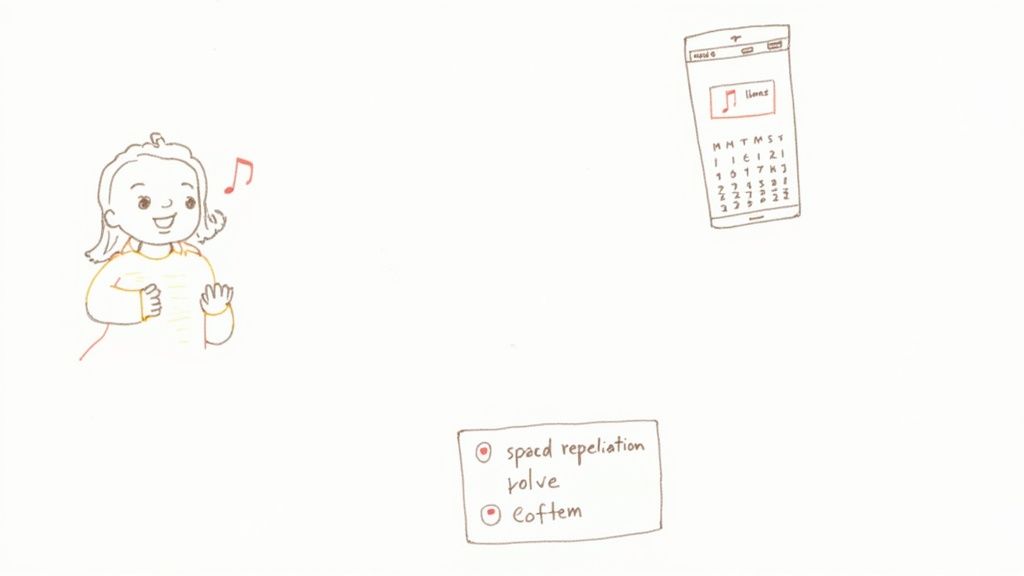
Knowing the words is one thing, but actually using them is another. The secret to making the days of the week in Spanish stick is to move beyond simple memorisation and find an active, engaging way to learn that fits you.
Whether you're a parent trying to help your child, a teen cramming for an exam, or an adult learning for fun, the right approach makes all the difference. These tailored strategies turn what could be a chore into something genuinely enjoyable, helping the vocabulary sink in naturally.
Tips for Kids and Young Learners
With kids, learning has to feel like play. It's the only way. Abstract ideas like "days of the week" only click when you attach them to fun activities that get their senses involved and make repetition feel like a game.
-
Sing a Catchy Song: Music is a fantastic memory hack. Hop online and search for a simple "días de la semana" song. The rhythm and tune will lock the words and their order into your child’s brain far better than just repeating them.
-
Create Flashcards: Get creative and make a set of seven cards. You could draw a sun for domingo or a school bag for lunes. These little pictures create strong visual links that help them remember.
-
Play a Daily Game: Start every morning with a simple question: “¿Qué día es hoy?” (What day is it today?). Then, have your child find the right flashcard. This small daily ritual builds a practical, consistent connection to the words.
This isn't just a random vocabulary list; it's foundational knowledge. In South America, where Spanish is the main language for nearly 210 million people across nine countries, the days of the week are one of the very first things taught in school. Data shows that almost 100% of public schools in places like Argentina and Chile introduce these words early on to help kids understand time and routine.
Strategies for Teens and Adults
For teens and adults, the game changes. The goal is to weave the new words into your existing life, making them a functional part of your everyday routine. This is how you shift vocabulary from your short-term memory into your long-term, practical toolkit.
The best learning happens when you create your own little immersive environment. By weaving Spanish into your daily habits, you force your brain to actively use the new words, not just passively see them.
Here are a few practical ideas to get you started:
-
Change Your Device Language: This is a simple but incredibly powerful trick. Switch your phone or computer calendar to Spanish. Seeing lunes and martes every time you check your schedule provides constant, effortless reinforcement.
-
Use Spaced Repetition Apps: Tools like Anki or Quizlet are designed to show you flashcards right at the moment you're about to forget them. This method is scientifically proven to be a highly efficient way to lock in vocabulary for good.
-
Start a Simple Journal: Every day, just write a sentence or two in Spanish, starting with the day. For example, “Hoy es miércoles. Fui al trabajo y comí con un amigo.” (Today is Wednesday. I went to work and had lunch with a friend.) This simple act builds context and reinforces grammar at the same time.
If you’re a fan of quick, focused study sessions, especially for memorising new words, you might want to explore microlearning examples for vocabulary.
How the Week Shapes Culture in the Spanish-Speaking World
Knowing the days of the week in Spanish is about more than just filling in your calendar. It's your window into the rhythm of daily life across the Spanish-speaking world, where the names for the days act as signposts for social gatherings, family time, and the general pace of life. When you understand these patterns, you start to connect with the culture on a much deeper level.
Take the work week, for instance. It often has a more relaxed build-up than you might be used to. While lunes (Monday) is definitely back-to-business, the social energy really starts to pick up by jueves (Thursday) evening. In many cities, you’ll notice the nightlife buzzing a little earlier as people get a head start on their weekend plans.
The Social Weekend
The real heart of the week, though, is the weekend. Viernes (Friday) kicks off a period packed with social activity. It’s a time for catching up with friends, dining out, and soaking up the city's vibrant atmosphere. That energy flows right into sábado (Saturday), a day often filled with shopping, errands, and even more social events in the evening.
But Sunday is when the cultural importance of the weekend truly shines. Across Spain and much of Latin America, domingo (Sunday) is sacred family time. It's incredibly common for big, extended families to come together for a long, relaxed lunch that can stretch on for hours.
This weekly rhythm influences everything, from shop opening hours to what's on TV. Consumer data from South America shows just how much daily life is structured around this flow. In Colombia, for example, home to roughly 47 million Spanish speakers, prime-time TV ratings often hit their peak on viernes and domingo as people gather to unwind. It’s a perfect example of cultural habits being shaped by the week.
Getting a feel for these nuances—from the gentle ramp-up of the work week to the cherished family gatherings on Sunday—gives you a far richer picture of the Spanish-speaking world. You won’t just know what the days are called; you'll understand what they really mean. For a bigger look at this diverse world, be sure to check out our guide to the many countries that speak Spanish.
Common Questions About the Days of the Week in Spanish
As you start using the Spanish days of the week, you'll probably run into a few tricky spots. It happens to everyone! Let's clear up some of the most common points of confusion so you can speak and write with total confidence.
Why Aren't the Days Capitalised in Spanish?
This is a classic question for English speakers, and it's a great one. In English, we treat days of the week as proper nouns, so we always capitalise them. But in Spanish, they're just regular old common nouns.
That means you only capitalise a day of the week if it's the very first word in a sentence. This rule also applies to the months of the year, so it's a handy one to remember. Getting this little detail right will instantly make your Spanish look more authentic. For instance: La reunión es el martes. (The meeting is on Tuesday.)
How Do I Say "On Monday" or "On Fridays"?
The temptation here is to literally translate "on" to the Spanish preposition en, but that's a common mistake we see all the time. Spanish handles this much more simply: you don't need a preposition at all.
Instead, the definite article does all the work.
To say "on" a specific day, you just use the masculine article that matches the day. Use el for a single day and los for a recurring day, like "on Mondays". The article itself carries the meaning of "on".
Here's how it works:
- el lunes = on Monday
- los lunes = on Mondays (meaning every Monday)
Are There Abbreviations for the Spanish Weekdays?
Absolutely! You'll see them everywhere, especially on calendars, in appointment books, or any place where space is tight. You might come across one, two, or three-letter versions.
A very common single-letter format is L, M, X, J, V, S, D. Pay close attention to Wednesday (miércoles). It's often abbreviated as X so it doesn't get mixed up with Tuesday (martes). That's a nifty little trick to remember next time you're trying to read a Spanish calendar!
Ready to put these rules into practice and master the days of the week in Spanish? At Spanish Council Singapore, our native teachers create fun, engaging lessons for all ages. Explore our small-group and private Spanish classes today!